
For decades, America has been told that the key to better schools is more money. Underperformance, the argument runs, is really a question of resources. Just give the teacher unions what they ask for, and good outcomes will follow.
Mississippi is starting to show that this simply is not true.
Over the past decade, Mississippi has made such progress in fourth grade reading that people have taken to calling it the “Mississippi miracle.” Mississippi ranked 9th in the country for fourth grade reading in 2024, up from 49th in 2013 — a forty-place climb in a decade, from near the bottom of the table into the top ten.
Mississippi’s fourth graders now read better than their peers in New York, Minnesota and California — every one of them a state that spends a great deal more per child than we do. And here is the part the spend-more crowd would rather you did not dwell on. We get those better results on far less money.
Mississippi spends around $12,300 per pupil, one of the five lowest figures in America. New York spends $31,918 — more than two and a half times as much — and its children read less well for it. New York, in other words, buys more than two dollars of schooling for every one of ours, and ends up further behind.
Perhaps the starkest comparison of all is with California. A Black fourth grader in Mississippi is now somewhere between two and a half and three times more likely to read at grade level than a Black fourth grader in California — 19 percent reach proficiency here, against just 7 percent there — and California spends well over half as much again per pupil as we do. If money were the answer, those numbers would be the other way round.
There is no reliable relationship between what a school spends and what its children actually learn. Mississippi proves this point not only when you compare our results to other states, but when you examine what is happening inside Mississippi in granular detail.
Here at the Mississippi Center for Public Policy, we built a free online tool — CompareMySchool.com — that lets any parent in the state see exactly how their school is doing. Type in a school’s name and up comes its grade, the share of children reading and doing math at grade level, and how it ranks against every other school in Mississippi — and against the rest of America, too.
We intended it to be a tool for families to use this summer, as they contemplate the start of the next school year and perhaps begin to wonder if their kids are in the right school. CompareMySchool.com pulls all of the data into one place, in user friendly format.
But once we built the site, something unexpected leapt out. The tool lets you line up every school district in Mississippi and set what it spends per pupil against how its
children actually perform. If the conventional wisdom were right, you would expect a clear pattern: the more a district spends, the better it does.
There is indeed a correlation between spending and outcomes, but it is the opposite kind of correlation. The higher the per pupil spending the worse the grades.
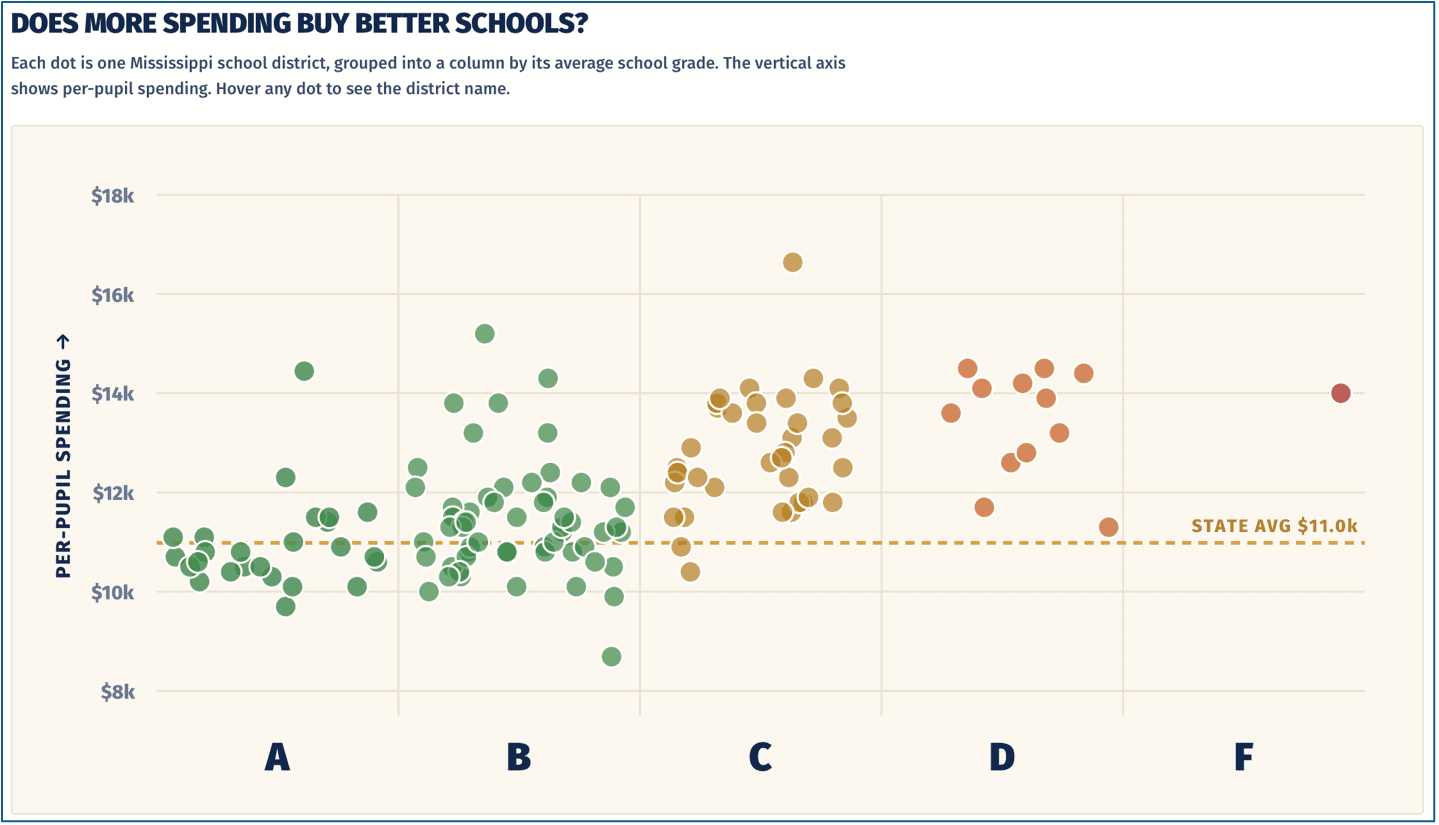
Higher spending, worse results
Across Mississippi’s districts, higher per-pupil spending goes hand in hand with worse outcomes, not better ones. The lowest-spending quarter of districts gets, on average, 63 percent of children to proficiency in reading and math. The highest-spending quarter manages just 36 percent. Read that again. The districts spending the most are getting barely half the results of the districts spending the least.
Ocean Springs, down on the Gulf Coast, is the top-performing district in the state - more than three-quarters of its students at proficiency - on about $10,300 per pupil. Jackson Public Schools spends $16,640 per pupil, more than 60 percent more than Ocean Springs, and gets fewer than a third of its children to proficiency. Petal spends roughly 42 percent less per pupil than Jackson — and more than doubles Jackson’s results. DeSoto County, the largest district in the state, educates nearly 34,000 children on the lowest per-pupil budget in Mississippi — and still beats Jackson almost two to one.
Our webtool also allows families to compare what their public school district spends against what the local private school down the road charges to do the very same thing — and the gap is startling.
Jackson Public Schools spends $16,640 of public money on each child. A few minutes away, there are private schools that charge about a third that amount. It’s the same story across the state where typical private school charges about $7,000 a year, while often getting far better results. The public sector, it turns out, is not the cheap option.
What matters is not how much a district spends, but how it spends it. This data in Mississippi strongly suggests that what we need to see are reforms that allow families dissatisfied with what their school board has to offer with the option of taking their child’s share of funding to a school outside government control.
Mississippi’s own data — now in the hands of every parent at CompareMySchool.com — makes the argument that money is not the answer. Better-run schools are, and the surest way to get more of them is to trust parents to choose.