
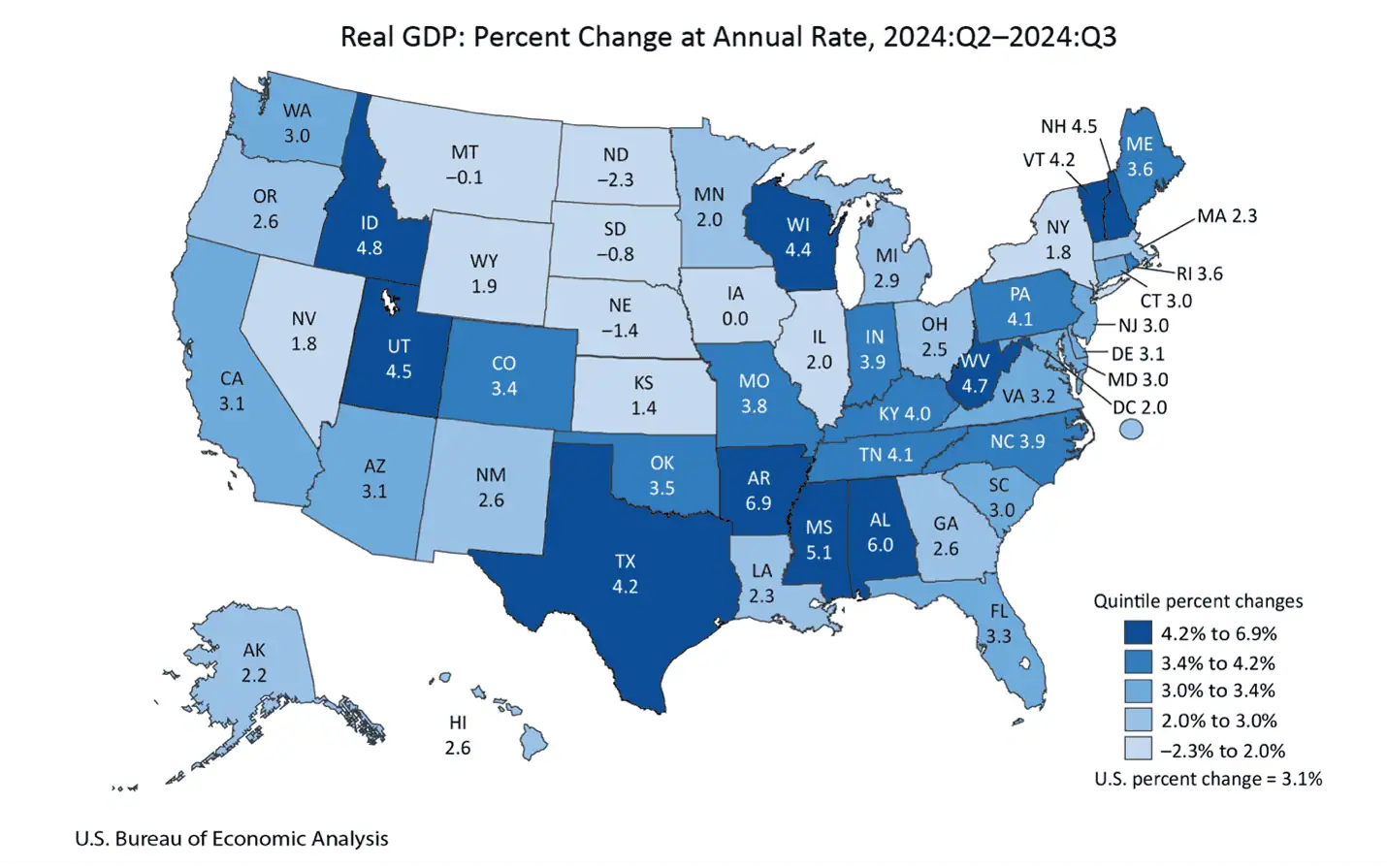
Did you know that Mississippi is now one of the fastest growing states in America? Only two states saw real GDP rise faster than it did here in the third quarter of 2024.
Were you aware that personal income in our state rose more here than almost anywhere in the US this past year?
New data from the Bureau of Economic Analysis shows that Mississippi is on the up.
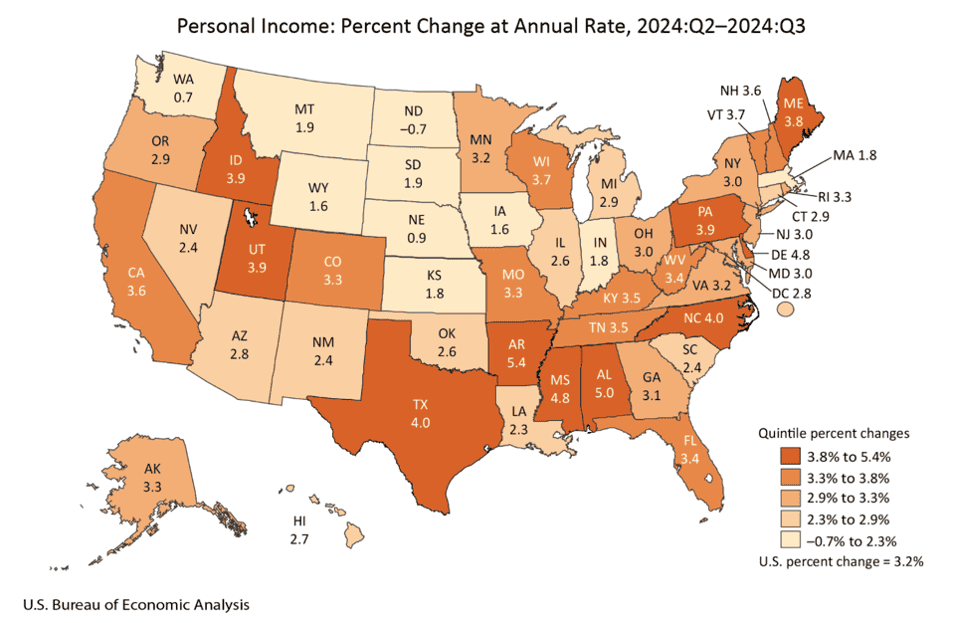
For as long as anyone can remember, Mississippi has ranked 50th out of 50. Not for much longer, perhaps. According to this new data, ours’s was one of the top performing states in 2024. If we keep growing for the next few years the way we did in 2024, we won’t be bottom of the class for much longer.
Mississippi’s success is not an accident. It’s a consequence of a number of key free market reforms:
- Labor market deregulation, with an Occupational Licensing law in 2021.
- Tax cuts with legislation to cut the state income tax to a flat 4 percent in 2022.
- Further tax reform to make it more tax efficient for businesses in 2023.
- Education funding reform as a step towards school choice in 2024.
These reforms have begun to energize our state. They make it easier for people to get ahead, for businesses to invest, and for families to spend their income on their priorities. They draw in inward investment, which is changing our state for the better.
If Mississippi is not to lose this momentum, we need to go even further. That is why MCPP has just published a Blueprint for Mississippi – a list of the ten key reforms that would lift our state to the top of the economic table.
The number one reform we need to prosper is school choice. Why? School choice is the only way to be certain of raising standards. The better job we do of educating young people, the greater their chances of leading a prosperous, fulfilling life.
Our Blueprint sets out how we can accomplish school choice, giving every family in our state the choices that today only the very rich enjoy.
To prosper, our state needs less regulation and less government. Our Blueprint sets out proposals to cut taxes further and dismantle the costly, leftist bureaucracy that seems to be in control no matter who you vote for.
Decades of crony cartel politics has stifled innovation in our state. Years of lobbyists cutting cozy deals in the Capitol that commercially advantage their clients has held Mississippi back. A lot of the intentionally restrictive laws that limit health care provision simply need to go. Our Blueprint sets out how to make this happen.
MCPP has been a driving force behind many of the key free market reforms that have helped energize our state. But at every opportunity, crony cartel politics has tried to prevent change.
The crony cartel will try again. It’s what self-serving cartels do. Already they are mobilizing half-baked arguments against school choice. They are lobbying to maintain intentionally restrictive laws that hold back the healthcare economy. Brace yourself for politicians explaining why we can’t afford tax cuts despite a healthy surplus.
In politics, nothing moves unless it is pushed. MCPP won’t just publish our Blueprint. We will push and push hard. Mississippi’s future is too important to let bad politics get in the way.
Mississippi could be on the cusp of transformative changes. If we keep going, we will not only no longer be 50th, but we could become – like Tennessee or Alabama – a state that young people want to move to, not leave.
Download a copy of our blueprint here!
Remember when Japan was predicted to overtake America?
Back in the 1980s, Japan was the coming country. Japan’s economy had enjoyed decades of rapid growth. Her exports where everywhere, and with inventions like the Sony Walkman, it looked as though Japan was the technological future, too.
America looked like a power in decline. Forty years ago, many traditional US industries were failing. Crime seemed out of control.
By the mid 1990s, Japan’s GDP was 71 percent that of the US - and the gap looked to be closing. One “expert”, Herman Kahn predicted that Japan would surpass America as the world’s largest economy by 2000.
Today? Japan’s economy is a quarter the size of America’s. Japan hasn’t produced much innovation since the Tamagotchi (Don’t ask). Despite all the talk about Japanese electronic wizardry, the great digital innovations of the past few decades have happened on this side of the Pacific.
Today, of course, we’re told that the great ascending power is not Japan, but China. China’s economic growth over the past 40 years has been phenomenal. In industry after industry, Chinese exports have crushed the competition. China, unlike Japan, is not just an economic competitor but a strategic rival to the United States, pursuing an aggressively expansionist policy in the Pacific, south Asia and parts of Africa.
By 2021, China’s GDP was almost 80 percent that of the US and the experts were telling us China would overtake America within a couple of decades.
But look at what has happened since. China’s economy seems to have peaked as a percentage of US output. China has even more debt-induced malinvestment than Japan had during the 80s asset bubble.
Chinese demographics (current Total Fertility Rate 1.02) are in an even worse shape than Japan’s (TFR 1.30). And China’s fiscal position is unlikely to improve with all of President Xi’s imperial ambitions to fund.
As recently as 2008, Europe’s economy was about the same size as the United States’. Today, America’s economy is twice the size of Europe’s. Looking at the number of large companies established over the past 50 years on either side of the Atlantic. Home Depot, a single US company, eclipses all the new businesses created in the European Union since 1974.
So why are Japan, China and Europe all in their different ways underperforming America? Because each are, in their different ways, reverting back to a type of political economic tradition far less successful than America’s.
Japan, superficially Western in so many ways since 1945, has behind that façade a strongly corporatist political economy. A handful of well-connected conglomerates are able to dominate markets, but shielded from internal competition, they don’t innovate. (To appreciate how stifling this is, try to imagine what America might be like, for example, if IBM was the only computer company, with all the competitors kept out.)
China, after a brief move towards market liberalization begun by Deng Xiaoping, is reverting to what you might think of as a Ming tradition. Dissent is stamped on. A bureaucratic elite micromanages and controls. The sclerotic effects are already being felt.
Europe, repeated rescued from an indigenous form of autocracy by the Anglosphere powers (1704, 1815, 1914, 1944, Cold War), is tragically reverting to type. Today, a courtly elite enthroned in Brussels attempts to regulate and control ever more aspects of social and economic life across the Continent, destroying it in the process (Mercifully, Britain escaped from this in 2016 and might yet return to a more Atlantic tradition).
To flourish, the United States needs to stay true to the political and economic model envisaged by the Founders; limited government, lower taxes and liberty. The good news is that with the new administration in Washington, this may well be about to happen. Elon Musk is determined not only to cut federal spending (something America urgently needs to do to avoid bankruptcy). He is looking to turbo charge productivity growth, moving people from the public to the private sector, and radically cut red tape. Reports of America’s relative decline seem to me to be wildly exaggerated. If Musk and co deliver half of what they are promising, we might just be on the cusp of an extraordinary period of progress and innovation in America. The divergence between America and the rest of the world is only going to accelerate.
I feel an overwhelming sense of privilege to be onboard!
Imagine a world in which the President of the United States could prevent you from reading a story about incriminating emails found on his son’s laptop?
Actually, that’s what happened. When the New York Post ran a story about Hunter Biden’s laptop, administration officials put pressure on media outlets to prevent you from reading it.
Envision an America in which articles about the origins of Covid could be taken down by administration officials during the pandemic? You don’t have to imagine. That’s literally what they did.
If you are appalled at the prospect of powerful politicians trying to suppress awkward opinions, I suspect you’d be concerned at any attempts by some in our state to restrict debate and discussion on certain topics, too.
Unfortunately, some state officials seem to think they can bully organizations like MCPP in order to shut down what we say. This seems to be the case with school choice, an issue on which every conservative ought to agree. Some evidently don’t agree and are mad at us for promoting change.
MCPP is 100 percent committed to parental choice as the only certain way to raise standards and counter left- wing values in the classroom. We relish the opportunity to listen to those with different ideas and engage with those that have a different viewpoint.
Anyone is free to disagree with us. But no one that disagrees with our stance should ever try to shut down our advocacy the way Biden’s gang shut down the Hunter laptop story.
Here’s why we won’t be cowed.
First, it’s a question of credibility: MCPP is a conservative think tank. That means we’re cheerleaders for conservative policies, but not for any politicians.
To be sure, we probably agree 90 percent of the time with most elected state-wide officials. But when we disagree, we won’t hide the fact. Instead, we will do so openly, honestly and dispassionately (maybe even using a little humor from time to time ….) A think tank that shied away from asking state leaders questions that they’d rather not answer wouldn’t be worth a dime. Why would anyone take such an organization seriously?
Second, you are the media: Biden’s gang, like politicians down the ages, tried to bully media organizations into ignoring inconvenient stories. That tactic doesn’t work anymore since Musk set social media free.
Each week, MCPP reaches tens of thousands of folk across our state. We do so with published articles and media appearances. But the single biggest way we reach people is directly, the way I’m connecting with you now. Our email list has tens of thousands of subscribers, and a phenomenal open rate. This Wednesday, I uploaded a short video in the morning. By lunchtime it had been viewed 48,000 times. As of now, it’s been seen over 130,000 times – a high percentage in Mississippi. Thanks to Elon Musk’s X, we reach several million people every month, again many in Mississippi. Unless anyone has the power to shut down our social media operation, we are going to keep going.
Third, and most important, School Choice is right: School choice is, as President Trump has said, the civil rights issue of our time.
It's more than about school standards. The case for giving families control over their child’s share of tax dollars is moral. MCPP has outlined a three-step strategy to achieve universal school choice in our state. We are surrounded on three sides by conservative led states that have adopted school choice.
People are free to disagree with us. So, too, are state-wide officials who can vote against school choice or kill it in committee (like some did with the ballot initiative, and anti DEI legislation and much more besides). But equally organizations like MCPP are free to explain to the public who is supporting school choice and who is trying to kill it. We won’t be cowed.
Of course, what made the story about Hunter Biden’s laptop so explosive was not what was on the laptop. It was the realization as to what some were prepared to do to suppress stories they didn’t like. Nothing perhaps could be more ruinous the reputation of any politician.
Parental choice is the only certain way to raise standards and counter left- wing values in the classroom. MCPP has a plan to make this happen in Mississippi.
Mississippi is already surrounded on three sides by states that have school choice. Arkansas, Alabama and Louisiana have all now passed legislation to give families control over their child’s share of the education budget. However, perennial efforts to achieve something similar in Mississippi through Education Savings Accounts, or ESA's, have failed. Each time a universal ESA proposal has been attempted the legislation dies. We would love to see a universal program of publicly funded ESA's in Mississippi, which families could use to pay for school, but I believe the chances of such legislation passing anytime soon are slim.
That’s why MCPP is pursuing a different three step strategy to achieve universal school choice in our state:
- Step One – An individual budget for every student: During the last legislative session, MCPP spearheaded efforts to secure a school-funding formula in order that every public school student now has a personalized education budget.
We did so knowing that once each student has a personalized budget, it becomes much easier to argue that they should then be allowed to take their budget to a school of their choice. We have achieved this.
- Step Two – Public-to-public school choice: Thanks to a bill (HB 1341) passed in the last legislative session, military families, including those in the National Guard, are able to send their children to a traditional public school of their choice—if it has capacity.
We are openly pushing for legislation in the 2025 session to allow each student to take their personal budget to a public school of their choice, giving every family in Mississippi the right that military families enjoy. Responsible conservative policy means allowing school boards to have the final say over capacity and giving strong safeguards to school so that they do not have to take students with a history of disciplinary problems.
- Step 3 – Parental Choice Tax Credit: Tens of thousands of families in our state choose not to send their children to public school, either because they homeschool or they send their children to private school. We believe they should be able to claim a refundable income tax credit to help them with expenses, like tuition and fees.
We have a carefully costed plan for a Parental Choice Tax Credit that would achieve this, building on the tax credit system we already have. Interestingly, the Republicans in Washington, D.C., have indicated that they might pass a similar tax credit federally. These three steps would ensure universal school choice in our state—and give families in Mississippi the choices that families now have in neighboring states. The good news is that Mississippi is already halfway to making this happen!
Morton Blackwell, the great conservative activist, likes to say that “In politics nothing moves unless it’s pushed”. MCPP is happy to push – and to push hard …. even if it upsets one or two anti-school choice activists. It’s what we exist to do.
We are open about our goal and our strategy for achieving school choice because we know that sunlight is the best disinfectant. There’s no need for mystery and opaque maneuverings. Nor will we shy away from engaging directly those that might like to stop parental choice by stealth. If school choice is opposed by lawmakers that sent their own kids to private school, we won’t hesitate to ensure that Mississippi knows.
Over the course of the coming months as we head into the 2025 legislative session, I will be sure to update you on progress – and I’ll be sure to inform you who supports and who opposes parental choice! This is a fight we can win!
What do you most like about your job? For me, it is being invited to speak about the work the Mississippi Center for Public Policy (MCPP) is doing to try to improve our state. Typically, I get a couple of invitations each month to talk at Rotary Clubs, schools or the Kiwanis. Just the other week, I received one such invitation from the North Jackson Rotary Club.
As invited to, I talked about some of our policy goals, such as school choice, deregulation and tax reform. Ever sensitive to the fact that good folk have different opinions about things, I meticulously avoided saying anything even remotely partisan. Rotary Club lunches are enjoyable precisely because they are committed to building goodwill and understanding.
As I sat down after speaking, however, up popped Luther Munford, someone I had only met on my way into the event. Mr. Munford proceeded to attack school choice – and at times I almost felt, me - at length, all under the guise of asking a question. Fair enough, I thought. Free speech and all that, although Mr. Munford did not sound very big on goodwill. In fact, he sounded borderline rude.
I thought no more of the incident until I read Mr. Munford’s recent newspaper article in which he appears to have continued the attack he started at the North Jackson Rotary Club. Curiously, for an article purporting to be about school choice in Mississippi, he launched his article with an attack on Brexit. Aware as he is of my role as one of the founders of the official Brexit campaign back in my native Britain, Mr. Munford perhaps thinks that by attacking the way 45 million Brits voted he is somehow getting at me. Whatever.
Once Mr. Munford gets around to attacking school choice, rather than me, he makes a series of erroneous assumptions that deserve a rebuttal.
Mr. Munford says school choice is unpopular. This is just not true. Polls show that more than 7 in 10 Mississippi voters, including a majority of Democrats, want school choice. Mr. Munford seems especially vexed by the idea that parents given the choice might want their children to attend a religious school. Assuming I have understood him correctly (his syntax is a little garbled) school choice would mean that “the problem of funding truly racists religious beliefs becomes even greater”.
Any suggestion that Mississippi private schools are full of “racist religious beliefs” will no doubt come as a surprise to anyone that attends or teaches at one. Mr. Munford then attacks private schools on the basis that “no one knows how well Mississippi private schools are doing because they are not subject to any form of public accountability”.
Again, plain wrong. Private schools are hyper accountable to fee paying parents. It is the public school accountability system that is failing, giving A grades to school districts where many kids can’t read properly.
Mr. Munford then proceeds to attack school choice on the basis that it would take money out of the public sector. Allowing each public school student to take their base share of state funds (about $6,600) to a public school of their choice (assuming the public school has capacity) would not impoverish the public sector. It would reallocate the money, forcing failing schools and underperforming districts to raise their game.
Our plan for a Mississippi Parents’ Tax Credit for those that choose not to take their place at a public school, because they prefer to home school or go private, would be capped at $150 million. It is not draining money from public schools but supporting families that are currently paying twice.
What I find hardest to understand about Luther Munford’s attack on school choice is that he sent his own children to one of the most expensive private schools in our state, St Andrew’s.
Luther Munford is on record as saying he “believes strongly in public education”. But not strongly enough to send his own kids to public school.
Mr. Munford attacks putting money into private religious schools because of the risk of “racist religious beliefs”. I presume there were no such beliefs at St Andrew’s Episcopal School when his own kids went there? He attacks private schools for not being accountable. When he was a parent at St Andrew’s was there not sufficient accountability to him as a parent?
Perhaps if one were to ask why, as an advocate of public education, Mr. Munford did not take the opportunity to send his own kids to, say, Murrah High School, he might have an explanation as to why his family circumstances were different. Anti school choice activists need to recognize that every family’s circumstances are different. That’s why families need to be able to make choices about their children’s education that currently only people like Mr. Munford are able to make.
Sending a child to St Andrew’s today costs about $20,000 a year. We should all support parents’ 100 percent if they are blessed enough to be able to send their children to such an awesome school. But we should at the same time help local families that cannot afford that to allocate their $6,600 of state funding to a school they can get into. To do anything else could be called hypocrisy.
Donald Trump is the most pro-school choice President in history. “As president”, he has said, “I will establish the national goal of providing school choice to every American child”. “If we can put a man on the moon and win two world wars, then I have no doubt that we as a nation can provide school choice to every disadvantaged child in America”.
Unfortunately, Mississippi has made little progress towards school choice due to a tiny handful of anti-school choice Republicans. Even though three of our surrounding states, Alabama, Arkansas and Louisiana, now have school choice, we still don’t. The biggest obstacle to the education reforms we need is the current Senate Leader, Lieutenant Governor Delbert Hosemann. He has taken every opportunity to thwart efforts to achieve more parent power.
Initially, Mr. Hosemann took to claiming that school choice would be unconstitutional. This is an erroneous argument, as a carefully prepared legal briefing note we circulated shows. Having conceded that there is, indeed, no constitutional barrier to school choice, our Lieutenant Governor began to search for alternative excuses. Schools might not have the capacity, seems to be his latest one.
That is why the draft bill we worked on ensures school boards get the final say as to their capacity. No one is forcing them to take more kids. Another excuse crumbles….. One by one the arguments invoked by anti-school choice Republicans to justify their inertia have been dismantled. But it still appears that the will to give Mississippi families the parent power they have in our neighboring states just isn’t there.
Why is a Republican Lieutenant Governor in a conservative state teaming up with progressive activist groups, like the Parents’ Campaign, and briefing leftist media outlets like Mississippi Today to thwart reform? Mr. Hosemann, I gather, has indicated he is flat out opposed to a tax credit. This means Mr. Hosemann is very likely to be on a collision course with the next President, whose team, I understand, is literally finalizing plans for a federal tax credit right now. Will Mr. Hosemann continue to oppose a tax credit?
Mr. Trump has made it clear he will abolish the federal Department of Education. Trump does not intend to dismantle power in DC only to see it handed over to local bureaucrats in Jackson. He would like to see parents have control over their child’s education. If a handful of local Republicans continue to kill off school choice (“It died in committee”, is likely to be their next excuse), I suspect that the conspicuous absence of invitations to Mar-a-Lago may become the least of their worries.
In a fight between anti school choice Republicans and Team Trump, I imagine Trump will win. He’d certainly have support from the local conservative base who have voted conservative for years but not always got a great deal to show for it. Perhaps part of the problem is that one or two of our anti school choice Republicans have an unfortunate habit of never wanting to engage with anyone with different ideas to their own. That can become a problem if you don’t actually have very many ideas of your own. I’m not sure that a policy on four semesters a year, or cell phone usage in schools, quite cuts it ….
Those that get endorsed by Trump to run in 2027 will, I imagine, be Republicans that actually support the new President’s agenda in the coming months, particularly the 2025 session. There’s still time to get on board with school choice in Mississippi.
“All political lives end in failure” observed the British Prime Minister, Harold Macmillan. His did. So, too, will Joe Biden’s.
Forced out after four years, it is difficult to think of a single significant achievement by the Biden administration. Biden’s legacy will be higher national debt and a more divided America. But is it really the case that political lives always end in failure?
Watching the recent movie about Ronald Reagan, it was obvious that after two terms in office, the Gipper’s accomplishments clearly outweighed any defeats. Reagan’s legacy was a buoyant economy, stronger America and the defeat of Soviet communism.
If Biden’s legacy is of extreme failure, and Reagan’s of remarkable success, many politicians don’t seem to leave much of a legacy at all, good or bad. Like footprints on a beach at low tide, tomorrow it will be as though they were never there at all.
Many politicians fail to leave much of a legacy for the simple reason that they hold office but have little idea what to do with it. That’s not, of course, what they tell themselves in the early days. In the afterglow of their election victory, surrounded by staffers, and praised by smooth-tongued lobbyists, political leaders busy themselves with the business of government.
Yet often the urgent squeezes out the important. Once in office, they end up playing the role of Senator, Congressman, or state Governor, like an actor in a movie handed their lines by someone else.
Rather than implementing a blueprint that matters, they are distracted by the trivial. Instead of delivering difficult messages, they delude themselves that another press conference about blah blah is vital.
Rare is the type of politician who can make the political weather, rather than respond to it. Many politicians fail to leave a legacy because they fool themselves that they are responsible for things that would have happened anyhow. Or they imagine that they will be fondly remembered for things that happened on their watch.
How many Mississippians remember who was governor when the Nissan factory came to Mississippi? How many credit whoever happened to be in office? Any politician in our state wanting to leave a real legacy needs to address those things that have kept our state 50th out of 50 for too long.
First is education. Mississippi needs a wholesale reform of education, with school choice and parent power. With so many surrounding states implementing universal school choice, change is possible. The first wave of Mississippi leaders to actually come out and lead on this will be seen to deliver historic changes for the better.
Second is the state economy. Mississippi’s economy continues to be weighed down by a relatively high tax burden and red tape. Despite cutting the state income tax, Mississippi families and businesses still pay more than in surrounding states. Certificate of Need laws hold back the healthcare economy in our state. State leaders that lead on lower taxes and deregulation would stand out nationally and historically.
These are the issues that will define the future of our state. Our state leaders will be defined by if and how they address them. State leaders that address these issues will leave a giant legacy. Those that don’t, won't be a household name in their own home.
We are now less than two weeks away from the Presidential election – and Trump seems to have momentum. In the all-important states of Pennsylvania, Georgia and North Carolina, Trump looks ahead of Kamala. By a whisker.
From a policy perspective, what might a Trump victory on November 5th mean? A Trump win would be bad news for the administrative state. Talking to one of Trump’s policy people a couple of months ago, they suggested to me that in his first term Trump had been too trusting of officialdom. The 45th President had underestimated the extent to which the bureaucratic machine in Washington would try to frustrate his policy goals.
I doubt that in a second term Team Trump would let that happen again. If Trump wins, I expect to see parts of the administrative state dismantled. Rumors suggest that Elon Musk would be asked to form an efficiency task force. With a ballooning national debt, perhaps Musk could reengineer government to reduce its size and costs, while improving its effectiveness? Trump has explicitly committed to eliminating the federal Department of Education. Speaking on “Fox & Friends”, Trump reiterated the point, saying that he wanted to get “education out of Washington”. In response to a question from a student, Trump said school choice “is one of the biggest things on my platform”.
Trump went on to point out that the US currently spends more on education than many other Western countries, about $16,000 per student per year. Unlike some in Mississippi, Trump did not pretend that there had been some sort of education ‘miracle’. Indeed, Trump emphasized that the education system produces poor results, despite all the money lavished upon it.
Honesty about the true state of education is the essential first step if there is to be significant reform. In conservative Mississippi, we have somehow ended up with a new Education Superintendent, Lance Evans, that is anti-parent power. The other week, Evans went out of his way to attack school choice.
How odd that in a Republican-run state we should have such an anti-school choice Education Superintendent at the moment when Trump looks likely to win the White House. Did the Republican leaders of our state not know Evans was anti school choice before he was appointed? Or did they know the man they were about to appoint was anti parent power, but go ahead all the same?
A Trump victory will surely flush out the anti-school choice Republicans in states like Mississippi who have done little to advance parent power. It is not enough to pay lip service to school choice, yet somehow allow anti school choice officials to take the helm at the Department for Education. Nor is it acceptable to say you want school choice, when we have only a handful of Charter Schools because those appointed to oversee the Authorized Board seem happy to say “no” to new schools.
This kind of politics has all the integrity of WorldCom accounting. A Trump win on November 5th could have the effect of an audit. Time could soon be up for anti-school choice “conservatives” in states like ours.
Local mom, Amanda Kibble, is celebrating an important win for her family, and for school choice.
Earlier this year, Governor Tate Reeves signed HB 1341 into law. This new law gives military families in Mississippi the right to transfer their children to any traditional public school around the state, assuming that the receiving school has capacity. Early indications suggest this is extremely popular, with lots of military families using school choice to switch schools.
Amanda, and her family, found out the hard way that the law might not apply to those who serve their country in the National Guard. There was a real risk that Amanda’s son might lose his place at his preferred school.
That’s when Amanda approached MCPP, and we took up her case. MCPP has a long history of fighting for school choice, and our legal arm, the Mississippi Justice Institute has successfully litigated in defense of school choice.
I am delighted that Attorney General, Lynn Fitch, has now issued an opinion that the new school choice law for military families also applies, at least in part, to those in the National Guard. Three cheers for the AG!
If military families now have public-to-public school choice, why shouldn’t everybody? That is exactly what our “Move Up, Mississippi!” campaign aims to achieve.
This week’s win for school choice makes it all the more disappointing that the new State Superintendent for Education, Lance Evans, took a sideswipe at school choice recently.
Speaking at a lunch in Jackson, Evans criticized school choice, suggesting that if a single dollar of public money went into private schools, those private schools should be subjected to the regulatory oversight that public schools are subject to.
Those that oppose school choice, and indeed I suspect Mr. Evans, know full well that extending state oversight across the private school sector would be untenable – which is why they suggest it. But it is not the clever argument against school choice that they might imagine.
Giving every family in our state the right to choose a public school, as military families are now able to do, would not transfer public dollars into private schools.
Amanda Kibble and those military families that now have school choice are not taking money out of public schools. Does Lance Evans oppose their right to choose a school for their child?
MCPP proposes that under a separate program, families that attend private schools, or who home school, could get a tax credit reflecting the fact that they are already paying for a place at a public school that they are not taking.
Evans attack on parent power was not the worst of it. More disappointing was the plodding presentation that preceded it about how amazing education is in our state.
Evans trumpeted the fact that about a third of districts were rated D or F in 2016. Now only a handful are rated D or F. This, he implied, was evidence of progress, rather than a reflection of a broken accountability system.
When officials invoke the broken grading system as evidence of improvement, it is not just the credibility to the grading we should question.
How bizarre, that in a solidly Republican-run state, we have somehow ended up with an anti-school choice official in charge? Are the nine-member State Board of Education aware of Evans’ anti-school choice position? Are the various state leaders that appointed those members of the Board?
Since 2000, the number of students in America has increased by 5 percent. The number of teachers by around 10 percent. The number of education administrators, however, has shot up by 95 percent.
No wonder the education bureaucrats don’t want mom and dad to have control over where their child’s share of the education budget goes. They might start to demand that it goes into the classroom.
Lance Evans talked about making private schools accountable. Private schools already are accountable to every fee-paying parent. The issue is how to ensure that public schools are made similarly accountable, too.
We need to give every family in our state the public-to-public school choice that military families now have.