
The recent scandal regarding celebrities and the elite class and the college admissions of their children has riled up many as we wonder about the deserving child who was left out in favor of an undeserving child.
But even before this scandal, we knew Americans believed the primary consideration for college admissions should be high school grades.
This common belief runs directly against the narrative of Ivy League institutions, and many others, where the trap of identity-based admissions has affected both the highest and lower margins of applicants. However, this belief has reached the point where one ethnic group is being discriminated against simply for being exceptionally talented at achieving high grades.
Affirmative action was designed to provide a remedy to long-standing discrimination allowing schools “considerable deference” in how they select students. This concept of considerations to race and identity in education has been debated extensively in the courts.
These court battles began in 1978 with University of California v. Bakke to Students for Fair Admissions v. Harvard, which may soon make it to the U.S. Supreme Court. The latter case is redefining the generational debate about affirmative action. Unlike other cases, which have questioned if students on the margins can be rejected so that diversity may be preserved at universities, Students for Fair Admissions v. Harvard asks if minority students that excel, can be discriminated against because of their race, specifically Asian students.
Harvard contends that the lawsuit is frivolous as Asians make up roughly six percent of the national population while making up more than 17 percent of Harvard students. Yet Harvard’s own argument is used against it by Students for Fair Admissions, who contend that Harvard’s knowledge of this led the university to discriminate against highly qualified Asian applicants in favor of non-Asian students. Essentially, Harvard’s case is that they have too many Asians.
While schools are granted privilege to foster “equality” in admissions, courts have consistently denied any effort to employ quotas or “racial-balancing” in admission considerations. If the accusations against Harvard are true, it is likely the U.S. Supreme Court will find the university went beyond the law. Regardless, the ruling here will likely have a big impact on future cases involving race-based, university admission policies.
Harvard does make a very good point in its lawsuit; they suffer from an over-representation of exceptionally talented applicants for admission. How awful it must be for them.
Suggesting that some people are just “too good” to be Harvard students could be seen as a symptom of the current times, yet it is more likely this sort of discrimination is a byproduct of the current structure of affirmative action. Diversity in education has proven to be beneficial, but not when the definition of diversity is narrowly confined to the color of skin or the country of origin. When diversity is programmatically enforced by an intentionally vague policy, you can bet actual diversity is not the goal; alterations to student populations based on emotional appeals are.
Such admission policies can be incredibly dangerous to colleges and Harvard has emerged as the face of it. Asian students often outperform white students (and every other race and ethnicity) on academic and extracurricular metrics. This is no secret in the Ivy League community, yet they lag far behind on personal appeals. The mysterious conglomeration of factors, which qualifies some to be Ivy League material and others not, is curiously subjective. And the plaintiffs, Students for Fair Admissions, have made the argument that such policy is inherently discriminatory.
Students, regardless of who they are and where they come from, should be judged by their academic records, their extracurricular accomplishments, and their personal references from school officials/teachers/coaches who know them best, not by arbitrary factors. The result of Students for Fair Admissions v. Harvard will likely impact admissions policy significantly. Let’s hope it rewards students who apply for admission based on the quality of their records and not the color of their skin or the country of their origin.
A bill that could protect the donor lists of non-profit organizations was passed by the Senate before deadline on Tuesday.
House Bill 1205 would prohibit state agencies from requesting or releasing donor information on charitable groups organized under section 501 of federal tax law. Some of these groups can engage in political activity.
The bill, which is sponsored by state Rep. Jerry Turner (R-Baldwyn) was originally written to include all of the different 501(c) designations. The bill was amended in the Senate Accountability, Efficiency, Transparency Committee for the bill’s protections to only include 501(c)(3) organizations, which are prohibited from political activity.
A floor amendment changed the bill’s language back to that in the original House language and removed a reverse repealer, which is a legislative tactic on a bill designed to keep alive and invite further discussion by preventing it from becoming law.
“It is an honor to support legislation that prevents corruption and intimidation by protecting the right of people to give to nonprofits of their choice and to prevent the politicization of the right of individuals to give to the causes they hold dear,” said state Sen. Jenifer Branning (R-Philadelphia).
State Rep. Mark Baker (R-Brandon) was one of the bill’s co-sponsors in the House and presented it on the floor. He said it’s an issue that cuts both ways and isn’t aimed at just right-leaning 501(c) groups.
“The right associated to privately contribute to non-profits anonymously, to me, is critical to the exercise of the First Amendment,” Baker said. “Protecting this right is crucial to the health and the freedom of our society. There are groups that do things that I don’t agree with, but I agree that they have the right to keep their donors private.”
Several Democrat senators railed against the amended bill, which passed the Senate on a largely party line vote of 32 to 18.
“If you pass this amendment, you will open the biggest loophole since we passed campaign finance disclosure in Mississippi,” said state Sen. David Blount (D-Jackson). “If you pass this amendment, you are saying that 501(c)(4)s can get involved with your campaign or your opponent’s campaign.
“As long as they don’t expressly advocate the election or defeat of a candidate, they can do whatever they want and not disclose anything.”
State Sen. David Jordan (D-Greenwood) was even more strident in his criticism of the amendment.
“The only difference between this amendment and Jesse James is you need a horse,” Jordan said. “This really hurts the system. We have enough corruption at the national level and now you want to bring it to the state level and that’s wrong.”
HB 1205 is being held on a motion to reconsider, which means the Senate will have until Friday to send it to the House for concurrence since it was changed.
If the House concurs with the changes, the bill will go to Gov. Phil Bryant. If not, the two chambers will have to settle their differences in a conference committee.
According to federal law, 501(c)(3) groups have to disclose their donor lists to the IRS, which are not disclosed on publicly available tax filings. These organizations are eligible to receive tax-deductible contributions, but can’t engage in direct political activity.
The IRS recently changed its regulations in July to remove donor lists from the publicly-available tax forms for 501(c)(4) and 501(c)(6) organizations. Changing the rules for 501(c)(3) organizations would require action by Congress.
Two days before the Framers signed the Constitution, one delegate noticed a defect in the plan. He rose to point out that under the current proposal, only Congress could initiate the process of amending the Constitution. But if the federal government grew out of control, it could never be counted on to rein in its own power. There needed to be a way for the states to initiate the amendment process.
The other convention delegates agreed and unanimously voted to add provisions to Article V, which equipped the states with the power to call for a convention at which delegates would make amendment proposals—which would then have to be ratified by the states.
The day the Framers feared, when the federal government would far exceed its legitimate powers, arrived years ago. Congress has long exercised powers that are not constitutionally authorized. At the same time, in an effort to avoid hard choices and increase its members’ reelection chances, Congress has delegated most of the actual work of legislating to faceless, unaccountable bureaucracies, which continue to grow unchecked.
The Federal Register, which contains all proposed and final regulations issued by federal agencies, has published over 3.2 million pages. If it were printed and stacked, it would be taller than the Washington Monument. This mountain of regulation—not even legislation—slows economic growth, stifles innovation, and prevents countless Americans from pursuing their version of the American Dream.
The growth in our federal government has also led to unsustainable federal spending. The federal debt recently topped $22 trillion. Our country’s entire GDP is only 20.5 trillion, meaning that if we took every penny that is earned or produced by every American over the course of a year, we still could not pay off our debt. Every American’s share of the debt is currently about $67,000, and within 10 years, every man, woman, and child will owe $100,000. Future generations of Americans are being born into staggering debt for services they will never see.
The Supreme Court has been complicit in this perversion of the constitutional order, failing in its duty to serve as a check on the power of the legislative and executive branches. As the federal government has grown large enough to control every facet of our lives, so has the importance of the Supreme Court grown. The Court now routinely rules on the most important political issues in American life, including healthcare, immigration, affirmative action, abortion, political gerrymandering, and campaign finance. These “winner takes all” decisions have led to more polarization and a more toxic political discourse.
With a conservative majority on the Court, there is hope that the constitutional ship can be righted. But it will take decades to uproot the mountain of bad precedent that has built up for nearly a century. We should all hope that the federal courts will finally begin taking their constitutional role seriously. But we should do more than hope.
It is long past time for the states to exercise their sovereign power under Article V to call for a convention to reign in the federal government’s power. Two thirds of the states must call for such a convention. Thirteen states have already done so, and a Convention of States Resolution is currently pending in the Mississippi legislature. Mississippi should join the call.
While some have expressed worry that the convention may make things worse and not better, citizens are amply protected from any threats to their liberty. The convention call that Mississippi legislators are considering would limit the proposals that could be considered to those that either impose fiscal restraints on the federal government or limit its power and jurisdiction. Other states have also voted to allow discussion of proposals to impose term limits on federal officials, but Mississippi’s resolution does not include that subject.
Moreover, any amendments that are proposed by the convention would have to be ratified by three quarters of the states. Any ill-considered amendments would not survive that crucible.
The far greater risk is inaction. We know with certainty that, without action from the states, our federal government will continue to grow and spend unchecked. Amending our Constitution to remedy this threat is no insult to our founders. It’s an acknowledgement of their wisdom in equipping us with the tools necessary to overcome a threat to our Republic which they foretold so many years ago.
This editorial appeared in the Clarion Ledger on March 13, 2019.
The Mississippi Senate passed a bill intended to promote school safety Tuesday and bypassed some key reform bills, setting up a busy calendar on the deadline.
Wednesday is the final day for general (non-revenue bills) to pass out of the other chamber.
The Senate declined to take up House Bill 1352, the criminal justice reform package and HB 1268 which would change procedures governing constitutional challenges to local ordinances. Both bills maintain their places on the calendar.
HB 1205 was also bypassed by the Senate. It would prohibit state agencies from releasing or requesting donor information from 501(c) non-profit organizations. And HB 702, which would expand cottage food operations in the state, was also passed.
In the morning session, the Senate passed a bill, HB 1283 that is intended to address school safety. The bill would require school districts to develop and conduct an active shooter drill within the first 60 days of the start of each semester.
It would also establish a monitoring center connected with federal data systems with three regional analysts monitoring social media for threats.
The bill would also create a pilot program for six school districts with a curriculum for children in kindergarten through fifth grade with “skills for managing stress and anxiety.” The pilot plan would be federally funded.
It would also mandate that all school district employees receive refresher training on mental health and suicide prevention every two years.
The Mississippi Office of Homeland Security would also develop a curriculum to train and certify threat assessment officers, which would be required to conduct an annual inspection and threat assessment of each school in the state. They’d be required to inspect surveillance equipment and floorplans.
Teachers and administrators would also be trained in conducting what the bill calls behavioral health screenings for students.
The Mississippi Department of Education will develop and implement a statewide media campaign based on the concept of “see something, say something.”
The school safety bill will return to the House for concurrence, since it was amended in the other chamber. If the House concurs with the changes made to the bill, it’ll be headed to Gov. Phil Bryant.
If not, the bill will go to a conference committee to smooth out the differences.
The Senate also passed a bill, HB 977, that would allow out-of-state, licensed physicians the ability provide treatment to players and coaches at sporting events.
An amendment similar to several dead bills that would’ve allowed licensed medical professionals to practice in the state for charity failed on a voice vote. The amendment was authored by state Sen. Angela Hill (R-Picayune) and failed on a voice vote.
As a conservative woman, I consider campus free speech and free association protections to be vitally important.
In my experience, conservative women are more likely to have their ideas attacked and silenced on many campuses. Maybe it’s because we believe in taking responsibility for our actions. Maybe it’s because we don’t blame the so-called misogynistic patriarchy for all our problems. Maybe it’s because we refuse to believe there is a glass ceiling limiting our opportunities or maybe it’s because we know we don’t have to keep the victim card in our back pockets “just in case.” Whatever the reason, conservative women can sometimes find themselves with a target on their back.
Consider the case of former Secretary of State Condoleezza Rice. A few years ago, Rice was invited to Rutgers University to deliver a commencement address. The campus outcry was so divisive that Rice eventually declined to speak.
Two years later while delivering a commencement address at the same school, then president Barack Obama reminded the students and faculty of Rutgers that they should embrace debate and discussion. “Don’t feel like you got to shut your ears off because you’re too fragile and somebody might offend your sensibilities,” counseled Obama. “Go at them if they’re not making any sense. Use your logic and reason and words.” The Rutgers population could have used that message a couple years earlier.
Discouraging free speech and association
Far too often, college campuses are not places where students are encouraged to use logic, reason and words to dialogue about a controversial issue. As a conservative woman in college, I personally encountered an environment that discouraged political free speech and association.
As a freshman, I realized that there was a need for an organization where students could meet and discuss different ideas. So, I started a student conservative women’s organization to do just that. To start, I needed a faculty sponsor. My potential sponsor, though, had concerns of backlash from other faculty members. She was also worried about how her employer – the administration of the college – would treat her for sponsoring a conservative political group. This woman loved her job. She was a good professor. She was a great advisor. It’s terrible she had to consider the future stability of her job before she could sponsor a campus club that shared her own opinions and beliefs.
As it turns out, her concerns were real. The university did not appreciate our group’s constitution. The administration was scared. They were scared of causing any sort of friction among students. And they were scared that some students might be offended. After much back and forth, I finally persuaded the Student Life administrators to allow our group to be formed, thus creating an empowering place where conservative women could assemble, meet, and share our ideas.
It’s concerning to me that my own college campus was so nervous about legitimate debate on important topics that my own group almost didn’t even get started, which, in a way, would have silenced my own voice. Whatever happened to the constitutional right to free association?
The FORUM Act
It’s also concerning to me that, even here in Mississippi, attacks are made on campus free speech. However, there are some who are combating this, like Rep. Stacey Wilkes who introduced The FORUM Act this legislative session. Though it did not become law this year, the protections Rep. Wilkes is championing, such as the right to free speech and free association on Mississippi college campuses, are incredibly important. FORUM is designed to protect the lawful, constitutional expression of students and the campus community, provide recourse should those rights be inhibited, and to make the university accountable for protecting those rights.
As a Missouri native, I know firsthand the problems that can occur when college campuses do not have clear policies to protect the free speech and free association rights of all students. Three years after I established my conservative women’s club, months of protests at the University of Missouri showed just how necessary legislation like the FORUM Act is and what can happen when colleges and universities do not have a clear plan to follow that would protect the campus community’s right to speech.
The University of Missouri
At one such protest, a professor taking part in the demonstration demanded the use of force to keep student journalists from documenting the protestors, violating the media’s First Amendment protection to do so. It took four months and intense pressure from the media and the public before she was fired from her position at Mizzou. Following this incident, campus police threatened the Mizzou community announcing that the university’s Office of Student Conduct would take “disciplinary action” against students who had reportedly engaged in any “hurtful speech.” The email sent out with the announcement stated that though the language was not criminal, they wanted such incidents reported and that the Office of Student Conduct could take disciplinary action if the individuals were identified as students.
Four months prior to all of this, in July, Missouri became the second state in the nation to pass the Campus Free Expression Act (Senate Bill 93). The legislation’s purpose was to protect campus media coverage and counter protests, as well as regular protests anywhere on university property. Essentially, the bill eliminated campus free-speech zones. In this case, obviously, protestors were taking full advantage of that freedom. Which is good, and this was a good first step. However, had the Missouri legislature gone further, passing something like the FORUM Act, most of what happened at Mizzou could have been avoided, or dealt with in a more appropriate way.
What FORUM would do is bring back a campus culture in which people get accustomed to hearing points of views different than their own. From there, they would learn to respond in a respectful and civil manner. This is the exact opposite of what Mizzou did. Instead, they tried to suppress the speech of others in their attempt to appease the protestors. Once all the drama cleared, Mizzou realized where they went wrong in prolonging the protests and began taking steps to recover. This included adopting a policy statement committing the university to free speech principles.
Justice Oliver Wendell Holmes is credited with writing that, “The protection of a people’s right to hear is of particular importance on college campuses, where students’ intellectual development is dependent on the ‘free trade in ideas.’” Ultimately, it is dedication to these principles that we should all share – whether conservative or liberal, or female or male.
Everyone will benefit from campus free speech and free association protections, especially the students our university systems are supposed to serve.
The legislature is very close to reinstating a provision in the film incentives program that died two years ago. And, in doing so, continuing and expanding a program that we know is losing taxpayer dollars.
Senate Bill 2603 has passed the Senate, and, last week, the House, with only minor changes that will need to be resolved before a bill is sent to Gov. Phil Bryant for his signature.
Mississippi currently has two incentives on the books. One is the Mississippi Investment Rebate, which offers a 25 percent rebate on purchases from state vendors and companies. The other is the Resident Payroll Rebate, which offers a 30 percent cash rebate on payroll paid to resident cast and crew members.
Previously, Mississippi had a non-resident payroll portion of the incentives program. This allows for a 25 percent rebate on payroll paid to cast and crew members who are not Mississippi residents. It expired two years ago, and the Senate has refused to consider it after passing the House twice.
It’s a different story this year.
A terrible return on investment of taxpayer dollars
A 2015 PEER report shows taxpayers receive just 49 cents for every dollar invested in the program. That means that for every dollar the state gives to production companies, we see just 49 cents in return. If you or I were receiving that return on our personal investments, we would fire our financial advisor. Of course, no one spends his or her own money as carefully as the person to whom that money belongs.
For those looking at a bright side, we are actually “doing better” than many other states. This includes our neighbors in Louisiana, who recover only 14 cents on the dollar. They also have one of the most generous programs in the country; it was unlimited until lawmakers capped it a couple years ago. (Other reports show the Pelican State recovering 23 cents on the dollar, but either way it’s a terrible investment.)
Beyond Mississippi and Louisiana, film incentives are a poor investment throughout the country. Numerous studies have been conducted on film incentives. All sobering for those worried about taxpayer protection. Here is a review of the return per tax dollar given, from 2008 through 2013. In these third-party studies, covering 12 different states, there was not a program that returned even 50 cents on the dollar.
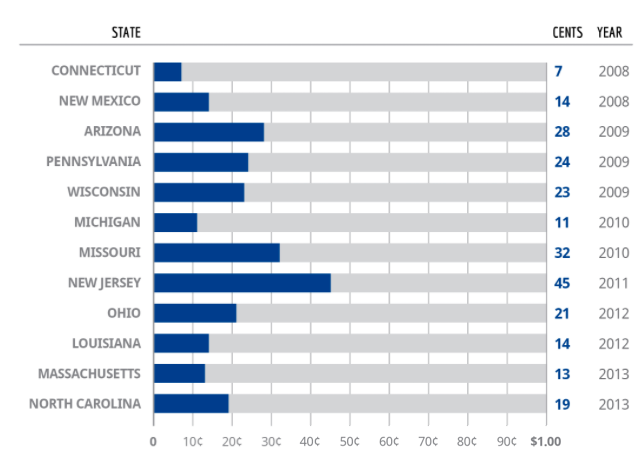
Source: John Locke Foundation
Since this chart was published, studies on similar programs in Florida, Virginia, and West Virginia have shown similar results. No program had a positive ROI.
We have to do it if other people are
One of the commonly prescribed reasons for why need film incentives is it’s “good” for the state to have movies filmed here. As is often the case in government, we focus on the inputs. How many films are made here? What movie star was in Mississippi? That is nice, but the focus should be on outcomes.
The other common argument is that other states are doing it. Throughout the country, producers hold states hostage and threaten to move without incentives. Producers in Mississippi have raised the same point. Again, that is not good reason to essentially throw taxpayer money away.
Simply because another state is wasting money does not mean Mississippi should join them, or continue this practice.
In a comprehensive list of state film production incentives compiled by the National Conference of State Legislatures (NCSL), we see states that do not have incentives for producers but offer tax breaks to everyone, without partiality. For example:
Alaska: No film incentive program. Effective July 1, 2015, the film production incentive program was repealed. Alaska has no state sales or income tax.
Delaware: No film incentive program. However, the state does not levy a sales tax.
Florida: This program sunset on June 30, 2016. It has not been renewed. The state does not levy a state income tax.
New Hampshire: No film incentive program. The state has no sales and use, or broad base personal income taxes.
South Dakota: No film incentive program. There is no corporate or personal income tax in South Dakota.
Our goal should be for Mississippi to have the most competitive business climate in the country. The tax breaks that a few chosen industries or companies receive should be made available to all. When we do that we will remove the need for taxpayer funded incentives.
There has been a movement underway around the nation and in Mississippi to reform our criminal justice system.
The movement has gained momentum due to our mass incarceration problem in the U.S. — a reality where our prison population has grown roughly seven-fold since the 1970s and left us with highest incarceration rate in the world.
By way of comparison that helps visualize the extent of the problem, the U.S. incarcerates 655 per 100,000 people of any age, while Turkmenistan incarcerates 583, Cuba 510, Rwanda 434, Russia 415 and Brazil 324, according to data maintained by the Institute for Criminal Policy Research at the University of London.
In a nation with the highest incarceration rate in the world, Mississippi has the third highest rate as a state.
If you are hearing these types of statistics for the first time and are very surprised, you are not alone. Most are very surprised. And as you might suspect, our unique incarceration habit is a very expensive one. It is a budget-busting endeavor that is eating an ever-increasing percentage of state budgets around the nation, and it is doing so at the expense of other worthwhile and necessary public investments.
Perhaps this is one reason why even in this divisive political era, the reform movement has drawn supporters from across the political spectrum.
The Mississippi Legislature has been one such supporter, and more than that, it has been a leader on this issue nationally. In recent years it has passed two criminal justice reform measures, H.B. 585 (2014) and H.B. 387 (2018), and it is currently considering H.B. 1352, another reform measure. H.B. 1352 seeks to make it easier for people who have paid their debt to society to re-enter the workforce by removing barriers to employment. These barriers occur in various ways that are not directly or indirectly tied to fighting crime or reducing recidivism, such as through the denial of occupational licenses and the loss of driving privileges for offenses that are not related to driving.
In addition to addressing work-related issues, H.B. 1352 also addresses mental health issues, which along with addiction issues affect our criminal justice system. These issues often go unaddressed in prison. For addiction issues, drug courts have proven to be an effective tool. H.B. 1352 builds on drug court successes by allowing these courts to also offer treatments to those with mental health issues.
The cost implications are huge. Mississippi spends over $300 million annually in a cash-strapped state to support an overly large prison system. Funds are scarce to non-existent to dedicate towards measures that would reduce crime in the first place. H.B. 1352 would create a dedicated fund to ensure that cost-savings from reforms are invested in programs that are aimed at reducing crime and making communities safer.
Criminal justice reform is an issue that garners bipartisan support because of shared goals — safer communities, fewer people in prison, more people leading productive lives, and cost savings from unnecessary overincarceration. Over 95 percent of the people currently incarcerated in our prisons will be re-entering our communities at some point. A current reality is that approximately a third of those persons will reenter prison within three years. The reasons for this can range from the commission of a new crime to violations of a parole condition. We can change this equation to some degree by ensuring that when people leave our prisons, they can go to work. H.B. 1352 will help do that.
It is difficult to combat the realities of recidivism. There is no sense in making this battle more difficult by making it harder for the recently released to find employment through the imposition of unnecessary barriers. It is imperative that we eliminate these barriers, such as the denial of occupational licensing, that make it harder for people to find work and more likely to turn to crime.
Our current incarceration system is not effective. We should be smart on crime and adopt evidence-based solutions that actually make our communities safer – policies that have demonstrated success through the numbers, not simply emotion-based actions that provide only chest beating points. A smarter approach involves offering the dignity of work to people who have made mistakes and focuses incarceration efforts on those who truly pose a threat to public safety. This, in turn, will create safer communities for the people of our state. That’s something we can all agree on.
This editorial appeared in the Clarion Ledger on March 12, 2019.