
The Mississippi House passed a bill Tuesday that could allow the state’s electric power associations to provide broadband service to their customers.
On Monday, the House Public Utilities Committee voted to send the House Bill 366, known as the Mississippi Broadband Enabling Act, to the floor for a vote.
The bill was authored by House Speaker Philip Gunn (R-Clinton) and it has several provisions that include:
- Removing the prohibition in state law that prohibited EPAs, also known as co-ops, from conducting any business outside providing electrical service to their customers.
- A requirement for EPAs to maintain the reliability of their electric service.
- A mandate for EPAs to conduct feasibility studies before providing broadband services.
- The EPA would be unable to use electric sales revenues to subsidize its broadband services, but it can make capital investments in the broadband entity along with utilizing loan guarantees.
- Being compelled to charge the same pole attachment fees to their broadband entity as they would to any outside private entity.
- EPAs wouldn’t be able to cut off electric service to broadband customers with delinquent bills.
“I’m not here to say this is a perfect bill,” said House Public Utilities Committee Chairman Jim Beckett (R-Bruce). “We’re not going to get everyone broadband overnight. It’s going to take a long time.”
Debate on the bill veered into a discussion over transparency with the finances of the EPAs and the membership of their boards, which are voted on by the customers.
State Rep. Robert Johnson III (D-Natchez) offered five amendments on the bill, with the first three amendments passed on voice votes. The first dealt with investor-owned utilities and the fact the act wouldn’t infringe upon their property or interests.
The second required the EPAs seeking to enact broadband service under the act to send notice of its elections to its board of directors to its customers. The last that passed concerned the information of customers via newspapers about the results of its board elections.
“When you’ve got EPAs that serve 1.8 million people in the state of Mississippi, more than half the state’s population, 60 percent are African-American and only 4.4 percent of the board membership,” Johnson said. “When you talk about women, it’s even less than that. I’m going to support this bill because the chairman (Beckett) did a good job.”
Johnson also tried to pin a reverse repealer clause on the bill, which would’ve brought it back for more work, and require EPAs offering broadband to provide quarterly financial statements to the Mississippi Public Service Commission. Both failed, with the fourth amendment defeated on a 71-42 roll call vote.
State Rep. Mark Baker (R-Brandon) accused Johnson of using the EPA amendments to improve his position regarding litigation regarding the EPAs and their finances.
The EPAs are not-for-profit corporations and are regulated by the Federal Energy Regulatory Commission. The state’s two investor-owned utilities — Entergy and Mississippi Power — are regulated by the three-member elected Mississippi Public Service Commission.
Public Service Commission Chairman Brandon Presley, a Democrat, has pushed the issue of rural broadband and was on hand for the vote.
The pole attachment fees are what outside entities pay to the utility to use their infrastructure for running lines to consumers. Since the investor-owned utilities are regulated by Federal Communications Commission when it comes to their pole attachment fees, they’re far lower than the EPAs. The co-ops aren’t subject to pricing rules on pole attachment fees and theirs are conversely higher.
Putting a provision that keeps EPAs from giving their broadband entities a discount on pole connection fees would help the issue of unfair competition in suburban areas of the state served by EPAs and traditional broadband providers such as AT&T, Xfinity and C Spire.
The loan guarantees might be a back door for subsidies, either from state or national taxpayers.
According to a report by the Congressional Research Service, there is $690 million in loans and grants available for the Telecommunications Infrastructure Loan and Loan Guarantee Program. This program, administered by the Rural Utilities Service of the U.S. Department of Agriculture, provides grants and loans for areas that lack high-speed broadband coverage.
A bill known as “The Mississippi Broadband Enabling Act” is moving fast through the House.
The legislation is designed bring broadband to every corner of Mississippi, so says its supporters.
Who can be against that? Likely not many members of the House. This bill will allow the cooperatives that brought electricity to rural Mississippi to do the same with high-speed internet.
But as with most policy, we should dig deeper beyond the title or the talking points before proceeding. Because this legislation leaves more questions than answers.
To begin, the mission of Electric Power Associations (EPAs), as defined by current law, is to make “electric energy available at the lowest cost consistent with sound economy and prudent management of the business of such corporations.”
Today, EPAs can lease their pole attachments to internet providers. However, because their rates are very high, significantly higher than the rates of investor owned utilities that are regulated by the state, it is cost prohibitive. That is a business decision made by both entities, but it is still an option.
While EPAs cannot provide internet services themselves, even without this legislation they can already create a separate entity and provide the services using their pole attachments.
The truth that everyone knows is that rural broadband is expensive. It has not been feasible in the private sector to offer a product at a price point people can afford or are willing to pay. That does not change because of this legislation.
While the initial focus of EPAs was rural electricity, they serve many suburban areas today as population shifts occurred. They would likely be the prime targets for EPAs, as they will be the easiest to reach, but many of those customers already have the option of AT&T, Xfinity, or C Spire.
Will an EPA run fiber for several miles to reach one or two houses at the end of a gravel road? And can they do that for $50 a month or whatever consumers believe is a reasonable price? Those are some of the questions to be asked.
Because, if it is not feasible as the market has shown, it seems inevitable that this plan will open the door for a ratepayer and state taxpayer bailout.
One of the biggest bills facing the Mississippi legislature — rural broadband — is already headed to the floor for a vote.
The so-called Mississippi Broadband Enabling Act would allow the state’s 26 non-profit electric power associations, also known as cooperatives, to provide broadband to their primarily rural customer base.
The House Public Utilities Committee voted Monday afternoon to send the bill to the House floor.
The bill, authored by House Speaker Philip Gunn (R-Clinton), would require EPAs to conduct economic feasibility studies before providing broadband services, maintain the reliability of their electric service, maintain the same pole attachment fees for an EPA-owned broadband affiliate as for private entities wishing to use the EPA’s infrastructure and submit a publicly-available compliance audit annually.
Another similar bill is in the Senate. Senate Bill 2078 is sponsored by state Sen. Chuck Younger (R-Columbus) and differs in that would simply authorize EPAs to provide broadband service to their electric customers without requirements for pole attachment fees, feasibility studies or an annual compliance audit.
This bill is in the hands of the Senate Energy Committee.
House Bill 7– Sponsored by state Rep. John Hines Sr. (D-Greenville) would prohibit appointed or elected public officers from taking part in partisan political activity.
HB 19– This bill, sponsored by state Rep. David Baria (D-Bay St. Louis), would require bond counsel to be selected through competitive requests for proposal process. When a local government entity wants to issue bonds to fund a project, they need counsel to oversee bond proceedings and write key financing documents. The bill has been double-referred to two committees, which means it’ll likely die a quiet death before it can make to the House floor for a vote.
HB 31– This bill would eliminate the requirement for a supervising physician for nurse practitioners with 3,600 or more hours in clinical practice. The bill is sponsored by state Rep. Jay Hughes (D-Oxford) and is in the hands of the Public Health and Human Services Committee.
HB 60– Sponsored by state Rep. Earl Banks (D-Jackson), this bill would authorize $2 million in bond funds for the Jackson Zoo for capital improvements. With the help of city of the Jackson, the zoo had to repay the state for bond money from 2015 and 2016 when its administration spent most of the money on daily operations in violation of the memorandums of understanding it had with the state’s Department of Finance and Administration.
HB 67– State Rep. Ashley Henley (R-Southaven) sponsored this bill that would eliminate the state sales tax on food and increase the diversion of sales tax revenue to municipalities from 18.5 to 20 percent. It’s in the hands of the Ways and Means Committee.
HB 71– This bill would extend the repealer on tax incentives provided by taxpayers to filmmakers and is sponsored by state Rep. William Tracy Arnold (R-Booneville). If the bill is not signed into law, the state’s questionable film incentives will expire on July 1.
Under present law, filmmakers can receive a 25 percent cash rebate on their local spend in the state and a 30 percent cash rebate on payroll paid to resident cast and crew whose wages are subject to state income tax. There’s also a 5 percent additional payroll rebate for wages paid to any member of the cast or crew who is an honorably discharged veteran of the U.S. Armed Forces.
The bill has been referred to two committees: Tourism and Ways and Means.
HB 85– Cell site simulator devices such as the Stingray would require a warrant if this bill authored by state Rep. Steve Hopkins (R-Southaven) is signed into law. The bill would provide an exception for the warrant requirement if it’s necessary for law enforcement officials to use the cell site simulator device to prevent loss of life or injury.
The devices are used by law enforcement to spoof cell phone towers and track any device within range into connecting with the stingray. This allows law enforcement personnel to not only locate and track the person in possession of a specific phone, but also gather their communications content as well.
A similar billl ast year also authored by Hopkins died in committee. This year’s bill has been referred to the House Judiciary B Committee.
HB 118– At present, Mississippi law prevents home-schooled students from participating in extracurricular activities, such as athletics, in their respective school districts. This bill, sponsored by state Rep. Arnold, would allow those students to participate in extracurricular activities and will be considered by the Education Committee.
HB 173– This bill, sponsored by state Rep. Bill Shirley (R-Quitman), would limit the salaries of the State Superintendent of Public Education, the Commissioner of Higher Education and the Executive Director of the Mississippi Community College Board to a pay scale of 150 percent of the governor’s salary. State Superintendent Carey Wright is the nation’s highest paid state leader of K-12 education, making $307,000 per year. Mississippi IHL Commissioner Glenn Boyce earns slightly less than $360,000 annually. Gov. Phil Bryant is paid an annual salary of $122,160 per year.
SB 2020– Sponsored by state Sen. Videt Carmichael (R-Meridian), this bill would expand the Public Service Commission from three elected members to four elected (by U.S. House districts) and one appointed by the governor with the advice and consent of the Senate. Under the bill, the now-separate Public Utilities Staff would become part of the PSC again. A similar bill died last session. The bill is now in the hands of the Senate Accountability, Efficiency, Transparency Committee.
The next deadline is Monday, which is the final day for the introduction of general bills. The deadline for committee action is February 5.
Lt. Gov. Tate Reeves outlined his plans for the 2019 legislative session, mixed in with a pitch to be the state’s next governor, at the Stennis Capitol Press Forum Monday.
Reeves touted the state’s progress in K-12 education, historically low unemployment rate and increasing tax revenues while vowing that he will never, as governor, support the expansion of Medicaid, which he called Obamacare.
He also supported increasing pay for both teachers and state workers in this year’s session and promised that despite increasing revenues, most state agencies will receive the same level of funding as last year’s budget.
“For the next three months, my focus will be to finish the job I was elected to do, leading the state Senate and passing good, conservative policy,” Reeves said. “I’m proud of my record over the past seven years, because I’ve done what I promised voters I would do. Cutting taxes and finding efficiencies in state government.
“I’m not afraid to say no to my friends and I have no plans to change just because this is an election year.”
As for the state’s improving financial condition, he cited the most recent tax revenue report from the Department of Revenue. The report shows that collections for the fiscal year so far are $90.4 million or 3.52 percent over the sine die estimates. The biggest increases are in the use tax (7 percent tax that is now assessed on internet sales) which was 20.17 percent and nearly 14.98 percent increase in corporate income tax revenue.
The state’s unemployment rate was 4.7 percent in December, which still lags behind the national rate of 3.7 percent.
The two-term lieutenant governor and former state treasurer also decried the decision by the governing board of the Public Employees' Retirement System of Mississippi from 15.75 percent of payroll to 17.4 percent.
“The request by Public Employees' Retirement System will be funded in its entirety,” Reeves said. “Even though I am disappointed that the board broke years of precedence and made a significant request for an increase before they received the annual actuary report this year.”
Reeves said the extra taxpayer money for employer contributions to PERS could add up to between $75 million to $80 million. Taxpayers could also be paying more at the municipal and county level, as local government contributions could add up to $25 million or more.
As for the issue of a decreasing population in Mississippi, Reeves blamed the lack of a large urban area with the kind of amenities desired by millennials and the large number of out-of-state students attending the state’s two largest universities. The University of Mississippi had 41.7 percent of its enrollment from out of state, while 35 percent at Mississippi State University hail from outside the state.
Reeves did get in a shot at one of the gubernatorial candidates on the Democrat side, Attorney General Jim Hood.
“The political enemy of 2019 are the liberal ideas of (U.S. House Speaker) Nancy Pelosi, (Senate Minority Leader) Chuck Schumer and (state Attorney General) Jim Hood,” Reeves said, linking Hood rhetorically with two national Democrats with little popularity in the state.
Former Heisman Trophy winning quarterback Tim Tebow was able to play football for his local public school in Florida while being homeschooled.
Tebow, the Heisman winner, two-time national champion, and first round draft pick, made international news most recently when he proposed to Demi-Leigh Nel-Peters, a former Miss Universe.
Florida is one of about three dozen states that allow homeschool students to play sports for their local high school. Some states have enacted this policy through legislation. In other instances, state high school athletic associations have put this policy in place. The Alabama High School Athletic Association recently made such a change.
Though the policies may vary, the intention is similar: just because you are homeschooled does not mean you can’t play sports for your local high school that your taxes are funding.
Every neighboring state permits homeschool students to play high school sports. Mississippi stands out as the only state that does not.
Over the past several years, including this year already, various bills have been introduced in the legislature to make this change. Only once has such a bill made it out of committee and it was killed on the Senate floor thanks in large part to an odd coalition of opponents that included the Home School Legal Defense Association (HSLDA). HSLDA normally take a neutral position on “Tebow bills,” but believed that particular legislation threatened the academic freedom of all homeschoolers.
Homeschoolers in Mississippi enjoy a high level of academic freedom. Something that upsets many people in both parties. In an effort to preserve what homeschoolers have already “won” in Mississippi, it doesn’t look like any changes will be made to the homeschooling code sections any time soon.
At least not until a Tim Tebow comes on the scene in Mississippi.
A proposal floated by a Mississippi coalition to increase the state’s cigarette excise tax by 221 percent — to $2.18 per pack — would result in a huge increase in tax evasion and avoidance, according to a recent statistical analysis.
If the increase is adopted, Mississippi will find itself surrounded by lower-taxed states, which will encourage cross-border shopping by individuals and large scale smuggling, too, among other undesirable consequences.
It was anecdotal evidence about cigarette tax evasion and avoidance, or “smuggling,” that led one of the authors (LaFaive) and two of his colleagues to estimate the degree to which cigarettes are smuggled between states, as well as from Mexico and to Canada. They estimate that through 2016, Mississippi’s smuggling rate was a mild 4 percent.
The estimate is built around their statistical model, which measures the difference between smoking rates published by the federal government for each state and legal paid sales. There are often yawning gaps between the two — the amount of cigarettes that should be smoked based on sales and the amount of smoking that actually occurs — and that difference is probably explained by smuggling.
The model can be used to make “what-if” estimates based on proposed changes in tax rates. At an excise tax of $2.18 per pack, smuggling would leap from 4 percent to 35 percent of the total market. That is, of all the cigarettes consumed in Mississippi after such a tax hike, 35 of every 100 cigarettes would be smuggled. The model also reports that 21 percent of all consumption would be a function of “casual” smuggling. Casual smuggling is represented by individuals who typically buy lower-taxed smokes elsewhere for personal consumption.
The degree of casual tax avoidance or evasion makes sense when you consider that Mississippi, at $2.18 per pack, would be surrounded by lower taxed states Tennessee (62 cents); Alabama (67.5 cents); Louisiana ($1.08); and Arkansas ($1.15). Consider too, that Missouri, which imposes a tax of just 17 cents — the lowest in the country — is only a short drive through Arkansas.
When tax rates vary substantially across state borders, that gives people an incentive to shop elsewhere for their smokes and for larger, organized crime cells to engage in large, long-haul smuggling operations.
For example, New York State imposes a state excise tax of $4.35 per pack, and New York City tacks on an additional $1.50. Nearby Virginia — a five-hour drive — imposes a tax of only 30 cents. It is this difference that consumers seek to save (and smugglers try to profit from) by acquiring lower priced, often illegal cigarettes. In New York, inbound trafficking is rampant and news stories about it are easy to find.
Just last November, the New York state attorney general announced a 242-count indictment involving 17 cigarette smugglers who moved over 18 million untaxed smokes into the Empire State. That’s just one cell and one bust. There have been many others. This is something Magnolia State lawmakers should consider before taking up legislation that could make Mississippi’s smuggling look more like a New York racket.
Moreover, smuggling is not the only consequence of high cigarette taxes. Others include brazen theft of cigarettes from retailers and wholesalers, shipment hijackings, violence against people and police, cases of murder-for-hire, accidental deaths involving police pursuits and public employee corruption.
All of the risks associated with higher cigarette excise taxes could be worthwhile if they led to far more people kicking the habit. Research shows, however, that as much as 85 percent of the after-tax change in legal paid sales is a function of tax avoidance and not quitting. Cigarette sales may drop dramatically, but it does not follow that smoking rates do.
None of this should suggest that either of us wish to encourage smoking. Neither of us are smokers and we would discourage others from starting. But the data shows us that there are far more effective ways — including tobacco alternatives, non-combustion substitutes, and innovative harm-reduction products — to reduce smoking than raising taxes.
The evidence from around the country and elsewhere tells us that relatively high cigarette excise tax rates can produce every sort of mischief, including undermining the very health goals such taxes were adopted to address.
This editorial was co-authored by Michael LaFaive. He is senior director of fiscal policy for the Mackinac Center for Public Policy and author of “Prohibition by Price: Cigarette Taxes and Unintended Consequences,” a chapter in the book, “For Your Own Good.”
The state of Mississippi eclipsed spending $10,000 per student last year.
According to the 2017-2018 Superintendent’s Annual Report, released Thursday, the state spent $10,034 per student, on average. This amount was based on average daily attendance, which was 439,599 students last year.
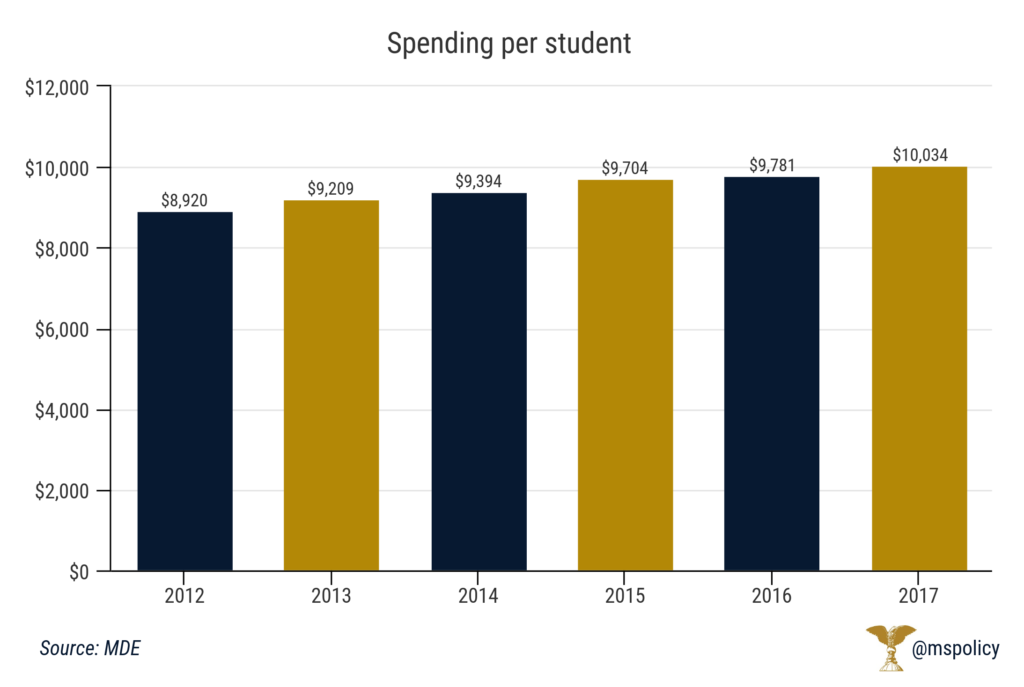
This marks the sixth straight year that the average expenditure per student has increased. In 2012, the state was spending $8,920 per student. It increased to $9,209 in 2013, $9,394 in 2014, $9,704 in 2015, and $9,781 last year.
On a district-by-district basis, spending per student fluctuated from a high of over $21,000 per student in the Montgomery County School District to a low of $7,800 in the Lincoln County School District. The Kemper County School District, Amite County School District, Moss Point School District, and Lumberton School District rounded out the top five.
Eighty-six districts spent more than $10,000 per student, and 24 spent more than $12,000 per student.
National figures on what each state is spending tend to vary widely depending on the source. The U.S. Census, which tracks public education finances, showed a national average of $11,762 during the 2016 fiscal year. However, the same data had Mississippi spending just $8,702, almost $1,000 less than what the state reported.
Simultaneous to the increase in per-student-expenditure, the average daily attendance has also decreased each year. While that number was just under 440,000 this year, it was 461,000 in 2012. This represents a drop of more than 4.5 percent. Enrollment numbers decreased again for the 2018-2019 school year, and, presuming education funding is not reduced, the per- student-average will only continue to increase.
Mississippi law enforcement agencies need little justification to seize property or even cash from owners under state law.
All law enforcement has to do is connect property to a crime to seize it, and can use proceeds from it to supplement their budgets. Those whose property is seized have to prove in a civil court their property was not involved with a crime or the proceeds of a crime.
One case that exemplified this policy occurred at Jackson’s Medgar Wiley Evers International Airport on February 20, 2017. Ashley Tami Renee Phillips was trying to catch a flight when a Transportation Security Administration officer detected $30,000 in cash that was in three bundles in her checked luggage. In the request for forfeiture, the Jackson Airport Police Department alleged that the cash was concealed in clothing in her checked luggage.
The Department brought in a drug dog and the animal alerted to the presence of narcotics on the currency, giving the police the justification to seize it. This despite a study that says that nearly 80 percent of U.S. currency is contaminated by cocaine residue.
Phillips hired a local attorney and contested the seizure, denying that the money was concealed in the clothing in her luggage.
The airport police and Phillips finally reached a settlement that allowed law enforcement to keep $5,000 of the money, with the rest returned to Phillips and her attorney. In most cases, however, it is not worth it to challenge a seizure. Attorney and filing fees often make it cost prohibitive for the value of the seized property.
When a Mississippi law enforcement agency makes a seizure, it has to send a notification, usually by letter, to the property owner that details what was seized and informing them they have 30 days to contest the forfeiture in civil court. If the owner doesn’t contest the forfeiture, the ownership of the property or cash automatically goes to the agency that made the seizure.
Law enforcement agencies can retain 80 percent of the proceeds from any seizure if only one agency was investigating and 100 percent if more than one agency was involved. The remaining 20 percent, if one agency was involved, is shared with the local district attorney’s office or the Mississippi Bureau of Narcotics who help file the seizure paperwork with the judge.
In the case of the airport seizure, the Madison and Rankin County District Attorney’s office that filed the request on behalf of the police would receive 20 percent of the $5,000.
Last year, the Mississippi legislature allowed the expiration of the law that authorized administrative forfeiture — which allowed law enforcement agencies to seize property valued at less than $20,000 with only a notice to the property owner.
But even after the law was repealed, agencies continue to seize property under administrative forfeiture. In September, the Mississippi Justice Institute, the legal arm of the Mississippi Center for Public Policy, sent a letter to MBN advising the agency of the change in the law after it became apparent that the property seizures continued. Later that month, MBN sent notices allowing retrieval of improperly seized property.
Two years prior, Gov. Phil Bryant signed into law a bill that created a civil asset forfeiture database that is maintained by the MBN. The law also required law enforcement agencies to report some, but not all, data on their seizures. Previously, there was no reporting requirements on which assets were seized.
It also outlawed the practice of law enforcement agencies hiring outside counsel to pursue civil asset forfeiture claims, as it requires them to use either local district attorneys or MBN to handle all legal work on forfeitures.
Maintaining diversity departments at Mississippi State University and the University of Mississippi are hitting taxpayers in the wallet.
According to records obtained by the Mississippi Center for Public Policy, the University of Mississippi spent $1,249,868 of its 2018-2019 budget on diversity related operations, which include the Division of Diversity and Community Engagement, Center for Inclusion and Cross Cultural Engagement and the McLean Institute for Public Service and Community Engagement.
Mississippi State University spent $803,756 on diversity-related activities that include the Institutional Diversity and Inclusion Division and the Holmes Cultural Diversity Center.
As a percentage of their total budgets ($681 million for Ole Miss and $364 million for Mississippi State), Ole Miss and Mississippi State are both outspending the University of Michigan on diversity-related activities. Michigan was the flashpoint for two landmark U.S. Supreme Court cases involving race-based admissions policies.
The Ann Arbor-based school has a budget of more than $3 billion and spent more than $2 million on its diversity agenda with 12 employees. In 2014, the U.S. Supreme Court upheld a Michigan ballot initiative that prevented race-based admissions at the state’s institutions of higher education with a 6-2 decision in Schuette v. Coalition to Defend Affirmative Action.
The ballot initiative was in response to the 2003 U.S. Supreme Court decision, Grutter v. Bollinger, that upheld affirmative action admission policies at Michigan and other universities.
The University of Alabama has six full-time employees dedicated solely to two diversity-related organizations, the Diversity Equity and Inclusion office and the Women and Gender Resource Center. The Tuscaloosa-based institution had a budget of $2.14 billion in 2017.
Louisiana State University has nine full-time employees whose role is dedicated to diversity-related issues. LSU had a budget of $1.018 billion in 2018.
Ole Miss spent 95.8 percent of its diversity-related budget ($1,249,868) on personnel-related costs. That adds up to $1,197,080 in 2018-19 for eight full-time employees with more budgeted for part-time student workers.
That figure could also increase with four unfilled positions, two of which (assistant vice chancellors for diversity and community engagement) pay $120,000 apiece per year.
What are the objectives of the various diversity departments on college campuses?
Former Ole Miss Chancellor Jeffrey Vitter called diversity “a hallmark of education” and said that it “enriches the environment and experiences of all our campus constituents.”
In the diversity plan at Ole Miss, the university wants to increase the enrollment and graduation rate of minorities, hire more minorities in administrative, faculty and staff positions, change the curriculum to one that “enhances multicultural awareness and understanding,” and increase the use of minority vendors by the university.
Mississippi State has 11 full-time employees and more money budgeted for part-time student workers whose job descriptions are based on increasing campus diversity. Personnel-related costs absorb 82.2 percent of the diversity program’s budget at State.
MSU’s diversity plan is similar, with goals to increase diversity in both enrollment and among administration, faculty and staff along with providing more contracts to minority vendors.
Diversity is a lucrative career, especially at Ole Miss. The university pays Katrina Caldwell, the Vice Chancellor for Diversity and Community Engagement, $205,000 per year. She received a $5,000 raise in 2018 after being hired from Northern Illinois University.
According to her bio on the university website, Caldwell’s duties include “leadership and coordination of UM’s efforts to create and supervise a diverse, inclusive and welcoming environment for all members of the community.”
Are taxpayers seeing a benefit for this spending? Not according to a paper from the National Bureau of Economic Research that shows that having a diversity staff doesn’t translate to an increase in the hiring of “underserved” racial and minority groups.
The paper, authored by Baylor University economists Steven Bradley, James Garven, Wilson Law and James West, took a look at data from U.S. universities from 2001 to 2016 that hired an executive level chief diversity officer and whether the diversity of their faculty and administrative hires increased as a result.
The four didn’t find any significant evidence that hiring a diversity officer results in more hiring of minority faculties and administrators and that the pool of diverse Ph.D. candidates is limited as many often accept employment outside the academy.
According to their research, two thirds of all U.S. universities have a chief diversity officer on staff.