
A Mississippi Senate appropriations subcommittee hearing on Department of Public Safety funding Wednesday morphed into a discussion of excessive wait times for driver’s license renewal.
State Sen. Brice Wiggins (R-Pascagoula) criticized the DPS, represented by Commissioner Marshall Fisher, for having four-hour plus wait times for driver’s license renewals.
“The issue is simple things could be done,” Wiggins said. “Four hour wait times are flat-out unacceptable for the citizens of Mississippi. Something has to change. I’ve heard of people coming in to say they just need to change their address and they’re told come back in six hours.”
Wiggins also said that he’d support more appropriations for DPS to help reduce wait times and suggested a phone, but also said it was more than just about money. He said that the department should enact a phone-based or online appointment system to lower wait times.
Fisher told Wiggins and the subcommittee that the examiners, who make around $21,000 annually, need a pay hike. He also said he’d like to have more of the driver’s license services online.
Fisher has asked the subcommittee for a $48.75 million increase in his agency’s budget that would include a new trooper school, more officers for the Mississippi Bureau of Narcotics, and more medical examiners for the state crime lab. This increase would also cover added employer contributions to the state’s defined benefit pension system.
Fisher also asked for his agency to be released from the purview of the Mississippi Personnel Board and the Employee Appeals Board. Under state law, a bill would have to be drafted to provide DPS with an exception.
During his briefing, Fisher said the number of state troopers is critically low and the agency needs 60 more troopers. According to his numbers, there are 488 troopers on the force at present, but of those, 160 have enough service time to retire this year.
State law authorizes a force of 650 troopers.
Fifty seven troopers were added to the force after a trooper school graduated last year, while up to 54 in the present class could join the force on May 1.
According to the U.S. Department of Justice statistics, the national average is 20 troopers per 100,000 residents. Using Fisher’s numbers on troopers, the state has 17 per 100,000 residents.
Fisher also said the autopsy workload for the state’s two medical examiners is too high and that the Medical Examiner’s Office needs seven additional personnel, including two new examiners. He said the two examiners performed 1,250 autopsies last year, which is far more than 250 per examiner recommended by the National Association of Medical Examiners.
School district consolidation in Mississippi can offer both efficiency and savings to taxpayers. It is also one of the trickiest, and most sensitive issues, to local residents, and local lawmakers.
Over the past five years, the state legislature has led on the issue with 10 separate consolidation bills impacting 21 different school districts. By 2021, the state will have 13 fewer school districts than in 2014.
The formula behind the consolidation has largely been to merge two, or in some cases three, districts that are in the same county and are both failing, or, at best, struggling. The consolidations have included:
- Consolidating North Bolivar School District and Mound Bayou School District into the North Bolivar Consolidated School District (2014);
- Consolidating Benoit School District, West Bolivar School District, and Shaw School District into the West Bolivar School District (2014);
- Consolidating Sunflower County School District, Drew School District, and Indianola School District into the Sunflower County Consolidated School District (2014);
- Consolidating Oktibbeha County School District and Starkville School District into the Starkville Oktibbeha Consolidated School District (2015);
- Consolidating the Clay County School District and West Point School District into the West Point Consolidated School District (2015);
- Consolidating the Winona School District and the Montgomery County School District into the Winona Montgomery Consolidated School District (2018);
- Consolidating the Durant School District and the Holmes County School District into the Holmes County Consolidated School District (2018);
- Consolidating the Greenwood School District and the Leflore County School District into the Greenwood Leflore School District (2019);
- Dissolving the Lumberton School District into the Lamar County School District (2019);
- Consolidating Chickasaw County School District and Houston School District into the Chickasaw County School District (2021).
Still, school districts in Mississippi serve a lower number of students, on average, than every other state in the Southeast, save for Arkansas. What does that mean? We are spending money on additional salaries, pensions, benefits, buildings, etc. that other states are not. This means less money in the classrooms.
Mississippi’s school districts are inefficient compared to other Southern states
| State | Total enrollment | Total school districts | Students per district |
| Florida | 2,721,459 | 67 | 40,619 |
| North Carolina | 1,443,163 | 115 | 12,549 |
| Virginia | 1,279,544 | 135 | 9,478 |
| Georgia | 1,744,240 | 199 | 8,765 |
| South Carolina | 718,322 | 82 | 8,760 |
| Tennessee | 960,704 | 142 | 6,766 |
| Louisiana | 720,458 | 126 | 5,718 |
| Alabama | 733,951 | 136 | 5,397 |
| West Virginia | 281,439 | 55 | 5,117 |
| Kentucky | 685,176 | 173 | 3,961 |
| Mississippi | 492,279 | 151* | 3,260 |
| Arkansas | 475,782 | 254 | 1,873 |
Source: National Education Association, “Rankings & Estimates 2014-2015”
The average district size among the 12 states was 9,467, almost three times the size of the average district in Mississippi. For Mississippi to be in line with that average, the state would need to see a reduction to 52 school districts, eliminating almost two-thirds of the districts in the state.
Florida is the biggest outlier in this group. Removing the Sunshine State from the mix would drop the average district size to 6,513. Even doing that, Mississippi would still need to drop to 75 districts to be at the average. That is a reduction of almost 50 percent.
Among neighboring states, if school districts in Mississippi were to serve the same number of students as school districts in Alabama, Mississippi would need to experience a reduction to 91 districts. To mirror Louisiana, Mississippi would need a reduction to 86 districts. And to match the same number of students per district as Tennessee, Mississippi would need a reduction to 73 districts. Either of these changes would represent a decrease of 40 to 50 percent of the districts in the state.
Additionally, the districts in Mississippi are largely unbalanced. Half of all public school students in the state attend school in one of just 28 school districts. Yet, 63 districts have less than 2,000 students and educate just 16 percent of students.
There is not a magic size for a district. There are poor performing large districts, starting with Jackson Public Schools, just as there are high-performing small districts. But this inefficient distribution of students, which results in excessive bureaucracy, costs taxpayers money and prevents dollars from making it to the classroom.
While there is overwhelming local pressure to oppose consolidation, the legislature should continue with the process of reducing the number of school districts in Mississippi.
* This data was released before Mississippi began consolidating school districts, but the drop in the number of districts isn’t great enough to change these statistics.
It has often been said that government does not create jobs, it merely creates the environment that encourages, or in some cases, discourages, job growth. When it comes to occupational licensing, the emphasis is on discouraging job growth.
Because of these often burdensome laws, Mississippians are forced to spend time and money to receive permission from the government before they can earn a living.
While licensing was once limited to areas that most believe deserve licensing, such as medical professionals, lawyers, and teachers, this practice has greatly expanded over the past five decades. Today, approximately 19 percent of Mississippians need a license to work. This includes everything from a shampooer, who must receive 1,500 clock hours of education, to a fire alarm installer, who must pay over $1,000 in fees. All totaled, there are 66 low-to-middle income occupations that are licensed in Mississippi.
What is the reasoning behind new licensing? The public argument is generally centered around the belief that we must do this in the name of consumer safety to protect individual citizens. But the reality is often something less altruistic. Mainly, these occupational associations are more interested in building a moat around their industry with the help of government. The harder it is for someone to enter an industry, the less competition and consumer choice the industry incumbents face.
This may artificially raise the wages of industry practitioners by raising the prices of goods and services that require such licenses, but it does so at a cost. Consumer choices are limited and consumer costs are increased. And the added cost is not insignificant. Mississippians pay a hidden tax of more than $800 each year due to onerous occupational licensure requirements, according to a 2016 report from the Heritage Foundation.
In 2018, the Mississippi legislature, with little discussion and few dissenting votes, passed a bill to make it more difficult to become a real estate broker. The proposed law sought to increase the time it would take to become a broker, going from the current one year to three years. Fortunately, Gov. Phil Bryant vetoed the legislation.
Who were the individuals supporting such legislation? Was it the Coalition of Mississippians Against Inexperienced Brokers? A group of citizens negatively impacted by brokers who had just one year of experience? No, it was, naturally, the Realtors Association.
But the bigger problem isn’t just one specific association pushing the legislature to limit competition, it is the cost of all unnecessary and burdensome regulations on Mississippi’s economy.
According to a recent report from the Institute for Justice, Mississippi has lost 13,000 jobs because of occupational licensing and the state has suffered an economic value loss of $37 million. To put that into perspective, just by legislative action to rollback unnecessary licenses, we can create two Nissan plants…without spending a dime of taxpayer dollars.
Instead of relying on government, these are the actions that will encourage and promote economic growth in Mississippi. If that is our goal, we need to trust in the benefits of the free market and a “lighter touch” from government and occupational licensing regimes and we need to return to a belief in individual responsibility.
This can be achieved in a number of ways. For example, voluntary certification offers an avenue for reform. This already occurs in many industries and allows private third-parties to set standards for individuals to voluntary subscribe as one level of quality assurance.
One of the more widely recognized private certifications is the Automotive Service Excellence (ASE) certification for mechanics. You can open a garage tomorrow with – or without – the ASE certification and customers may or may not care.
But that decision is left to the entrepreneur and the customer, not to the government or the industry lobbyist or the board of licensure. We can do this with any number of professions currently licensed by the state. If we really want more jobs and fewer people dependent on government, it starts by creating an environment that encourages work; not one that encourages the creation of hurdles and obstacles.
This column appeared in the Daily Leader on January 4, 2018.
Mississippi’s defined benefit pension system has enjoyed consecutive years of above-average investment income, yet its financial position has only improved slightly.
The Public Employees' Retirement System of Mississippi — which serves most state, county and municipal employees — earned $2.385 billion in investment returns in fiscal 2018, a 9.48 percent rate of return, after earning $3.4 billion or a 14.96 percent rate of return in 2017, according to its comprehensive financial report released on December 18
The plan expects an annual return on its investments of 7.75 percent.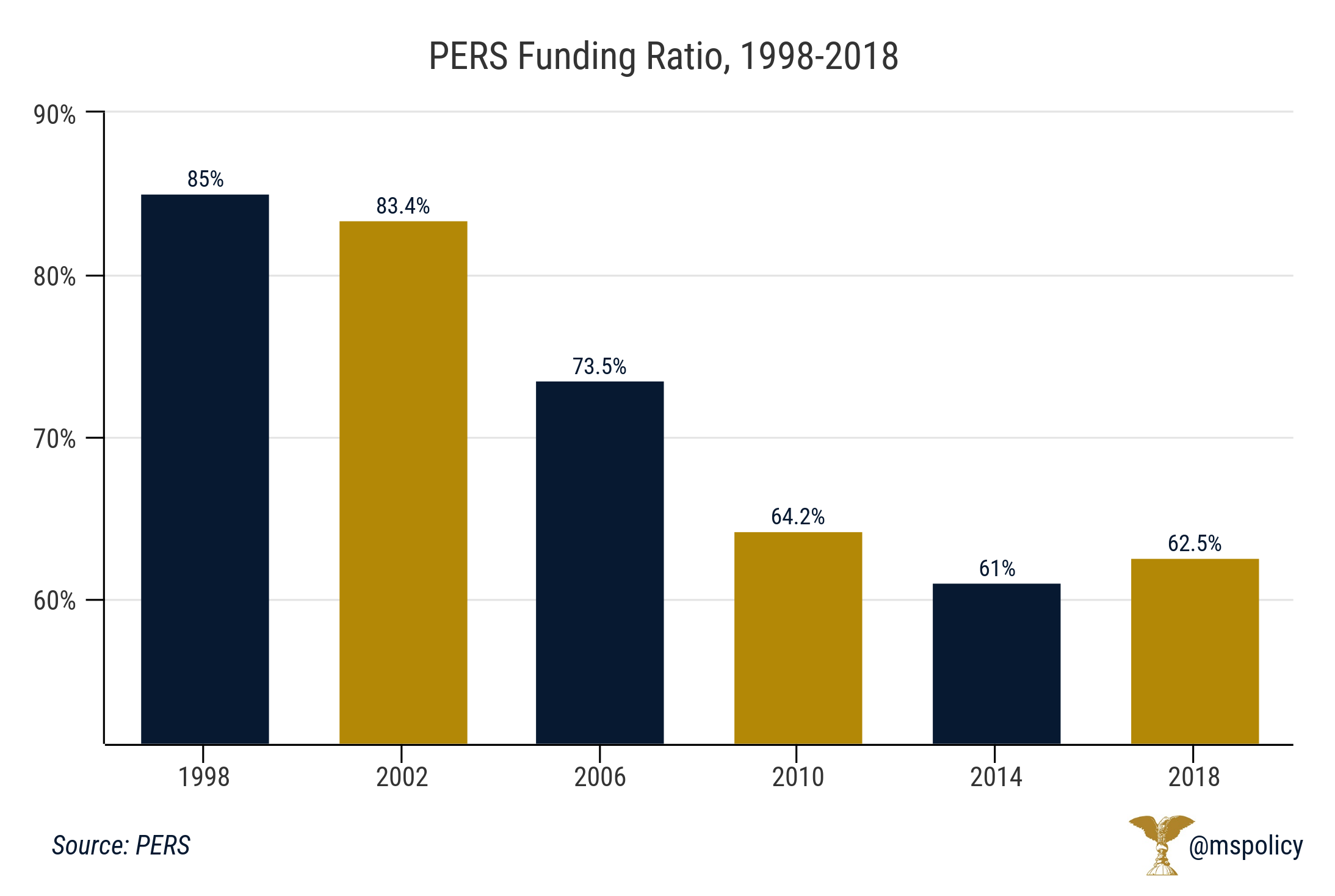
The funding ratio, which is defined as the share of future obligations covered by current assets, also ticked upward for the second consecutive year, improved from 61 percent in 2017 to 62.5 percent. As recently as 2001, the plan was 87.5 percent funded.
The funding ratio is a useful measure for gauging the health of a pension fund, as PERS was 85 percent funded in 1998.
Despite the second year of big returns on its investments, the plan’s unfunded liability remained the same at $16.6 billion. To fill this gap would require 2.76 years of all general fund tax revenue.
Along with the annual report from PERS, there are independent organizations that also track state administered pension plans. According to Pew, Mississippi has a funding gap of $18 billion. According to their report, Mississippi taxpayers would need to contribute an additional 4.6 percent to fund the system. The American Legislative Exchange Council (ALEC) has a bleaker picture for the retirement system, showing just 24 percent of promises currently funded and unfunded liabilities of over $80 billion.
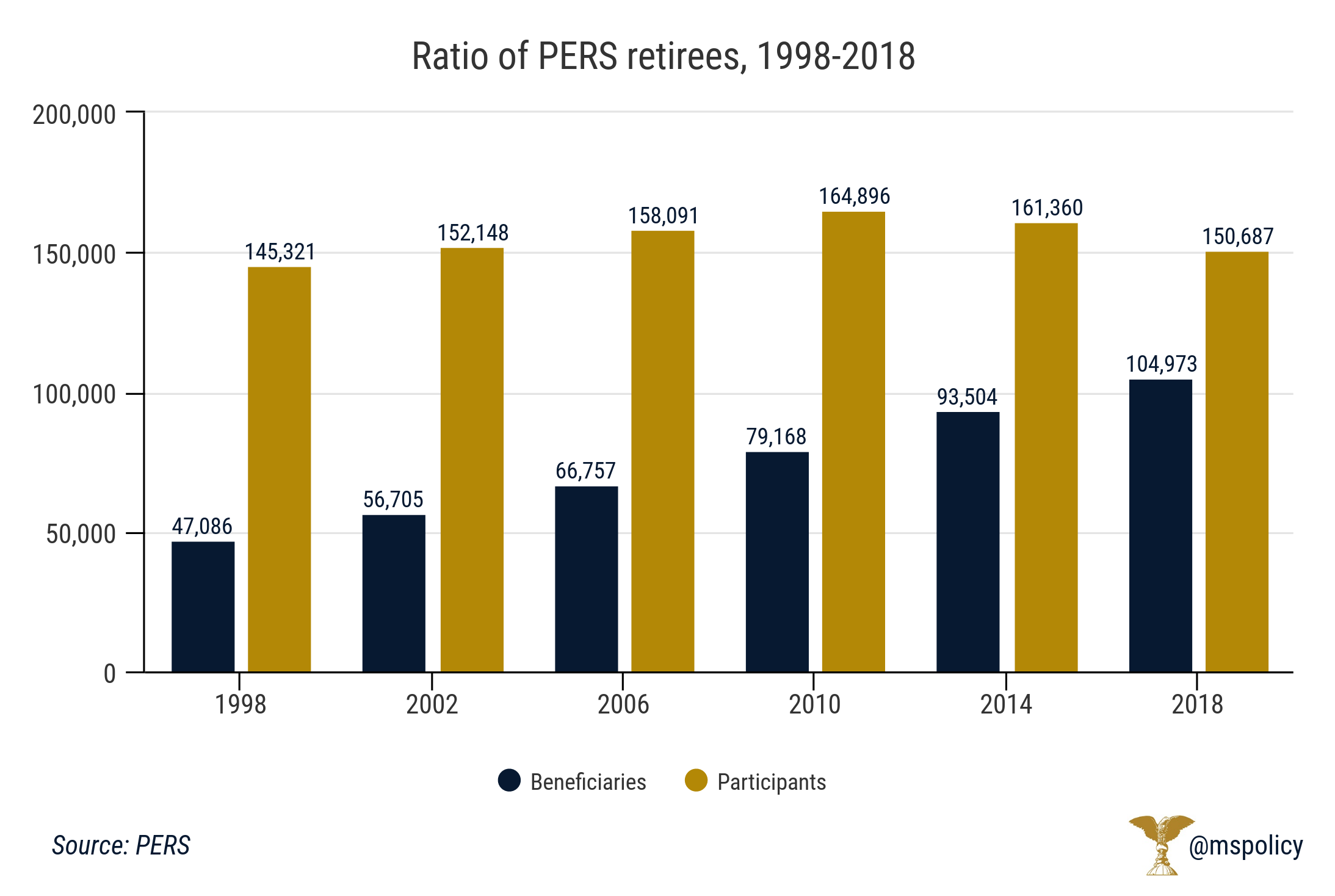
The reason is the increasing number of retirees supported by a shrinking number of contributing employees. Benefit payments added up to $2.6 billion, an increase of 5.3 percent over 2017, as the number of retirees increased from 102,260 to 104,973.
The number of contributing employees dropped from 152,382 in 2017 to 150,687. The amount of employer (taxpayer) and employee contributions added up to $1.6 billion, about the same as the year before.
The PERS board voted this summer to increase the taxpayer contributions from 15.75 percent of payroll to 17.4 percent. The legislature will have to appropriate $75 million or more for the employer contribution for state employees, while the increase for municipal and county employees could be on the hook for $25 million or more.
The trend of increasing numbers of retirees and decreasing numbers of contributing employees will continue for the foreseeable future thanks to unfavorable demographics.
The average age of the plan's members is 44.8, up slightly from last year (44.7) and members with at least 15 years of service represent 27.9 percent of all state and municipal employees in the PERS system. In 1999, the average age of PERS members was 42.4.
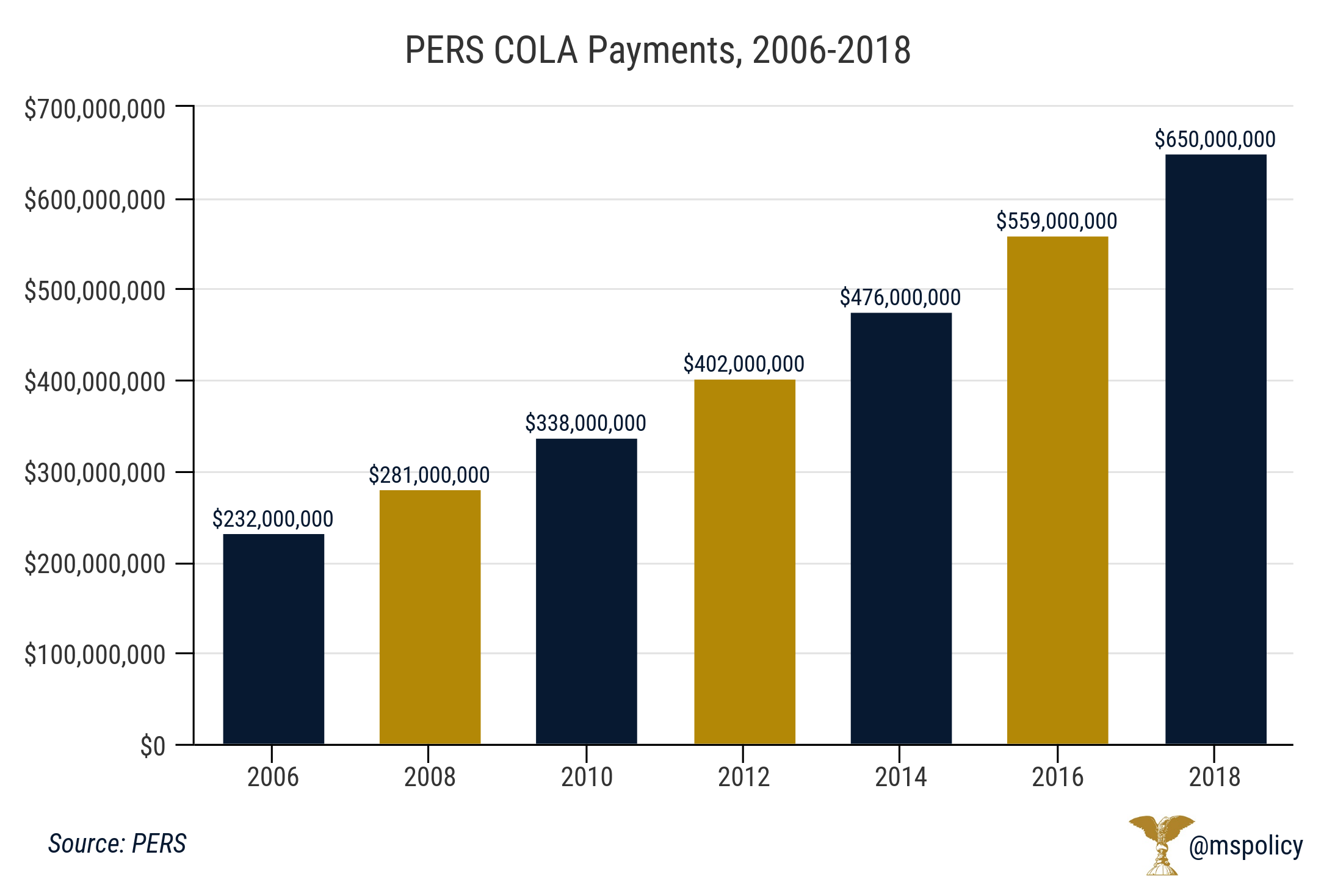
With more retirees, the plan’s payments for its cost of living increase or COLA added up to $650 million, a 7.8 increase over last year’s COLA payments of $603 million.
The fund provides a cost of living adjustment that amounts to three percent of the annual retirement allowance for each full fiscal year of retirement until the retired member reaches age 60.
From that point, the three percent rate is compounded for each fiscal year. Since many retirees and beneficiaries choose to receive it as a lump sum at the end of the year, the benefit is known as the 13th check.
Mississippi’s problems aren’t happening in a vacuum. According to the non-partisan Tax Foundation, Mississippi’s funding ratio of 58 percent in 2016 ranked 38thnationally and more than half of all states have pension funds that are less than two-thirds funded.
According to a recent scorecard, the GOP-dominated Mississippi legislature isn’t as conservative as members would like their constituents to believe.
The American Conservative Union Foundation released its annual ratings of the Mississippi legislature Thursday. Most Magnolia State lawmakers scored poorly on their votes on several bills selected by the ACU for their importance to the cause of limited government and economic freedom.
The average score for the legislature was 50.35 percent, up slightly from last year’s score of 50.31 percent.
Only six out of 122 House members won awards with ratings of 80 percent on their votes on the bills. The average Republican rating in the House was only 61 percent, with Democrats at 46 percent.
The Senate was even worse, as the average score was 46 percent with no senators winning awards. Democrats in the upper house averaged only one point less on average than their Republican comrades.
“In the 2018 session, lawmakers of the Mississippi legislature voted to continue hiking harsh requirements for people seeking to enter the workforce,” ACU Chairman Matt Schlapp said in a news release. “They also voted to fund crony government agencies that exclusively benefit select industries, including The Egg Marketing Board, whose mission is to persuade taxpayers to consume more eggs. We urge Mississippi lawmakers to reverse course and listen to the handful of conservatives in the legislature who are fighting for policy solutions that will create job opportunities and protect taxpayers from government waste.”
The bills that the ACU used to tabulate their ratings included ones that provided funding for the state’s Cosmetology Board, Mississippi Public Television, Mississippi Arts Commission and the Egg Marketing Board.
There were also bills that concerned alcohol policy (such as transportation of unopened alcoholic beverages through dry counties and ‘to-go cups’), occupational licensing, burdensome insurance mandates and limiting local government overreach on agricultural policies and the Second Amendment.
State representatives Joel Bomgar (R-Madison), Dana Criswell (R-Olive Branch) and Steve Hopkins (R-Southaven) were the only lawmakers to win the Award for Conservative Excellence, which went to lawmakers who scored 90 to 100 percent.
Three other state representatives — Chris Brown (R-Amory), Ashley Henley (R-Southaven) and Robert Foster (R-Hernando) — earned the Award for Conservative Achievement by scoring at least 80 percent.
In the House, the lowest scoring Republican member was state Rep. Donnie Bell (R-Fulton) with a score of 42 percent, while the highest-scoring Democrat in that chamber was state Rep. Kevin Horan (D-Grenada) with a 65 percent.
The lowest scoring Republican in the Senate was state Sen. Dean Kirby (R-Pearl) with a rating of 20 percent. The highest scoring Democrat in the upper chamber was state Sen. Juan Barnett (D-Heidelberg) with a 57 percent score.
The ACU is a non-profit organization that advocates for conservative policies such as economic and religious liberty, limits on the scope and size of government, pro-life policies and personal freedom at both the state and national levels.
Update: ACUF issued the following statement on a minor change to the scorecard:
In the originally published version, changes made by the Senate to HB 1083 were overlooked, and the ACUF description and position statement reflected the original version of the bill as passed by the House. Therefore, we have removed the bill from the Senate portion of our scorecard and retained the bill in the House. As a result, some members may find that their scores have slightly changed.
ACUF continues to fulfill our unique mission to reflect the voting records of every one of the nation’s over 8,000 elected officials, and we strive to provide our members and the general public with accurate scorecards to evaluate their elected officials. We sincerely apologize for our error and any confusion it may have caused.
This year’s session of the Mississippi legislature likely won’t feature many major reforms with an election year looming, but lawmakers will still be busy.
Here are some of the issues that are being discussed for the session that begins Tuesday.
Cigarette tax increase
There will likely be a proposal to increase the state’s per-pack tax on cigarettes from 68 cents to $2.18, a $1.50 increase.
There is a groundswell of support for the proposal, as evidenced by a survey commissioned by a group that includes the Mississippi State Medical Association, the American Heart Association and 30 other organizations.
The survey found 73 percent of Mississippians surveyed would approve of an increase, proceeds of which would go to fund smoking cessation and prevention programs. The national average, according to the non-partisan Tax Foundation, is $1.78 per pack though it is significantly lower in surrounding states.
An analysis by the Tax Foundation found that if a $1.50 tax increase passed, tax revenue would spike, then fall as it did each time the legislature increased the tax in the past. An increase would also make Mississippi’s cigarette tax higher than surrounding states and revenue would likely shrink even further as smokers in border counties crossed state lines to buy cigarettes.
Last year, a placeholder bill that included code sections that would’ve allowed an increase didn’t make it out of the Ways and Means Committee in the House.
Gasoline tax increase
Dick Hall, the Transportation Commissioner who represents the central part of the state, says that his agency needs a gasoline tax increase.
Hall told WJTV that the revenues coming in from the 18.4 cent per gallon gasoline tax aren’t enough to cover maintaining the state’s highways as the cost of labor and construction materials have increased 600 percent in the 31 years since the tax was last hiked.
Hall told WJTVthe backlog of 691 projects for the Mississippi Department of Transportation adds up to nearly $1 billion, far short of the money provided by the infrastructure package passed this September by the legislature in a two-week special session.
The bill that was signed into law by Gov. Phil Bryant includes $250 million in borrowing for MDOT projects and redirected 35 percent of use tax revenues to cities and counties.
Criminal justice reform
Bryant said in an op-ed on December 13 that he wants further reforms that build on the ones passed in 2014. Those reforms ended 300 percent growth in the inmate population between 1983 and 2013 by focusing prison space on violent and career criminals. The state's inmate population was down from 22,497 inmates in 2012 to 21,082 as of December 2018, showing the 2014 reforms are within predicted benefits.
What specific shape reforms could take could be anyone's guess, but the governor has let it be known that he's in favor of any reforms that decrease recidivism and enable one-time, non-violent offenders a second chance at becoming law-abiding citizens.
But at the same time, there is an expectation that some will push to re-instate the administrative forfeiture provision in the law that the legislature let lapse last session. Administrative forfeiture allows agents of the state to take property valued under $20,000 and forfeit it by merely providing the individual with a notice. An individual would then have to file a petition in court to appeal.
Rural broadband
There is a push to allow non-profit electric cooperatives to provide high speed broadband service to rural communities. Mississippi Public Service Commission Chairman Brandon Presley, who represents the Northern District, says that broadband is the electricity of the 21st century and is a vital need for rural communities to join in the economy of the future.
Right now, the co-ops aren't allowed by state law to provide anything more to customers other than electricity. Presley cites Alabama, which allows co-ops to provide broadband service to its customers, as an example to be emulated.
PERS
Lawmakers likely won’t commission any big reforms to the state’s defined benefit pension system for most state, county and municipal employees, but they will have to appropriate more money to fill an increase in the employer (taxpayer) contribution.
Gov. Phil Bryant’s proposed budget asks for $75 million in additional contributions for PERS, while the legislature’s budget proposal has $790 million in unallocated general fund revenue that can be used for several purposes including teacher and state employee pay hikes in addition to the PERS contribution increase.
The board that governs the Public Employees' Retirement System of Mississippi voted in July to increase the employer contribution from 15.75 percent of payroll to 17.4 percent.
Analyses by both the Legislature’s Joint Legislative Committee on Performance Evaluation and Expenditure Review (PEER) and PERS itself show that PERS, which is now 62.5 percent fully funded, according to its own calculation methods and assumptions, wouldn’t reach its goal of 80 percent fully funded by 2042. PEER recommended that PERS increase the contribution rate to fill the financial gap caused by an increasing number of retirees and a decreasing number of contributing employees.
Any increase in employee contribution would have to be done by the legislature and that’s unlikely in an election year.
Campus free speech
The issue of free speech on state-funded community colleges and universities will likely be addressed by the legislature this session. Many colleges and universities nationwide are implementing speech codes regulating student speech.
Since these codes are based on the nebulous concept of physical or emotional distress, they’d likely run afoul of a constitutional challenge. The legislature could address present issues with campus free speech and prevent future administrators from compromising free expression.
According to the Foundation for Individual Rights in Education or FIRE, Jackson State University is the only one of the state’s universities to earn their worst stop rating, red, for a problematic free speech policy that clearly infringes upon protected expression.
Alcorn State University, Delta State University and the University of Southern Mississippi were assessed with yellow ratings by FIRE, which means they restrict a more limited amount of free expression. Mississippi State University and the University of Mississippi received green ratings from FIRE. However, a group of students at Ole Miss recently presented the administration with a set of demands, which included the adoption of some form of a “hate speech” policy.
Delta State University’s problematic regulations were recently changed to put the university more in line with state and federal law.
Education Savings Accounts
Last year, a bill that would’ve expanded the state’s education savings account program for children with special needs to most children in the state died on the calendar after clearing the Senate Education committee. While such a sweeping reform might not be doable in an election year, there are some changes to the ESA program that, if enacted, could be extremely beneficial.
The PEER Committee released a report in December that criticized the lottery system that determines which eligible parents receive the ESA, which can be used for private school tuition, therapies, tutoring, textbooks, and other education expenses. They recommended that priority be given to those eligible parents on the waiting list. PEER also recommended that unused ESA funds, which added up to $1,700,529, could be re-appropriated for use in the next fiscal year.
The same PEER report found the program, with roughly 200 families on the waiting list, to be overwhelmingly popular among participants.
Mississippi and Louisiana both experienced population declines over the previous year, standing out among neighboring states and most of the South.
Louisiana had the fourth highest population loss, in terms of real numbers, at 10,840. Mississippi’s population declined by 3,133. While Mississippi has now seen a population loss in three of the past four years, this was the biggest decline since the official 2010 Census.
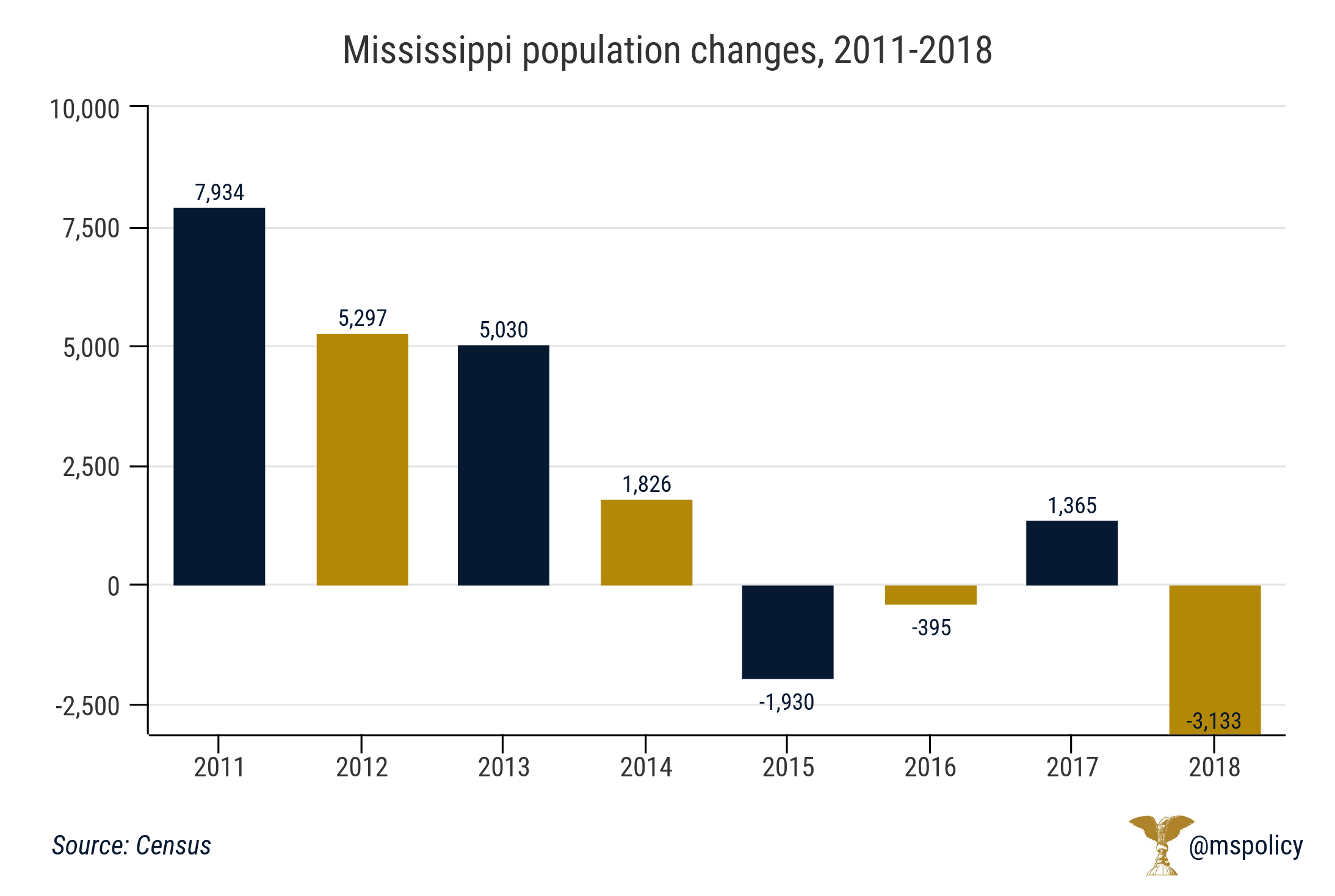
The 2018 population estimate is 2,986,530. Mississippi experienced a short population increase of more than 20,000 residents during the first half of the decade, but the population is now down more than 4,000 people since 2014.
Among other neighboring states, over the past year, the population in Alabama increased by 12,751, in Arkansas it increased by 10,828, and it increased by 61,216 in Tennessee.
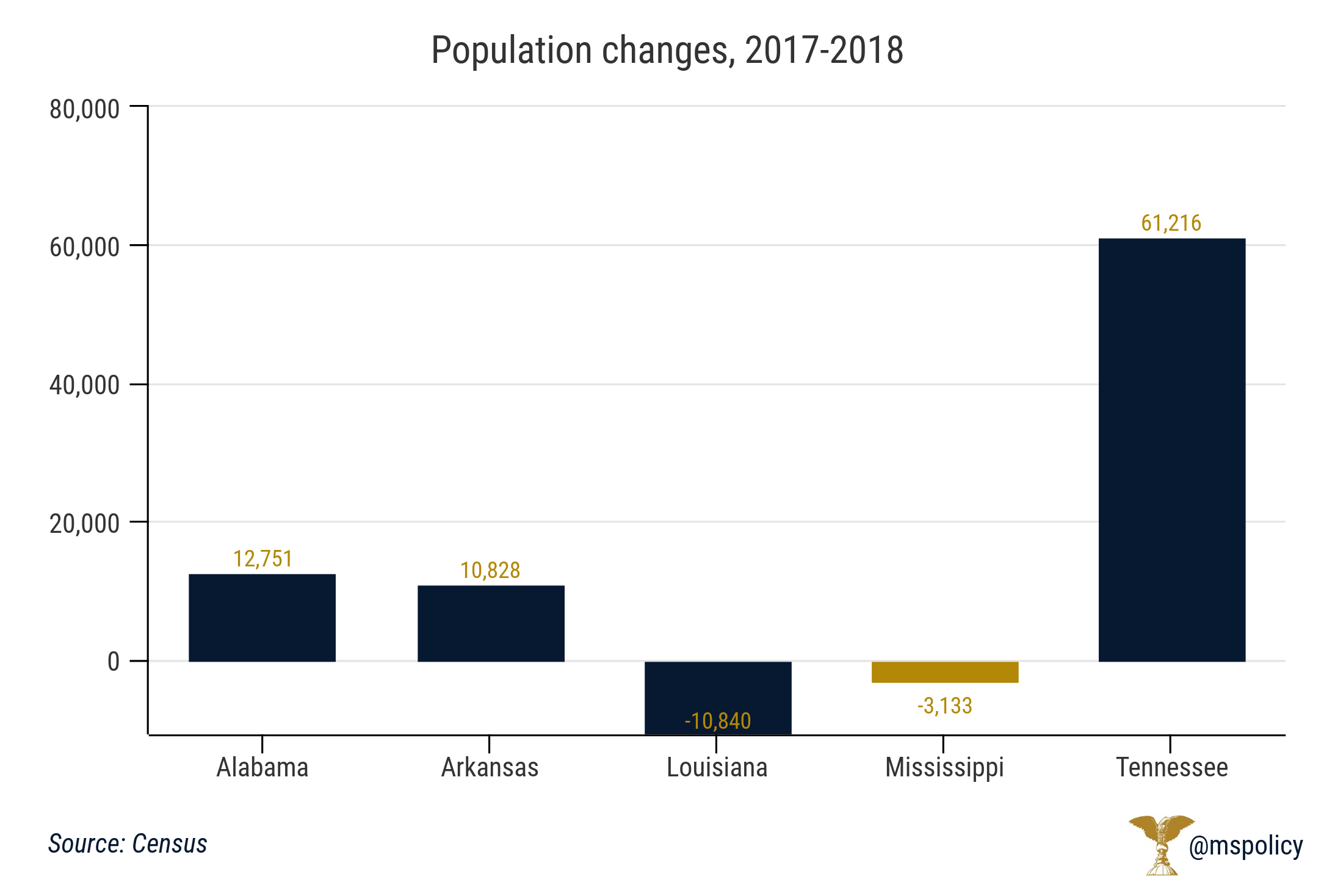
Tennessee’s population boom isn’t a surprise, or anything new. The state has added more than 400,000 residents since the 2010 Census.
And it’s part of a migration trend. People are leaving progressive income tax states and moving to income tax free states. Over the past year, 339,396 Americans moved to no income tax states, including Tennessee. And 292,947 left progressive income tax states.
Mississippians have among the highest tax burdens
As Census data shows, Mississippi’s tax burden is hurting the state. As a percentage of personal income, Mississippians have a state and local tax revenue rate of 10.57 percent. The national average is 10.08 and the Southeast average is 8.57.
Among neighboring states, Alabama has a rate of 8.23, Arkansas is 9.91, Louisiana is 9.22, and the income-tax free state of Tennessee is 7.76. This means Tennessee runs their government for about 25 percent cheaper than Mississippi. Mississippi is the only state in the Southeast, save for West Virginia, over 10 percent. The Mountaineer state is the highest in the region at 11.23.
Mississippi’s percentage has gone up steadily over the past few years. From 2010-2012, it ranged from 9.84 to 9.88. But this trend has, unfortunately, been going in the wrong direction.
The battle to preserve our natural rights of life, liberty and property is as arduous today as it was 242 years ago, when George Washington and his men made a daring defense.
Though we don’t fight our would-be rulers with muskets and bayonets today, we remain in a war to defend our constitutional rights from those who would continue to challenge them.
Our weapons today are different but our commitment to win must be no less earnest.
Our founders understood the high purpose and necessity of such a defense. They knew the opportunity of a constitutional republic was won by their generation but that it would also require an ever-vigilant citizenry to defend it from well-meaning but power-seeking governments, generation after generation.
As active and engaged citizens, we have a role as defenders of the blessings of liberty for all Mississippians. Whether a lawyer representing an entrepreneur who is prevented from starting a business by unnecessary and burdensome regulations, a policy advocate working with members of the legislature to push for limited government, a community activist working to ensure equality under the law, or an ordinary citizen writing an Op-Ed for the local newspaper, we’re all defending our shared blessings of liberty.
These blessings were not granted to us by government; they are natural to each of us as individuals. And none of us can be denied these blessings or given any modifier that makes our blessings preferable or subordinate to any others’.
As we celebrate the eternal blessings of the Christmas Season with family and friends, let’s take the time to think about that incredible crossing on Christmas night, 1776. When the hopes of independence lay in the balance, our country’s first president planned and executed the bold attack on the British.
George Washington led famished, cold, tired men across the Delaware in the darkness as rain turned to sleet and then to snow, and the winds blew without relief. The American colonists prevailed in that fight at Trenton and eventually, thanks to a spirit that would not be subdued, our independence was won.
With that enduring spirit in mind this Christmas season, we should take the time to recognize how rich our blessings are and how worthy of a robust defense is liberty.
As many prepare for end-of-year charitable contributions, data from the Internal Revenue Service continues to show Mississippi as one of the most charitable states in the country.
According to the IRS, some 250,000 Mississippians took an itemized deduction for charitable giving last year. The average deduction in the Magnolia State was $7,135. This is the 12th highest average in the country.
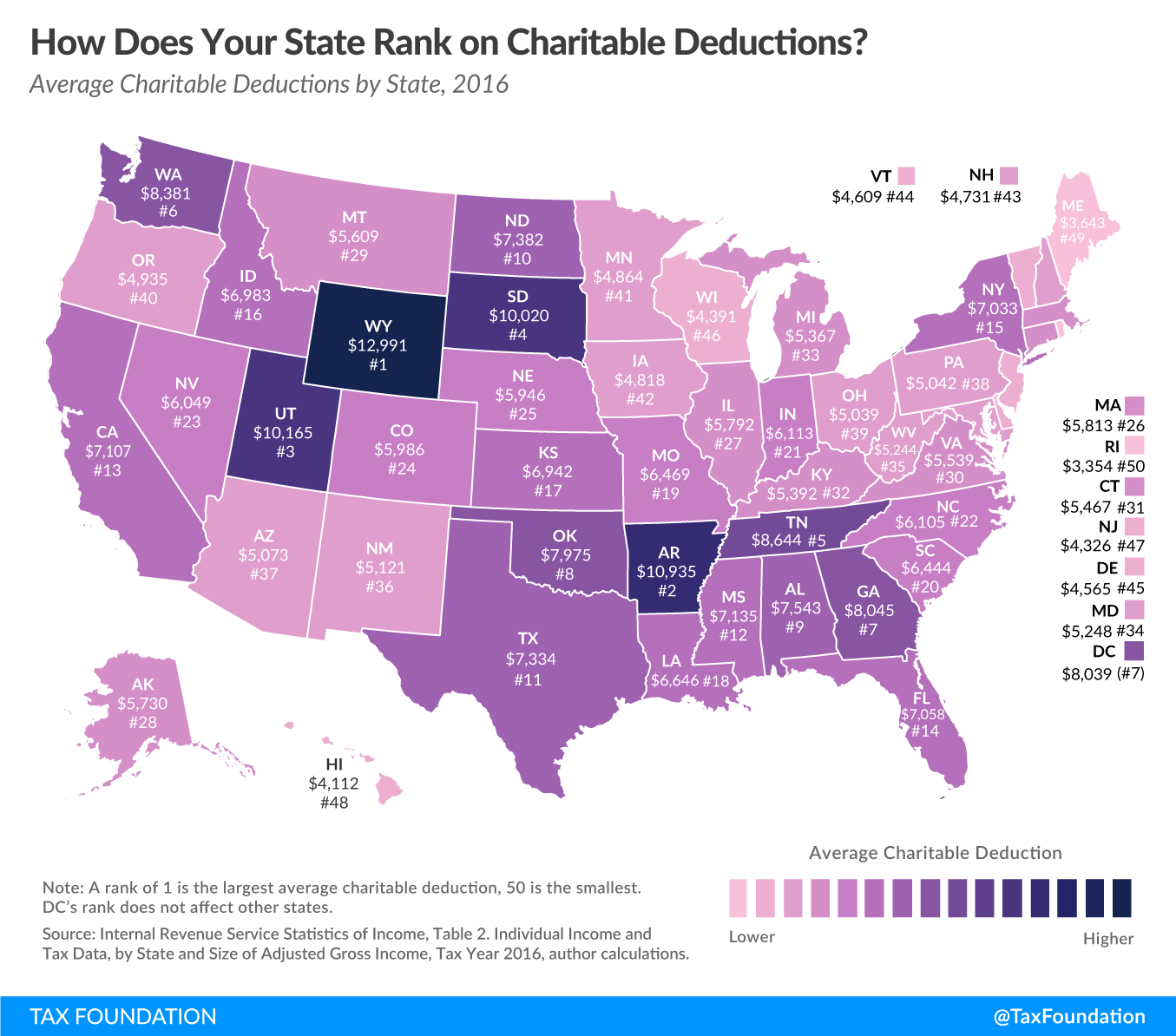
The top five charitable states were Wyoming ($12,991), Arkansas ($10,935), Utah ($10,165), South Dakota ($10,020), and Tennessee ($8,644).
Along with two of Mississippi’s neighbors coming in the top five nationally, Alabama placed ninth at $7,543 per contribution and Louisiana was 18th at $6,646 per contribution.
The five least charitable states were Rhode Island ($3,354), Maine ($3,643), Hawaii ($4,112), New Jersey ($4,326), and Wisconsin ($4,391).
As a note, this isn’t necessarily total amount of giving, but the total amount that eligible taxpayers deducted on their income taxes in 2016. A donation that was made but not reported on tax filings would not be counted in this report.
And as the standard deduction will be increased because of the Tax Cuts and Jobs Act that passed last year, it is assumed that far fewer individuals and families will itemize their deductions this year. That will impact tax filings, but what effect it has on actual charitable giving remains to be seen.