
This column appeared in the Commercial Dispatch on August 25, 2018.
“No one is leaving this special session without getting something.” … Mississippi Legislator
Update: The House has changed course and voted in favor of a lottery Tuesday afternoon, sending the conference report creating a state lottery to the governor.
The 2018 special session took a surprising turn on Monday as the House voted down the state lottery conference report (SB 2001) by a bipartisan vote of 54 to 60. Moments later, the same lottery bill passed the Senate 31 to 17. The conference report was necessary because the Senate declined to agree to a House amendment that left the door open to video gambling. Democrats, led by House Minority Whip David Baria, were also disappointed that the bill does not directly allocate money for K-12 education.
The lottery bill has been held on what is called a motion to reconsider. This means that when the House reconvenes at 12:30, lottery supporters will have another chance to get a majority vote. If the motion is tabled (i.e., defeated), the lottery is likely dead for this special session.
Status of BP money
With the defeat of the lottery bill in the House, it has become clear why the special session call has not yet been expanded to include the so-called BP money. At issue is approximately $700 million in BP settlement funds. Options for the money include allocating a majority of the funds to either 3 (or 6) coastal counties. Or at least some of the money could be sent to all 82 Mississippi counties. Many observers predict a 70%/30% split between the two blocks.
The promise of getting more BP money or the threat of getting no BP money will be used by lottery supporters eager to flip the House vote. Whether this threat has any merit remains to be seen. But it would seem that Democrats have more to gain from delaying the lottery because they can use the issue next year to both advocate for more K-12 funding. They can also fault Republicans for cutting taxes and not spending more on infrastructure. Moreover, while the lottery remains popular statewide, pockets of resistance in conservative areas are fierce. It may even be enough to get some members “primaried.”
Problems with initial bill
The initial lottery bill also left much to be desired, exempting the new lottery board from state public records and open meetings laws. The House addressed this problem by adding transparency language. A House amendment to leave the door open to video gaming also slowed the bill down. This change was opposed by casino operators as well as the faith community, which has thus far voiced muted opposition to the lottery – and this morning may be wondering if they should have done more to oppose the bill.
A decades-old debate, Mississippi would become the 45th state to enact a lottery if the House approves. A lottery board, appointed by the governor, would also serve as the board of the Mississippi Lottery Corporation. It would act as a private corporation domiciled in Mississippi. The lottery is expected to generate about $80 million in annual revenue, with 35 percent of total proceeds going to the state. The remaining 65 percent will go toward administrative costs/paying vendors and prize payouts. It is MCPP’s contention that this 35 percent of revenue is essentially a tax and that the lottery bill is primarily a revenue bill.
The Mississippi Infrastructure Modernization Act
Also on Monday, the House sent HB 1 on to the governor.
HB 1 provides more than $1 billion in infrastructure funding over the next five years. The legislation is the result of two years of negotiation and compromise between the House and Senate, seeking to find a fiscally responsible way to provide sustainable and reliable roads funding. The Mississippi Infrastructure Modernization Act:
- Provides $200 million annually for roads and bridges. Funding will reach $1.1 billion over five years. This money will come from $300 million in new bonds/debt, internet sales tax revenue from the 7 percent online sales tax, a new annual tax ($75 to $150 annually) on hybrid and electric vehicles, and sports betting revenue.
- Of note, raising the gas tax was never part of this package.
There is a common assumption that we often hear about Mississippi government. It is that the government is too small and we have reduced taxes too much. Therefore, revenues are down, and we have less money to spend on key government responsibilities, and that is the reason we trail much of the country in various rankings.
This makes for an easy soundbite, and at first glance it might appear to make sense. But of Mississippi’s many problems, the size of government is not one of them. Indeed, we have relied too much on government to grow the economy rather than enact market based policies that have allowed other states to prosper.
As Mississippi was experiencing minimal growth for more than two decades, other states in the middle of the country were prospering. They grew because of policies that emphasized economic freedom and limited government.
Mississippi has the fifth largest government share of state economic activity, and that is due to state and local spending, not federal funds. While there is a large contingent who would want to see the government spend more, it would actually be pretty difficult.
When the government grows, the state has increased ownership and the private sector shrinks. And economic freedom, which is based on free markets and voluntary exchange, individual liberty, and personal responsibility, wanes.
According to the most recent Fraser Institute Economic Freedom of North America report, which measures government spending, taxes, and labor market freedom, Mississippi was ranked 45th among the 50 states. Similarly, Cato Institute’s Freedom in the Fifty States, which measures economic and personal freedom, placed Mississippi 40th in their most recent rankings.
What is the correlation between economic freedom and prosperity? The freer states are more prosperous, have higher per capita incomes, more entrepreneurial activity, and lower poverty rates. We have the model. We need to just look at what similar states have done for economic growth. And it is important to know the difference between the reality of economic growth and the practice of economic development; those can be very different things.
Government incentives, often in the name of economic development and being ‘business-friendly,’ attempt to lure businesses to the state through financial benefits, such as site preparation, infrastructure, job training, or special tax breaks. The only reason these incentives are necessary is because of higher taxes or policies that burden businesses. Instead of special incentives for a few, Mississippi should work to provide a favorable climate for every business. And let the market decide where a business locates or expands. An economic development officer can sell low taxes and low regulatory burdens to a company looking for a great location like Mississippi. What’s more, the data shows us that such policies allow existing businesses already in our state to expand and grow from a small employer to a large employer without getting any incentives from the taxpayers. That’s economic growth.
Being business friendly isn’t based on who can seek the most favors, it is based on how free your state is.
To their credit, state leaders have attempted to improve the economic climate of Mississippi, most notably through tax and regulatory reform. In 2017, the legislature adopted a new law that will require all new licensing regulations to be approved before they take effect, ensuring new attempts to stifle competition will be reviewed before they are finalized.
And the Taxpayer Pay Raise Act in 2016 will eliminate the 3 percent income tax bracket, allow self-employed individuals to deduct half of their federal self-employment taxes, and remove the franchise tax on property and capital when fully implemented. Even though Mississippi’s overall tax burden is still above the national average, this will move Mississippi closer to a flatter income tax and make our business climate more competitive.
These reforms weren’t easy, but showed forward thinking to align us closer with neighboring states. Making the case for spending more money on your favorite government program is not what is needed to prosper. We need to think much bigger than that. If we want to do better than the bottom ten in categories like per capita income, it starts with doing better in categories like business friendliness, regulatory practices, and tax rates.
In this edition of Freedom In Five Minutes or Less, we talk about the new school LeBron James is opening, innovation in education, and why sending piles of cash to district schools usually does not work.
Gov. Phil Bryant has called a special session to begin this Thursday. Lawmakers will address infrastructure repairs and maintenance, along with the allocation of BP money, according to the governor's call.
“We will be able to add roughly $200 million into roads and bridges in the state of Mississippi,” said Gov. Bryant. “It will start the first year of 2019 and go into $260 million that will grow after that, so you will eventually reach the $300 million, but in the first three years of this plan, we have put over $600 million into roads and bridges in the state of Mississippi without raising taxes.”
Where will the money come from? Dr. Jameson Taylor, Vice President for Policy at Mississippi Center for Public Policy, provides a preview of the special session.
Milton Friedman once said, “Nothing is so permanent as a temporary government measure.” And that certainly includes “temporary” tax increases.
In Mississippi where I live and work, residents in the capital city of Jackson know that very well. Voters recently approved a $65 million bond issue to cover maintenance woes that have long plagued the Jackson Public School District. It was sold by supporters as “not a tax increase,” but a continuation of a previous tax increase from a previous bond measure that had been paid off.
Had voters in Jackson rejected the measure, there property taxes would have decreased five mills. The school district currently has, and will continue to have, the highest taxes in the metro area. Jackson residents pay 84.01 mills to support a school district that has been rated “F” by the state for the previous two years. Residents of nearby “A” or “B” rated districts pay between 54.55 and 67.94 mills.
But what occurred in Jackson isn’t much different than what we have seen throughout the country. And it’s been going on for longer than we probably imagine.
In 1936, Pennsylvania adopted the Johnstown Flood Tax, a temporary 10 percent tax on liquor to help victims of a flood rebuild. It was set to expire on May 31, 1937. That didn’t happen. By 1942, the tax collected $42 million and the town had been rebuilt. The tax remained. Eighty-two years later, the temporary, 10 percent tax is now a permanent, 18 percent tax.
Temporary taxes became very popular during the recession a decade ago. Faced with shrinking revenue, states and municipalities enacted numerous “temporary” tax measures. Many were either made permanent or replaced with new taxes.
In California, personal income taxes were increased by 0.25 percent on all rates and the sales tax rate increased from 7.25 percent to 8.25 percent. They both expired, but were replaced by new taxes via referendums. The sales tax rate was increased to 7.5 percent, a quarter-point increase from the original rate and personal income taxes on top earners were increased.
In Connecticut, a temporary 10 percent corporate income tax surtax was extended twice and increased to 20 percent.
In Delaware, the state temporarily increased the income tax rate for top earners from 5.95 percent to 6.95 percent. By 2014, the increase had been reduced to 6.6 percent as it was made permanent. Residents were still hit with a .65 percent increase. Estate and business tax increases were also made permanent.
In Kansas, sales tax rates were temporarily increased from 5.7 percent to 6.3 percent. The state then reduced the rate to 6.15 percent and made it permanent, reflecting a .45 percent increase.
And more recently in Louisiana, the state temporarily raised sales tax rates from 4 percent to 5 percent. The tax increase was set to expire on June 30 of this year. Instead, the state adopted a 4.45 percent sales tax, a .45 increase from the previous tax rate.
One could argue that many of the recent tax increases made permanent were actually at lower rates than their original temporary hikes; thereby resulting in tax “relief.” This is similar to calling a 3 percent increase to a government agency a “reduction in spending” or a “cut” because the agency had planned or requested a 5 percent increase in its budget.
It’s semantics, and everyone knows it, especially the proponents of the higher taxes. In many places, residents are paying higher taxes than they were prior to the recession. Calling it by another name does not stop it from being a net increase, even if it is slightly less than the “temporary” increase.
The goal, amongst the tax proponents, is for residents to get use to the higher tax and eventually it just becomes accepted. Then when a tax increase expires, or a bond is paid off, a politician or government agency bureaucrat tries to convince you that this new tax increase is not an increase at all, but rather, it is a commendable action to keep your tax rates the same. It’s like magic. Think of it is a slight of words, rather than a slight of hand.
So the next time you hear a politician sell you on a “temporary” tax increase, smile and tell them you’ve seen this act before.
This column appeared in the Washington Examiner on August 19, 2018.
Sending piles of extra money to district schools, either via taxpayers or celebrities, has not produced the outcomes we’re continually promised. Real reform comes from a fresh start.
While LeBron James is and will continue to be recognized as one of the great basketball players of all time, he has also worked tirelessly to become the sports hero of the left. He constantly receives fawning praise from the media, and the few who dare to second-guess him are instantly branded racists.
Ohioans love what James does on the basketball court. His politics? Not so much. In 2016, James took to the campaign trail to stump for Hillary Clinton. She went on to lose the Buckeye state by nine points. Donald Trump accumulated a larger percentage of the vote in Ohio than Barack Obama, George W. Bush, or Bill Clinton ever did in winning it.
As James left for Los Angeles to play basketball for the Lakers, as a parting gift of sorts and to much fanfare he announced the opening a new school for at-risk students in Akron, Ohio. If you only read the press clippings or watched ESPN, you would assume James was paying for the entire I Promise school and its reoccurring costs. This would not be unheard of for wealthy individuals or their foundations.
However, it is a public school, and Ohio taxpayers are footing most of the bill. James and his foundation are spending about $2 million in the school’s first year, and would spend $2 million or more a year as the school grows. But the public school district is still paying more than half the costs, perhaps up to 75 percent. This is all to be determined.
The district owns the building. The district pays for teachers and administrators. The students ride district buses. The district will cover these expenses by shifting students, teachers, and money from other district schools.
Don’t get me wrong, James is doing an honorable thing, but as a percentage of his net worth or annual income, this is the equivalent of the average person making a $500 annual donation to the local church. The important question to consider is: what changes will occur as a result of this outlay?
Can Public Schools Improve Themselves?
Beyond the issue of who is paying, I Promise has no incentive to innovate or be any different than other district schools. The kids will get bikes, and some other perks such as paid college tuition. The school will be operated by the same district it was previously. Union contracts are the same, meaning employment and financial flexibility will still be lacking. The kids will just be in a newly refurbished building.
We’ve seen celebrities dump large amounts of cash into public schools before, with Facebook founder Mark Zuckerberg and Newark, New Jersey as the most recent example. The results? Not so good. The problem?
“Zuckerberg envisioned the teacher contract reform to be a centerpiece of the reform and contributed $50 million — half of his total donation — to go to working on that cause. Zuckerberg wanted to be able to create more flexibility in teacher contracts to reward high-performing teachers and to fire teachers with poor records of student achievement. Those types of protections are determined by New Jersey law, and Zuckerberg couldn’t simply come in and change the rules without going through the state legislature to make the changes,” Business Insider reported.
The New Jersey legislature agreed on some new accountability measures for teacher contracts, but only if seniority protections remained. Seniority rules that require hiring and firing teachers not based on a school’s need for their skills or the teacher’s quality are one of the key barriers to improving public schools.
Billionaires Often Aren’t Very Good at Fixing Schools
This story has been told before. In 1993, philanthropist Walter Annenberg wanted to improve education by spending $500 million on public schools. With matching grants, that total ballooned to $1.1 billion. What was the outcome?
According to an assessment from the Consortium on Chicago School Research, “Findings from large-scale survey analyses, longitudinal field research, and student achievement test score analyses reveal that…there is little evidence of an overall Annenberg school improvement effect.” Essentially, the schools that received Annenberg’s money did no better than peers that did not.
Again, the policies that stifle innovation and progress don’t disappear because a famous person makes a charitable donation. Often, rich people hire advisors from the same system they’re hoping to reform, rather than people with a proven record of benefiting students. After all, spending more money on education is something we taxpayers have been doing for some time. Just look at this chart:
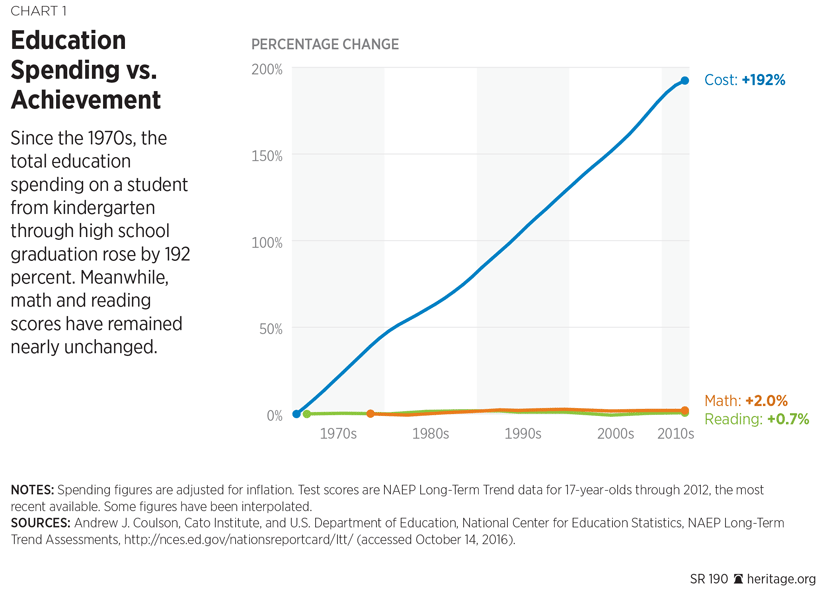
Since 1970, much to the chagrin of those who constantly complain about how much we spend on education, education spending has tripled (adjusted for inflation), while math and reading scores have remained virtually unchanged. In my home state of Mississippi, the increase is closer to “only” 150 percent, which is still not insignificant. The bottom line on test scores, however, follows national trends. Sending piles of extra money to district schools, either via taxpayers or celebrities, has not produced the outcomes anyone would like to see.
Successful Philanthropists Started Fresh
That is because district schools have stubbornly refused to change and been slow to adapt. We have seen educational entrepreneurs and businessmen become heavily involved in the charter and private school markets, rather than in public school reform, with much success. In New York City, Success Academy Charter Schools are showing that every child can thrive if they are in the right environment.
“Of the New York City charter network’s 5,800 students who took a standardized test, 95 percent passed the math test and 84 percent passed reading. As a comparison, 41 percent of New York City’s public school students passed the reading test and 38 percent passed the math test. This achievement comes from a charter school student group made up of 95 percent children of color and whose families have a median income of $32,000. The five-highest performing districts in New York’s public schools have less than 10 percent students of color and family median incomes ranging from $130,000 to $290,000, according to a Success Academy analysis,” education site The 74 notes.
The amazing results continue for students with special needs and who are homeless. Despite the criticisms that any large charter network receives, the network had 17,000 applications for just 3,000 open seats last year. Politics aside, parents just want what is best for their children.
In 2007, North Carolina businessman Bob Luddy opened Thales Academy to provide students a classical education at about half the price of area private schools, or around $6,000 per student. Luddy, who made his fortune as the owner of CaptiveAire, the nation’s leading manufacturer of commercial kitchen ventilation systems, operates Thales like a business.
His schools cost about half of what district schools spend to build. They don’t have auditoriums because those are too expensive to maintain. They save on personnel. Class sizes are larger, demonstrating their efficiency the way a business strives to create more products with fewer employees.
And it’s working. Today, one school has turned into six, with 25 Thales schools in planning stages in Georgia, Tennessee, and Florida. “In business we look at outcomes, did we gain sales, did we please our customers? Schools don’t look at it this way. We have a big building. We have sports. They’re all inputs,” Luddy says. Luddy is slowly working to change that, and he’s seeing a significant success with this innovative approach.
Innovation in Mississippi
In my home state, Cena Holifield had a vision to educate students with dyslexia. So she built a school that provides comprehensive dyslexia therapy for young students, and she did so at a time when most district schools did not, certainly not at the level you can receive at the 3-D School.
Parents from all over Mississippi, and even neighboring states, choose the 3-D School, even if it means breaking up their family for a few years. Because of the demand, the school now has two campuses, the original location near Hattiesburg and one on the coast in Ocean Springs.
T. Mac Howard had the vision of providing at-risk students in the Mississippi Delta with a high-quality education, which is very hard to come by for those without the financial resources. After beginning with an after-school program, he founded Delta Streets Academy, and today boys in Greenwood who otherwise would not have this option can now receive a great education at a minimal cost thanks to Howard’s vision and generous investors.
Those who become involved in education do so for noble reasons. Time will tell if James’ entrance into education is any different than that of other big givers who have spent heavily on district schools. For students and taxpayers in Akron, let’s hope it does. But the evidence makes it look like a very long shot.
This column appeared in the The Federalist on August 20, 2018.
In this edition of Freedom In Five Minutes or Less, we talk about the sharing economy and why regulatory action is bad policy.
The Mississippi Ethics Commission has found that the mayor and the alderman in the city of Natchez violated Mississippi's Open Meetings Act when they entered into executive session to discuss proposals for garbage collection and recycling services.
The Mississippi Justice Institute, along with The Natchez Democrat and private citizens, filed complaints with the Ethics Commission. The ruling calls on the city and the mayor to comply with the Open Meetings Act. One of the core functions of MJI is to hold our government responsible to its citizens. Transparency is a requirement of governing by principle.
MJI's arguments have been affirmed, once again, by the Mississippi Ethics Commission.
The New York Times, and every other media outlet, is free to hire or fire whomever it likes. The members of the management team at the New York Times are free to do or say what they’d like. But they are not immune from criticism for their double standards.
Last week, the New York Times named Sarah Jeong the newest member of its editorial board. This wouldn’t be cause for commotion under normal conditions, she is perfectly aligned politically with the other members of that group.
But shortly after the announcement, her previous racist comments on Twitter surfaced. Most won’t be referenced here because of her language, but I think #cancelwhitepeople tells you what you need to know. I think it is fair to say that if you substituted the word “white” with any other race or ethnicity, Jeong’s comments would have been unacceptable.
So, what did the New York Times do? It reaffirmed support, saying, “The fact that she is a young Asian woman has made her a subject of frequent online harassment.” So basically, she received mean tweets, to which she responded with racists replies, which is now acceptable. (Never mind the fact that many of her comments weren’t, in fact, replies but original statements.) And because she is Asian and female, she is allowed to do this?
So in the eyes of the Grey Lady, we need different speech codes depending on one’s race and sex? That might sound racist to you and me, but this double standard is prevalent among our friends on the left.
It is not unusual. And it extends beyond the traditional news media. We certainly see it in the sports media, which has taken on a politically active tone - much to the chagrin of sports viewers - or former viewers rather.
Two years ago, ESPN fired Curt Schilling as a commentator when he shared a meme mocking policies that allow men to use women’s bathrooms. At the time, the North Carolina bathroom bill was one of the trending issues of the day and Schilling came out on the side of the state, which was the side saying that men use the men’s bathroom and women use the women’s bathroom. Not exactly a radical take.
But for ESPN, Schilling’s speech was not consistent with its political viewpoint- and he was let go.
Enter Jemele Hill, another ESPN commentator, who also caused a stir on social media, referring to President Donald Trump as a white supremacist, saying he’s mostly surrounded himself with white supremacists, and he owed his election to a bunch of racist white people…among other things.
In her case, one of Hill’s bosses, Disney President Bob Iger, came to her defense, saying we need to understand the context for how Hill was speaking. Essentially, following Iger’s reasoning, if you have hurt feelings and a liberal opinion, say what you want. So ESPN doesn’t have a problem with political speech, as long as it’s political speech the boss likes.
If a company wants to be inconsistent in who it hires or which speech it finds permissible, that is its right. As a private company, Disney has a lot of latitude in its human resource decisions. But have the temerity to admit what you are doing. Don’t hide behind a claim of objectivity when your actions demonstrate what you really mean is that conservative speech is unacceptable. Conservatives have certainly gotten that message loud and clear from ESPN. A quick look at ESPN’s declining ratings or Disney’s share price over the past few years would seem to indicate the market has gotten it, too.
We see this same speech bias on college campuses. This is what happens when roughly 90 percent of our national media, and roughly 90 percent of our college administrations, think the same way. You don’t see your own bias when you live in ideological bubbles. This is how CNN can spend weeks ranting about the mean things supporters of President Donald Trump say to them while ignoring actual violence from the left.
Because it is always easier to turn a blind eye when someone you agree with is doing something inappropriate. And that is, unfortunately, the case with the New York-D.C.-L.A. media. That is why most on the right don’t trust and frankly, don’t care, what the national media is espousing.
The world would be a better place if our national media organizations and colleges and universities stopped bowing down to online rage mobs fueled by ideological bias and if such organizations were able to move beyond their bubbles and see that the nation’s viewpoint is actually much broader and diverse outside of places like New York, Bristol and New Haven. But at minimum, maybe they could at least drop the facades and the ridiculous double standards. It’s really insulting the intelligence of the rest of us.
Maybe I’ll tweet about it.
This column appeared in the Madison County Journal on August 8, 2018.