
In Janus vs. AFSCME, the United States Supreme Court issued a landmark ruling in favor of Mark Janus, a government worker in Illinois.
In the ruling, the Court restored First Amendment rights for Janus and all public sector workers. No longer will public sector employees be required to fund political agendas they disagree with. You can enjoy freedom of speech and association, even if you work for the government.
In addition, the way government unions will extract fees from members has changed. The union will now need public sector employees to “affirmatively consent,” or opt-in to pay dues, rather than being required to opt-out, something that unions often made very difficult.
The full impact of Janus on unions will be determined in the future. It is almost guaranteed that they will lose members, and therefore dues, because of the ruling. And by extension, political clout. In “closed-shop” states, those that are not right-to-work, the way the system generally worked was unions helped elect friendly politicians and those same politicians would choose to raise taxes or cut other programs before they would suggest cuts to pay or benefits for government workers. Not exactly a model for fiscal responsibility.
Unions have generally put on a positive front after Janus. But the question has long been, what will they do? Will they moderate in an effort to hold on to members who are not liberal Democrats? After all, only half of all teachers voted for Hillary Clinton. If recent conventions from America’s largest teachers’ unions tell us anything, the problem appears to be that the unions are actually not liberal enough.
The National Education Association (NEA), of which the Mississippi Association of Educators (MAE) is an affiliate, racked up these accomplishments at their recent convention:
- NFL quarterback Colin Kaepernick received the NEA Human and Civil Rights Award. You can view other recipients here.
- Parkland survivor and anti-gun activist David Hogg shared the stage with NEA president Lily Eskelsen Garcia.
- A commitment to promote the Black Lives Matter Week of Action, which includes a mandate that ethnic studies be taught in all grades.
- Support for all teachers to learn how to properly address students by gender; apparently scientific descriptors like “male and female” or “boy and girl” are no longer acceptable.
- Support for removing the names of anyone associated with the Confederacy from schools.
- A call to delay any votes on the pending Supreme Court nomination of Brett Kavanaugh.
- Encouraged teachers to assign readings that “describe and deconstruct the systemic proliferation of a White supremacy culture and its constituent elements of White privilege and institutional racism.”
- A pledge to oppose support for any business that “refuse services to same-sex couples and/ or LGBT individuals.” Who does that include? Well, the Southern Poverty Law Center will help them identify such businesses.
All business items are available for viewing here.
As for the nation’s other large teachers union, the American Federation for Teachers, they also got in on the fun of letting anyone to the right of Elizabeth Warren know they are not welcomed. Or at the very least, they do not have a voice.
In fact, Warren spoke at the convention. Along with her fellow senator, Bernie Sanders. The only person who could top Warren and Sanders was Hillary Clinton, and she was there as well. Among the issues AFT is demanding:
- Single-payer healthcare for all. (A new study showed this would cost taxpayers $32 trillion over the next decade.)
- Free college for all.
- Universal, full-day, free child care for all.
- Doubling per-pupil expenditures for low-income K-12 districts (emphasis on districts, not students).
- Taxing the rich…even more.
This is a crucial time for all government unions, including teachers unions. But they have made it perfectly clear what they are all about;and who is welcomed in their camps. Teachers unions may sounds nice because we all know teachers and we have all been impacted by teachers, but there is a world of difference between what teachers are doing in the classroom and what is coming out of the headquarters of AFT or NEA.
Not only do teachers unions stand against every student-centered education reform measure, they are fully aligned with far left ideology, whether it has anything to do with education or not.
Fortunately, the Supreme Court has spoken and individuals no longer have to pay for and be part of speech they disagree with as a condition of employment.
In this edition of Freedom In Five Minutes or Less, we talk with Claudia Williamson and Brandon Cline, the Co-Directors of the Institute for Market Studies at Mississippi State University and editors of Promoting Prosperity in Mississippi.
Get your copy of Promoting Prosperity by making a donation of just $30. Simply click on the button below and we will get your copy in the mail.
[give_form id="5278"]
Want to learn more? Get your copy of Promoting Prosperity in Mississippiby making a donation of just $30. Simply click on the button below and we will get your copy in the mail.
[give_form id="5278"]
Attorney General Jim Hood has filed a lawsuit against student loan lender Navient alleging “widespread abuses across all aspects of its student loan business.”
Just last month the attorney general of California filed a similar suit. Prior to that, a handful of other states had taken related action against the student loan management corporation formerly known as Sallie Mae. With some $1.5 trillion in student loan debt nationwide, expect to see more states getting involved in the lawsuits.
The lawsuits may or may not be successful, but they simply deflect blame. Neither Navient, nor any other student loan provider, is responsible for students not being able to pay back their loans.
For a few decades now, the belief that every child must attend college has been pushed on students from the moment they enter kindergarten. If you want to be successful, you need a college degree. Any degree will do, just get a college degree the message went.
And for students who were unable to pay for the rising cost of a college education, the government was there to help. By guaranteeing student loans, lenders are at no risk when students take on a loan; just the taxpayers. No 18-year-old, without any collateral, can walk into a bank today and ask for a $100,000 loan so he or she could get a degree in…something. But that is what taxpayers guarantee every day with student loans. At very low interest rates.
As a result, colleges annually raised their tuition, fees, and other expenses, just because they could. When you are receiving student loans, it is as if you don’t see the money. It just passes through like monopoly money and you often don’t realize how expensive everything is. Or how much it has gone up year-over-year.
Colleges can do this because there is no incentive to do otherwise. They gain nothing by lowering their prices. The government has created an incentive to raise tuition without any fear of repercussions. And colleges and universities, for the most part, are only growing.
Unfortunately, student loans are just another area where the government gets involved with noble intentions. This time it was to help people pay for college. But as a result of government involvement, college became a lot more expensive and a college degree lost value.
Of course, part of the reason a college degree may not have value is because of the degree you receive. It seems all too often that those who complain the loudest about their student loans, while asking the government (i.e., taxpayers) to forgive their loans, are those who have degrees in fields that have no application in the marketplace.
Education is valuable. But it is only valuable if your degree prepares you for a career field. And if somebody else actually cares about that field. Too many degrees simply prepare students to be professional baristas at Starbucks.
In a free market society, personal responsibility is imperative. That means you need to decide if college is or isn’t right for you. And don’t just do what the world says. Maybe you’d be better off in trade school. Maybe you start out in community college for two years, where tuition will be nearly free. These are choices everyone should make before enrolling in college.
But in the end, each individual is responsible for his or her actions. And that includes signing your name on student loans. Because lenders aren’t going to stop giving out student loans as long as the government is guaranteeing those loans.
Bob Franco grew up in Vicksburg and never really thought about leaving the state of Mississippi. It was all he knew. One of six children, the family didn’t travel much outside of Vicksburg.
After graduating from St. Aloysius, he moved to Oxford to attend Ole Miss. He then went to work for a couple different companies in the state before a new opportunity took him to New Orleans. And then eventually to Ohio as he worked his way to become the vice president of the $1 billion roofing division of Owens Corning. He would then go on to work for two different private equity firms in Ohio and Kentucky after Owens.
For a small-town kid with humble beginnings, he did pretty well for himself and had a successful career by any measure. And when Bob made the decision to retire, or semi-retire, he made the decision to come back to Mississippi after being away for more than three decades.
Bob didn’t plan to move to Louisiana or Ohio or Kentucky. It is where the opportunity took him. And where he could be as successful as he wanted to be. And as he looks back, and looks at his home state today, are the prospects any better a generation or so later? Has that much really changed?
Where are we starting?
Unfortunately, the current data, across many measures, paints a bleak picture. Mississippi has the lowest per capita personal income in the nation at just over $36,000. Our neighbors are doing better. Arkansas and Alabama enjoy incomes that are 10 percent higher while Louisiana and Tennessee have 20 percent higher personal incomes.
Figure 1: Per capita income in Mississippi and neighboring states
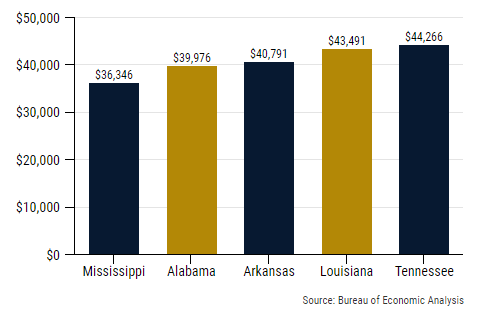
And these numbers are not simply impacted by one area of one state. Those living on the Tennessee side of the Mississippi/ Tennessee border have personal incomes that are, on average, $6,000 higher than those on the Mississippi side.
Over the past 15 years, per capita income, after adjusting for inflation, has grown at a rate of just 1.1 percent in Mississippi. In two separate 15 year periods prior to 2001, the growth rates were 2.1 percent and 1.9 percent. ‘Just one percent’ is not insignificant, and, unfortunately, Mississippi has not kept up.
But what explains these numbers? And what can be done?
Economic freedom in Mississippi
During the same time that Mississippi was experiencing minimal growth, other states in middle of the country were prospering. They did so because of sound policies that emphasized economic freedom and limited government.
Mississippi has the fifth largest government share of state economic activity. Is this just because of our reliance on federal funds? No. When just state and local spending is calculated, Mississippi actually moves up to fourth. This is a state problem, not a federal one. Many incorrectly believe that Mississippi’s problems are rooted in our government spending too little. The data shows that is not the case. It would, indeed, be very difficult to spend more.
When the government grows, the state has increased ownership and the private sector shrinks. And economic freedom wanes.
According to the most recent Fraser Institute Economic Freedom of North America report, which measures government spending, taxes, and labor market freedom, Mississippi was ranked 45th among the 50 states. And unfortunately that ranking is only moving in the wrong direction. In the mid-1990s, Mississippi was on par with the national average. And our per capita income was growing. But since then, the rest of the country has become freer, while Mississippi has become less free.
Figure 2: Economic freedom, Mississippi and U.S. average
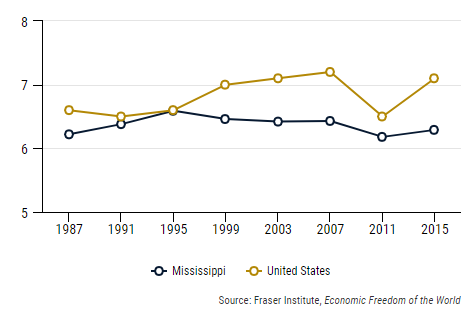
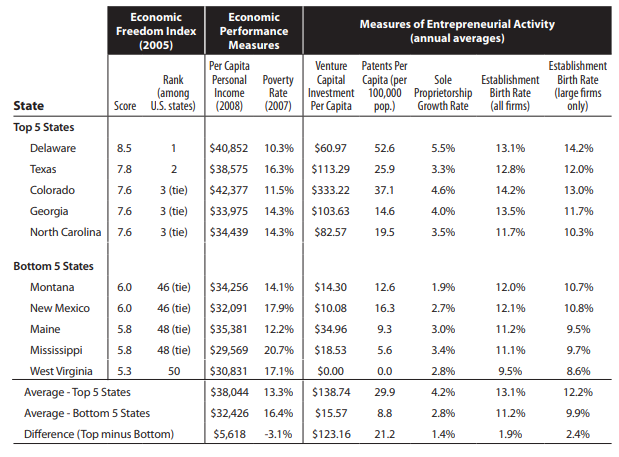
Do these rankings matter? A review of the top five and bottom five states in terms of economic freedom shows the freer states are more prosperous, have higher per capita incomes, more entrepreneurial activity, and lower poverty rates. (The information in the graphic below intentionally uses pre-recession data.)
Figure 3: Economic performance measures
Economic freedom is centered around free markets and voluntary exchange, individual liberty, and personal responsibility. It is not supposed to be managed, orchestrated, and predicted by the public sector.
Government incentives, often in the name of economic development and being ‘business-friendly,’ attempt to lure businesses to the state through financial benefits, such as site preparation, infrastructure, job training, or special tax breaks. The only reason these incentives are necessary is because of higher taxes or policies that burden businesses. Instead of special incentives for a few, Mississippi should work to provide a favorable climate for every business. And let the market decide where a business locates or expands.
Adopting market based policies
CNBC’s 2018 “Top States for Business” rankings painted an all too familiar picture for Mississippi. Mississippi was ranked 49th, a one spot drop from 2017. And the various business ratings generally correlate with freedom ratings. The more freedom, the more business friendly a state is. And the more the individuals in the state prosper.
Market based policies work. And state leaders have attempted to improve the economic climate of Mississippi, most notably through tax and regulatory reform. That is significant and they should be applauded. Yet at the same time, this past year the legislature attempted to make it more difficult to become a real estate broker, a measure backed by the Realtors Association. There was no impending threat to homebuyers via rogue brokers; rather it was an attempt to stifle competition. While the bill sailed through the legislature, it was rightly vetoed by Governor Phil Bryant.
There is still much work to do. The instincts are not always in the right directions. But there are reforms the state could adopt, including:
- Reduction or elimination of personal and corporate income taxes
- Simplified and fairer tax system that does not just reward those companies with a powerful lobbying presence
- Reduction of existing occupational licensing restrictions
- Enhancements of personal property rights
- Elimination of business subsidies
- Expansion of school choice programs
It can be done
Bob Franco is no different than many others who grew up in Mississippi only to search for opportunity elsewhere. But policy reforms can change everything. We can create more opportunity and see more people moving in than moving out. We have the blueprint. A blueprint based on sound evidence of what states have done to grow over the past couple decades. The blueprint is freedom and free markets, supported by a limited but effective government.
Moving briskly with the right policies, Mississippi leaders can cast a vision for a better future that increase incomes and improves quality of life. And it can be done within a generation.
In our first edition of Freedom In Five Minutes or Less, we talk about our upcoming Liberty Luncheon on Thursday, July 26.
A survey of Tennessee’s voluntary state funded preschool program found statistically significant negative results for children who enrolled in the program compared to those that did not.
There have been numerous studies on early childhood education in the past that proponents will likely point to in an attempt to discredit this survey. But this is the first randomized control test, or “gold standard” study. Because the program was oversubscribed, researchers were able to randomize the sample and provide a control group.
As we have often seen, this study showed some positive effects on student achievement at the end of preschool, but those gains have dissipated as the children enter elementary school. Specifically, by third grade, the survey found statistically-significant adverse actions on student math and science achievement and no significant effects on reading achievement.
These results don’t mix with the popular narrative of the day: that preschool is a wonderful thing, it is popular, and we would be better off if every parent began enrolling their child in a program at three years old. And because parents aren’t doing this, that is why their children may struggle when they hit kindergarten. That is the message from many politicians and the media.
Mississippi is headed in that direction
Mississippi began its journey into state funded preschool five years ago. Proponents celebrated that we were “finally” doing something. At the time, Mississippi Center for Public Policy was one of the few groups willing to speak out against such a program. As is often the case, legislators push a program because it sounds good or feels right without looking at the unintended consequences.
Mississippi has many wonderful private preschool providers. Many are run by churches, others by private schools or some other private enterprise. But they are competing with one another. They compete for students and the tuition needed to stay in business. That is healthy.
And parents can then choose the best program- for their family. That decision may be based on curriculum, or some other factor that is important to them such as whether the program is three days or five days or if it is a half day or full day. And it will usually involve talking with friends or scouring Facebook or other websites for reviews.
Beyond that, preschool isn’t necessarily the preferred early childhood education format for every family. Data shows it’s not and we see parents becoming very flexible for their children. If one parent can’t stay at home full time, many parents adjust their schedule so one parent can always be at home. Or they start working from home. Or they have relatives or friends watch their child. Again, there are options that families are taking advantage of.
Parents still offer the best childcare
For those who are fans of regulations, you will like the Tennessee program. The state mandates the minimum length of daily instructional time and the maximum size of a classroom. All teachers need a state license and each school has to choose among a set of approved curricula. So, very much like elementary and secondary school. And the results weren’t that much different.
What children need are involved parents. This has not changed, and will not change. Family is the building block of society and parents are responsible for raising their children. Children who stayed at home in Tennessee were better off than children who were enrolled in the program.
The debate today is similar to any time large government programs were born and expanded. In the 1960s, there was a perception that families and churches aren’t meeting all the needs for those in poverty, so the assumption is that government must step in. That’s the wrong step to take.
Yes, poverty programs solved some short-term problems, but they created the long-term perception that government was going to take care of people, inadvertently leading to more single-parent families. And the poverty rate remains virtually unchanged.
There is a belief that if something is wrong then only government can solve it. And as time passes, the government program only becomes larger and the private or non-profit sector shrinks before it disappears. We then begin living under the impression that this is government’s responsibility, regardless of how poorly government is functioning.
A parent friendly solution
Many parents like the idea of state funded early childhood education because it would remove a financial burden. That is understandable, but the state can do that without usurping the role of the private sector, and the family. And moving children from a good setting to a free, but poor, setting.
The federal government offers tax credits to help with childcare costs, and the state could do something similar. Rather than investing tax dollars in programs at state approved preschools, that same money could be returned to families for their child’s needs via tax credits. Families would be helped, the private sector would flourish, and government would not be expanded.
Pregnancy centers in Mississippi are providing free support and services for women that will eliminate the demand for abortion, regardless of any new rulings from the Supreme Court.
It is a wonderful time to be a pro-life Mississippian. It’s an even greater time to be a pro-life Mississippian with passion for free markets. The Center for Pregnancy Choices- Metro Area, with two Jackson locations, is a force to be reckoned with for our state’s abortion industry.
In fact, the Fondren and Frontage Road centers may just be the thing that makes Mississippi the first abortion-free state in the nation.
Supreme Court’s latest decision on pregnancy centers brought us closer to that reality than ever
If it were not for the Supreme Court rulings of Roe vs. Wade and Doe vs. Bolton, Mississippi would likely already be free from the requirement of legal abortion. Time and time again, abortion laws have passed our state legislature, often with the tireless work of the Mississippi Center for Public Policy, only to be halted by activist judges, and ruled as “undue burden” in the 5th Circuit Court of Appeals. The “undue burden” that halts the courts from ruling in favor of our state’s wishes refers to women needing to leave the state to find doctors who will commit abortions. It takes time to overturn court decisions, pass legislation, and see court seat changes.
The Center for Pregnancy Choices- Metro Area isn’t willing to wait for court processes to end abortion in our state. Private donors, churches, and local community groups fund free services that wipe out the demand for abortion far before the courts catch up to the conscious of Mississippi residents. With one lone abortion facility in our state, Jackson Women’s Health is standing on one leg.
The death of over 2,500 Mississippi babies annually takes place in the famous “pink house” in Fondren. Nearly half of the women obtaining abortions are from Hinds, Madison, and Rankin Counties. To put that in perspective, 1 in 7 pregnancies end in abortion in the tri-county area. Despite being a pro-life state, despite our overwhelmingly pro-life legislature, and despite our Bible belt reputation, abortion remains a reality for thousands of women in our state.
This is where The Center for Pregnancy Choices- Metro Area penetrates the market—with compassion and practical care
The CPC Metro Area offers medical-quality pregnancy tests, high-quality sonograms, counseling, literature, parenting classes, referrals to community services, infant supplies, and prenatal vitamins for free. Conversely, the JWHO abortion facility charges hundreds of dollars for consultations, sonograms, and counseling all pointed towards their highest profit product: abortion. They do not offer support for women desiring to carry their pregnancies to term. Under the banner of “choice,” women often enter and leave JWHO feeling as though abortion is their only choice.
The nurses and staff of The Center for Pregnancy Choices- Metro Area journey alongside pregnant women of all ages, races, and backgrounds to ensure they are informed of all resources available to them. A woman who enters the CPC Metro Area is counseled by a trained professional to hear her story and educate according to her needs. She will then receive a free sonogram, where she will be able to see her baby. She will leave with prenatal vitamins and literature to help make her decision. This woman can return or call back for help at any time she needs to be heard. Following her decision to carry to term, she can enroll in free parenting classes to prepare for her unplanned parenting experience and receive supplies such as diapers and clothes as incentive for participating. Following her decision to abort, she may still return for post abortive healing sessions with a group Bible study.
When a woman learns that there are ways to meet the needs of her unplanned pregnancy, she often feels the relief of not having to go to the pink house across the street. Instead, the entire staff celebrates her, her pregnancy, and her child.
Heavy, burdensome regulations threatened the freedom of pregnancy centers like The CPC Metro Area around the nation
The narrow 5-4 NIFLA vs. Becerra decision to protect the rights of charitable pregnancy centers is monumental. The law in question placed burdens on pregnancy centers that would force their staffs to betray their own conscience and offer confusing, conflicting information. Pregnancy resource clinics would have been mandated to include information on how to obtain abortions and, if not medically licensed, required to display a lengthy disclaimer in several languages that they do not employ medical professionals.
These charitable organizations, that save states millions of dollars with their non-governmental services, were to be treated as “fake clinics” with ulterior motives. Imagine visiting a salad bar and noticing mandated advertising of the burger joint next door. This is the world the “pro-choice” community wanted for pregnancy options. Instead, the court ruled that it was indeed the right of the pregnancy centers to offer their free services without the burden of intrusive advertisement regulation.
With Justice Kennedy’s seat pending for confirmation, many Americans are hopeful that the courts will catch up to the desires of states to determine their own conscious on abortion legality. In the meantime, the Center for Pregnancy Choices- Metro Area will be here, in Jackson, meeting the real needs of Mississippi women.
English statesman William Wilberforce and his Clapham Sect that started the movement to end the slave trade believed that culture is upstream from politics. Mississippi, the Hospitality State, the most philanthropic state in the nation, and arguably the most pro-life state in the nation, is that culture shift. We will rise up and meet the needs of women beyond the date that politics catches wind of our success.
Colleges and universities, both public and private, have long fashioned themselves as beacons of academic freedom. The place where ideas are to be discussed and debated, and conventional wisdom is challenged and deliberated. A place where various and diverse opinions are welcomed, and the young men and women, who will soon enter the workforce, are better off because of that experience.
Now, back to reality.
That sounds like a wonderful utopia, but we know the unfortunate truth. We know that too often academic freedom is only extended to one side of the political spectrum.
And ideas are not to be debated. Rather, one ideology is to be the truth and everything else is wrong, and usually bigoted, racist, and sexist for good measure.
Conservative speakers are regularly shouted down or shut down. In some instances, we have even seen small riots. And colleges have little appetite for supporting freedom of speech that they don’t like, nor do they care to protect the speakers themselves from the riotous mobs.
After all, if the bulk of the administration, faculty, and student body all think the same way, they see little reason or benefit to accept differing points of view; even as college leaders claim to promote academic freedom.
But a recent state Supreme Court ruling in Wisconsin just might strike a blow for academic freedom in America. Actual academic freedom; not just freedom in name only.
A professor at Marquette University, Dr. John McAdams, was effectively terminated for posting an opinion of a political topic on a blog that differs from the administration. The case is pretty simple. A graduate instructor, Cheryl Abbate, listed gay rights as an issue that “everybody agrees on” and “there is no need to discuss it.”
When a student, at this Catholic university, approached the instructor for debate, she called the student homophobic and said she was “invited to drop the class.” The student told McAdams about the encounter and he then wrote about it on his blog and named the instructor.
After Abbate received hateful messages, the school rallied behind the instructor. McAdams had to go in front of a Faculty Hearing Committee and suspension was recommended. The president of the university then added that McAdams could not be reinstated until he signed a letter saying his blog post was “reckless and incompatible with the mission and values of Marquette University.”
He declined.
That is where the lawsuit began. With the help of the Wisconsin Institute for Law & Liberty, McAdams won his case as the Supreme Court declared that the decision to fire McAdams violated Marquette’s own promise to protect his academic freedom.
Marquette is a private university. Private enterprises should have broad latitude on employment policies. A religious school, for example, should not be forced to hire a faculty or staff member who is of another faith or is atheist. Just as an employer should be free to require his or her employees to stand when the National Anthem plays.
But a university cannot make up the rules as they go along. Nor can they selectively enforce policies to fit what they do or don’t like. If a university wants to offer its professors academic freedoms, such professors must be allowed to say what is not popular among the administration or faculty.
This ruling represents one professor at one college in Milwaukee, Wisconsin. And as the new school year begins, there will certainly be new examples of conservative students or speakers who have had their rights restricted. But the hope is that in a world where the left has virtually unilateral control, liberty and freedoms may emerge.
And freedom of speech may enjoy a platform on our college campuses, again.