
This is an excerpt from School Choice: How to Unleash the Market in Education by Brett Kittredge. It was published in Promoting Prosperity in Mississippi.
Mississippi is adding the words “In God We Trust” to its license plate, and that has sparked some interesting debate. Much of that debate focused on an idea we have come to accept as gospel: that we have an American tradition of separating religion and politics. We do not. We have been misinformed and misled by generations of public policy, education, and media leaders on the so-called “separation of church and state.” The concept has been so pervasive that we generally accept the idea that it is inappropriate to bring any faith-based ideas to the public square. The idea that we should separate religion — of any faith or denomination — from politics is not only false, it is virtually impossible.
The arguments in favor of this separation arise from Thomas Jefferson’s 1802 letter to the Baptist Association of Danbury, Connecticut, in which he used the phrase. However, that letter, and the metaphor, have been granted meaning that Jefferson never intended. With proper historical context and examination, it is clear that Jefferson, a major proponent of religious liberty, never envisioned anything like today’s interpretation. If anything, Jefferson’s metaphorical wall was meant to keep the state from violating the individual liberty of religious conscience. Washington and Lee University’s Sam Calhoun, Professor of Law and Associate Dean, put it this way: “[Jefferson’s] wall was meant to insulate religious belief and practices from legislative interference, not to separate religion from politics.”
In the 1947 case Everson vs. Board of Education, Supreme Court Justice Hugo Black wrote, “The establishment of religion clause of the First Amendment means at least this: Neither a state nor the Federal Government can set up a church. Neither can pass laws which aid one religion, aid all religions, or prefer one religion over another.” The late Supreme Court Chief Justice William Rehnquist agreed with Justice Black. Rehnquist believed the Establishment Clause was only meant to prevent the establishment of a national church and the state giving preference to one religious group over another. It was not intended to exclude faith-based ideas from political discourse. In America, these ideas can be informed by any faith and any denomination, or by no faith at all. What we must reject is the Faustian idea that any public policy ideas that come from a faith-based perspective are invalid.
If we think about the public policy arguments that have made the biggest difference in improving our society and promoting individual liberty, freedom, and opportunity, we find religion and faith-based reasoning. Jefferson, Hamilton, Lincoln, Martin Luther King, and many others who opposed slavery made faith-based appeals on that issue. It is absurd to think that we should restrict our views of what is right and wrong to the private sphere only. In fact, we should question the motives of anyone who wants to dismiss another’s public policy ideas simply because those ideas are informed by a faith.
Yes, I’m a conservative. Well, actually, I’m a “conservatarian,” but more on that at a later date. Yes, I’m a Christian. No, I don’t want the government to endorse my ideas simply because some of them may be informed by faith. My argument is not that government should support a religion. In fact, it is the opposite. We need a more limited government. We need a government that is less intrusive in all matters. We should stop petitioning the government to solve most of our problems — including ones better solved by private institutions and free markets. The more we ask of government, the less freedom we have.
What I seek is government more in line with what Jefferson intended when he wrote about the wall of separation. He was intending to protect us from the state’s involvement in religion. He was not trying to prevent us from expressing religious views in public policy. In America, and in Mississippi, we must be open to diverse points of view, even to views with which we disagree. In that great tradition, we therefore must not dismiss views influenced by religion under the false notion that we are committed to a separation of church and state. We are not, at least not the way you think.
Jon L. Pritchett is president and CEO of the Mississippi Center for Public Policy, the state’s non-partisan, free-market think tank.
Arizona is the closest model to a free market education setting in the United States. Today they have five private school choice programs serving nearly 70,000 students. That number is likely to increase in the coming years after the legislature expanded the state’s ESA to universal (but capped) eligibility over a several year phase-in period. They also have more than 15 percent of public school students attending a charter school.
Arizona has over 600 charter schools with more than 200 charters opening since 2010 alone. Yet at the same time 100 charter schools were also closed.30 Remarkably, most of these failing schools have not being closed by the state, but rather by parents. If parents believe their child is not getting a great educa- tion, they are voting with their feet. Those schools that closed lasted, on average, just four years and had an average of 62 students their final year. Parents in Arizona enjoy school choice, and they are able to make immediate decisions about their child’s future. If a school is not performing at a level they believe it should, they do not have to wait for it to improve. They can simply move on.
And the charter schools in Arizona, with light regulations, are now competing with the most highly regarded district schools in the country. The 2015 National Assessment of Educational Progress (NAEP) scores show charter students in Arizona are nearly even with Massachusetts and ahead of New Hampshire, Minnesota, and New Jersey, which are states that spend among the most in the country per student.
At the same time, students in traditional district schools have experienced similar gains. In fact, Arizona led the nation in growth on the NAEP science test from 2009 to 2015. While Arizona has spent two decades providing families access to public and pri-vate school choice, all students have seen a benefit.
It turns out, when parents are given the opportunity to choose the best school for their children, children in both schools of choice and traditional district schools do better.
In a small way, Mississippi has seen the market effects of a school choice program. The 3-D School in Petal, MS is a specialty school that provides comprehensive dyslexia therapy services for students. Many of the families receive either the Dyslexia Scholarship or Special Needs ESA to help cover the cost of tu- ition. Because very few schools offer the services they provide, some families travel up to four hours per day roundtrip for their children to attend the school. The school has now opened a second location on the Gulf Coast due to this demand created by the school offering a high quality product and the scholarship programs that make the school more affordable for families.
Jon Pritchett talks with Jim Thorn of WYAB on May 2, 2018

Listen to the Segment
"Eternal vigilance is the price of freedom." It's easy in a political campaign or a legislative session to focus on issues of the moment. But a statesman — one who is worthy of being lauded by future generations — will guard the foundation of freedom we inherited from those before us. He will not succumb to emotion or pressure to compromise that foundation in the name of short-term political gain. He will take seriously his responsibility as a steward of the foundation, carefully monitoring its stability and measuring its vulnerability to the proposals that come before him.
Such a statesman will lead, not follow. He will listen to his constituents, to be sure, but when they ask for something that would compromise the foundation, he will vote according to his responsibility as a steward, and he will explain to his constituents the long-term negative effect of their request. Similarly, a statesman will listen to the chosen leaders within his own political body (a committee chairman, presiding officer, etc.), but if they ask or pressure him to compromise the foundation, he will resist them as well. To do otherwise is to be a follower who is blown and tossed by the political winds, whichever direction they may blow.
Mississippi is in desperate need of leaders who will govern by principle. We need them now, and we need to cultivate more of them for our future. That's not to say there are none currently in office; but those who are already in office need allies who will fight the good fight alongside them, encourage them, and infuse them with a renewed passion for freedom. Together, they can explore principled ways to improve our state and serve their constituents—and do so in a manner that preserves the integrity of the foundation.
Our nation's Founders knew that the only way to form and maintain a stable nation was to build it on principles of freedom and to entrust it to men and women who would protect those principles from eroding over time. In 1776, when Thomas Jefferson, John Witherspoon, and others set their pen to the parchment that declared America's independence from Great Britain, they stood on principles about the nature of man, civil society, and government passed down from such minds as John Locke and Edmund Burke, and influenced by the precepts of the Bible. The result was a Declaration of Independence that is unrivaled in its timeless ability to inspire those who yearn for freedom.
Unfortunately, in recent generations, the ideas conveyed in that document have been largely forgotten or ignored—or, in some cases, treacherously abandoned. The freedom for which our Founders pledged their "lives, fortunes, and sacred honor" is endangered by a growing misunderstanding of the proper role of government in the lives of its citizens—and the proper role of citizens in the exercise of governing. This loss of grounding in the citizenry is not only reflected in many of its elected officials, but in many cases, drives those officials to ignore timeless principles and follow the impulse to "do something—anything!" to solve a temporal problem. The result is further erosion of the freedom and the type of government our Founders sought for us.
It doesn't have to be this way. By returning to the principles that guided our Founders, we can restore their vision, even as we apply it in modern ways to our generation. That can happen only if we have leaders in our homes, communities, and elective offices who understand the principles and live by them. The goal of this primer is two-fold: first, to inspire leaders to govern by principle with integrity, honor, humility, and restraint; and second, to equip citizens with the tools they need to hold their elected officials accountable to these timeless principles.
This is an excerpt from Governing By Principle, MCPP's ten principles to guide public policy.
Many free-market think tanks believe it is counter-productive for think tanks to engage in the culture wars. They think our time should be focused exclusively on policy research, legislative outreach, and legal action. And while those activities are important for limiting government and encouraging individual flourishing, we should also be engaged in the war taking place in our culture.
The reason culture wars are important is, while policy, political, and legal actions tend to be lagging indicators of what is happening in our society, culture is a leading indicator. Culture signals what people believe and what they value. Want to know where our world is headed? Don't look to the halls of Congress or the Mississippi Legislature. Politicians follow the lead of the masses. Instead, look to the most popular TV shows, movies, and sports stars. They are shaping how people think about what is morally right and fair.
Presently, the progressives (opponents of free markets and limited government) dominate discussion in the culture wars. If conservatives and libertarians fail to engage on culture, we will lose when it comes to policymaking and litigation down the road. The fight begins in the culture.
Fighting progressives in the culture wars is akin to weeding your garden. If you want to grow a beautiful flower, you need to feed it sun, water, and nutrients, but you also need to remove weeds. If left unattended, invasive weeds can grow stronger. If not pulled early, they can take root in the soil and begin to compete with your flower. Over time, weeds can steal the water, sunlight, and nutrients. They can become bigger, taller, and stronger than your precious flower. While we focus on nurturing the fragile flower of liberty, we also must fight the weeds of collectivism, liberalism, and progressivism.
I'm encouraged by the culture debate that took place in NFL stadiums about national anthems last year. While progressives have infected the arts, higher education, Hollywood, and news, we still have a chance to keep sports inoculated from the disease. Until recently, sports have maintained their status as a great unifier of people from different backgrounds. No matter our race, color, sex, age, country of origin, or political interests, we share a love for our teams. As NFL owners, players, ESPN, and ESPN's parent company, Disney, learned the hard way, sports consumers want their sports delivered free of social commentary and political opinion. If a consumer wants political analysis, there are plenty of other channels.
The NFL controversy was just a small skirmish in the larger culture war. There will continue to be social justice warriors who are constantly in search of a victim to protect. There will still be virtue signalers who want to show how compassionate they are but ignore the broader consequences of their actions. Folks will continue to do things like sit for a national anthem, for instance, even if it erodes a unifying, patriotic gesture that should be used to bring us together. But the NFL skirmish showed those with traditional values could win. There is a time and a place for rigorous debate about social policies. That time is not during the national anthem of our nation's sporting events. If nothing else, perhaps we preserved the joy of watching live sports delivered to our devices without political interruption. It remains to be seen how long the defense will hold, though. We must keep fighting.
|
|
Getting it Right for Mississippi Families and Employers:
MCPP Proud to Support Criminal Justice Reform Law
The Mississippi Center for Public Policy (MCPP) is putting families first by encouraging efforts to get young men and fathers back to work. Last year, we made tremendous strides toward this goal by passing gold-standard welfare-to-work reforms. Mississippi’s progress in this area, in part, inspired President Trump to issue an executive order yesterday promoting welfare-to-work standards for federal entitlement programs.
We are also working to strengthen and reunify families by supporting criminal justice reforms that help ex-offenders obtain and keep jobs. One such package of reforms, HB 387, was signed into law today by Gov. Phil Bryant.
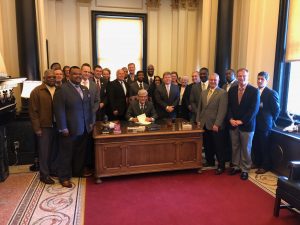
Dr. Jameson Taylor attends bill signing of HB 387
HB 387 builds on the successful model of criminal justice reform passed in 2014 by the Mississippi legislature. Owing to these reforms, according to analysis by The Pew Charitable Trusts, Mississippi has benefitted from:
- A more than 10 percent decline in our prison population.
- A renewed focus on violent offenders, who now occupy 63 percent of prison beds, as opposed to 56 percent previously.
- A 5 percent decline in the property crime rate, along with a historically low violent crime rate.
HB 387 reduces red tape that sometimes prevents former inmates from getting and keeping jobs. For example, the law requires parole officers to accommodate parolees' work schedules. HB 387 also requires a one-time census of county jails so lawmakers can better understand how to deal with this population.
HB 387 was sponsored by Rep. Andy Gipson (now Commissioner of Agriculture and Commerce), assisted by Rep. Joel Bomgar and others. The legislation was also supported by a broad coalition of organizations (see letters below), such as Right on Crime, Prison Fellowship, and the Mississippi Faith Advisory Council. In particular, Americans for Prosperity played an important role in supporting HB 387. MCPP was happy to help with their efforts. Please join us in celebrating this victory and applauding Gov. Phil Bryant for supporting smart and effective criminal justice reform.
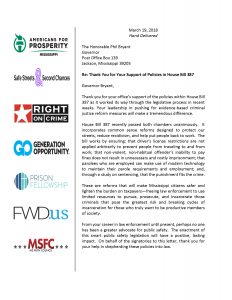 Coalition letter supporting HB 387
(Click to read full letter)
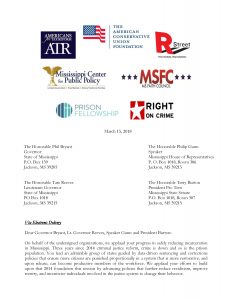
Coalition letter supporting criminal justice reforms
(Click to read full letter)
|
|

|
|
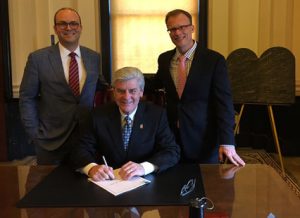
Ron Matis, Gov. Phil Bryant and MCPP VP for Policy Dr. Jameson Taylor
|