
The Inflation Reduction Act does nothing to reduce inflation. Seldom in America’s history has there been a piece of legislation put before Congress so inappropriately named.
If the Inflation Reduction Act was really about tackling inflation, you might expect it would say something about monetary policy. Nope. Or maybe it would change the Federal Reserve’s terms of reference. None of that.
What the Act does do is spend $739 billion. Add that to the $1.9 trillion that this administration has already spent in the name of COVID recovery, and we’re talking some serious money.
Over half ($369 billion) of the Inflation Reduction Act’s $739 billion spending will go to “fighting climate change”. The Act seeks to reduce CO2 emissions by roughly 40 percent by 2030.
According to an analysis by Princeton university’s Zero Lab, the bill would reduce greenhouse gas emissions by 6.3 billion metric tons over the next 10 years. It would do this by subsidizing a massive increase in solar and wind power production. The amount of energy that the US produces using wind and solar power is set to increase from 15 GW of wind and 10 GW of solar in 2020 to almost 40 GW of wind and 50 GW of solar by 2025 – 26.
“Great!”, I hear you thinking. “America would, at last, be producing lots of cheap, renewable energy”.
It won’t be cheap. Unless the Act is able to change the laws of physics, the cheapest way to generate electricity will remain through burning oil, natural gas or coal. If wind and solar were cheaper, the federal government would not be having to spend billions subsidizing the switch.
Here in Mississippi, energy companies are able to charge consumers what it costs them to produce electricity, plus a profit margin (of about 10 percent). In other words, producers do not really have much incentive to produce electricity as cheaply as possible when they know they can pass the cost on to their captive consumers.
Having the local Public Service Commissioners rubber stamp the price fixing process is no guarantee that it is done in the interests of consumers.
What Biden’s latest boondoggle will do is offer local Mississippi energy companies even more incentive to open solar and wind production plants, safe in the knowledge that they can benefit from the federal subsidies and that they can continue to pass on additional costs to ordinary Mississippi households. Various vested interests must be salivating at the prospects.
“But what about the new jobs the bill will create?” some will ask. Lobbyists for various vested interests in our state will be quick to point out that the Inflation Reduction Act will create thousands of clean energy jobs.
The idea that this Act will ‘create jobs’ is a fallacy. As Daniel Hannan recently pointed out in the Telegraph, back in the mid-nineteenth century Frédéric Bastiat used the ‘broken window’ argument to show that you do not make a town rich by smashing up its shop windows. Breaking all the windows might generate lots of economic activity as the shopkeepers rush to employ every available glazier. But what that would do is merely divert labor and capital from other more productive activity. So, too, with Biden’s new Act, which will divert labor and capital from more productive activity and engage them in activity that is inherently expensive and wasteful.
The Inflation Reduction Act represents another step toward the steady socialization of America.
For the past 20 years, Europe has subsidized a switch away from oil, gas and coal toward solar and wind. Renewables have been subsidized and oil, coal and natural gas production are often outright banned.
Today it is becoming increasingly clear that this has been a disaster. Not only are solar and wind simply unable to generate enough energy to keep Europe warm, what they do produce is hideously expensive. So expensive that much of Europe’s manufacturing plant is likely to have to shut down for periods of the coming months.
At the precise moment Europe’s energy disaster starts to unfold, the Biden administration seems determined to emulate it. America deserves better.
Getting the chance to work at Mississippi Center for Public Policy has been a summer well-spent, to say the least.
My knowledge of the intricacies of the policies that have created our great state has grown tremendously. I have not only learned where our state could improve, but also how these policies need to be implemented, and the exact measures to take.
My knowledge of communications has had a huge learning curve as I was exposed to areas of content creation in the media, political technicalities, and advertising which were entirely new and valuable assets to carry on into my future career, whatever it entails.
I hope that more young Mississippians can get involved with the Mississippi Center for Public Policy, whether it be through the internship program or the new leadership academy which I had the privilege to get to work on these past couple of months. MCPP is well-led, well-researched, and well on track to providing our state with the right policy-based solutions. It was an incredible learning experience for me, and I know that others would be lucky to receive the same tutelage as I did through such efficient mentors.

The Mississippi Center for Public Policy staff attended the Neshoba County fair this week.
While there, MCPP networked with several elected officials and other policy groups, as well as celebrated some of our state's wins throughout this year, such as the historic income tax cut.

Mississippi has had a conservative super-majority for about a decade. What do we have to show for it?
To be fair, income taxes have been cut. Last year saw a universal occupational licensing law, making it easier for people to move to our state. Mississippi passed a law to combat Critical Race theory. Nor should we forget that our state managed to avoid the sort of draconian lockdowns we saw elsewhere.
These are important accomplishments, but like many in Mississippi, I can’t help thinking that conservatives in our state ought to be able to do so much more.
Our state still ranks 50th out of 50 by many measures. We do not just need bold ideas to change this. Conservatives need to do a much better job of working together to achieve common goals. This is why we have started the Mississippi Leadership Academy.
The Leadership Academy aims to encourage the next generation of leaders in our state. We will introduce them to some of the significant public policy challenges our state faces, as well as to some key institutions and individuals that impact public policy in our state.
Our carefully designed six-step program will give young leaders the skills and knowledge they will need to be agents of change.
Participants in the program will meet many of our state leaders. They will spend time learning about the legislative process in Jackson and look at how laws are made. We want those that take part in the program to appreciate how a lack of economic liberty has been holding back our state.
I am delighted that we have a great lineup of participants, who will contribute to the program. These include State Auditor, Shad White, Chip Pickering, several nationally recognized thought leaders and leading academics.
The program will be run out of our offices in Jackson and begin in October, and the application process had just opened via our website. Those that are accepted will be expected to commit to spending one day per month on the course.
The liberty movement in Mississippi could be a far more effective force for change. We could try cutting the tax burden to make us competitive compared to Tennessee and Texas. Instead of expanding the size of the state bureaucracy, we could cut it by shutting down many of those boards and commissions that clutter up Downtown Jackson.
If federal handouts made a state wealthy, ours would be the richest state in the Union. Rather than looking for more federal funding, we could have lighter regulations to stimulate growth.
If West Virginia and Arizona can introduce school choice, why can’t we?
The rising generation of leaders in our state needs to mobilize and push for real change.
I am confident that those that graduate from the program will have had a first-class introduction to the public policy process in our state. They will also have the opportunity to build a network of contacts among current and future leaders within our state.
If you are interested in applying – or if you know of any young Mississippians that have an interest in public policy and the future of our state - please do apply right away.
Applications for the Mississippi Leadership Academy 2022-23 program can be found on our website at mspolicy.org/leadership-academy
Since moving across the Atlantic to run the Mississippi Center for Public Policy, I have led successful campaigns to:
• Cut the state income tax, resulting in both the largest tax cut in Mississippi history and a flat tax.
• Enact a law to combat Critical Race theory consistent with liberty.
• Reform occupational licensing, making it easier for skilled people to work here.
Low tax, liberty max – this is what real conservatism looks like. If only folk back in Britain were offered real conservatism!
In recognition of our success in building a mass movement that made these wins possible, the Mississippi Center for Public Policy has been nominated for an award – but we need your support to win.
Please vote to make sure Mississippi wins!

Thank you!
(Jackson, MS): The Mississippi Center for Public Policy’s success in helping push through the largest tax cut in Mississippi history has been recognized nationally.
The State Policy Network today shortlisted the Mississippi Center for Public Policy, together with Empower Mississippi, for an Outstanding Policy Achievement Award for their work in securing the passage of the Mississippi Tax Freedom Act 2022.
Thanks to the Tax Freedom Act:
- $525 million was returned to Mississippi taxpayers.
- Over a million income taxpayers in our state are better off.
- Mississippi will have the fifth lowest marginal income tax rate among states that have an income tax, and one of the lowest top marginal income tax rates in the southeast.
The Mississippi Center for Public Policy was additionally shortlisted for a national Communications Excellence award for building a mass movement that made change possible. Almost 90,000 individual Mississippians read our weekly newsletter each month and thousands watch and listen to our audio-visual output.
The public will now vote to decide if Mississippi will win the Communications Award.
"We face strong competition from some of the larger states” explained Douglas Carswell, MCPP CEO & President. “We really need Mississippians to vote online to make sure that Mississippi wins!"
Please vote to make sure Mississippi wins!
Here is the URL to vote: https://spn.org/2022-communications-award-vote/
"I am over the moon that we have been recognized nationally for both our policy work and for creating a mass movement for change!" said Carswell.
"Mississippi has historically had a high tax burden, and as recently as 2021 not even a majority of Republican lawmakers in the Senate favored the change,” he explained.
"We saw an opportunity in bringing many of the key policymakers in our state together and creating a coalition for change," Carswell said. "We published rigorous research and launched a campaign to popularize the case for change. As a consequence, the Mississippi Tax Freedom Act did not just pass in the legislature where it had previously died. It passed with bipartisan support."Further details about both award nominations can be found here:
- Policy Award: https://spn.org/blog/2022-bob-williams-award-finalists/
- Communications Award: https://spn.org/blog/2022-communications-award-finalists/
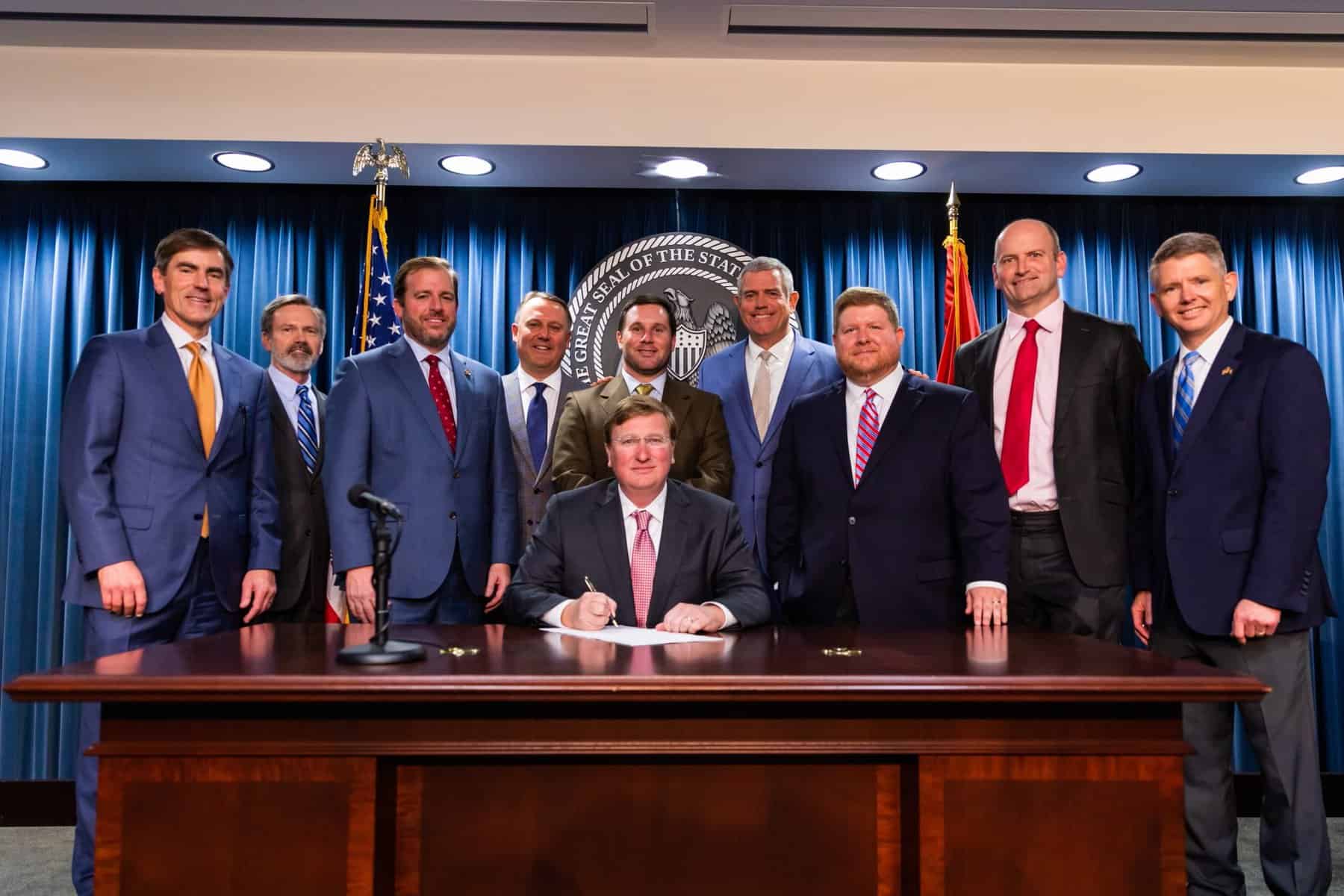
Douglas Carswell joins the Governor, Speaker Gunn and others at the signing into law of the Mississippi Tax Freedom Act.
Oxford Rotary Club hosted a lunch meeting with Douglas Carswell, President & CEO of the Mississippi Center for Public Policy on Tuesday.
A former Member of the British Parliament, Carswell talked about American exceptionalism – and why respect for the US Constitution was so important.

The Mississippi Center for Public Policy announced the launch of the Mississippi Leadership Academy today.
The Mississippi Leadership Academy is a six-step program designed to equip college student leaders with the skills and knowledge necessary to be effective change agents within the state. The program will run out of the MCPP offices, conveniently located in the capital city, beginning in fall 2022 and ending in May 2023.
The Leadership Academy is a way to inform, educate and connect the rising generation of Mississippians to the free market and the realm of policymaking. It will introduce participants to some of the key institutions and individuals that impact public policy in the state, as well as gain experience and see real-world government action.
“Mississippi needs change if we are to stop being 50th out of 50,” MCPP CEO & President Douglas Carswell said. “Our Leadership Academy aims to help us achieve policy change by supporting future leaders for our state. We have put together an exciting program that introduces participants to the key challenges we face.”
Students can apply for the academy through the MCPP website at mspolicy.org/leadership-academy.
We have an impressive lineup of speakers for the program, including State Auditor Shad White, Chip Pickering and several leading academics, opinion formers and policy experts.
Upon graduation, students will have made connections with student peers, as well as our state’s preeminent thought leaders, and will graduate from the program better prepared to defend American principles, enter the workforce and lead. Aside from learning about policymaking in our state, a key aspect of the program is to encourage and inspire young Mississippians to stay, live and work in the Magnolia State.
“Mississippi has had a conservative super majority for a number of years,” Carswell said. “The Leadership Academy aims to foster a shared sense of mission and purpose as to how we might use the majority to deliver real change.”

For media inquiries, please reach out to Tyler B. Jones, [email protected].
The U.S. Supreme Court just finished its term, and the left could not be angrier. Gun rights were upheld when the Court ruled that the government does not get to decide why people can carry guns, religious freedom endured when the Court ruled that a coach has the right to privately pray on the football field, and the ability to protect the right to life was returned to the states when Roe v. Wade was overturned.
Now, House Democrats have introduced legislation to expand the Court to create a liberal majority. Congresswoman Alexandria Ocasio-Cortez called the Supreme Court “illegitimate.” The call is growing louder to completely abolish the Supreme Court in its entirety. As also shown by the push to abolish the electoral college and the Senate filibuster, when the left does not get its way, its solution is to change the rules to ensure that they do next time.
However, there is a way to be pro-abortion and anti-Roe or anti-gun but agree with the Court’s pro-second amendment ruling. In fact, some of the justices of the Supreme Court might have just given the states the green light to enact laws with which they personally do not agree. All opinions on abortion, guns, prayer, or any other political issue are irrelevant in deciding a case. What matters is constitutionality.
Is Mississippi’s abortion ban after 15 weeks constitutional? The Supreme Court ruled that it is in part because the Constitution never mentions abortion. It ruled that New York’s gun law, which required that gun owners prove their reasoning for owning guns, was unconstitutional in part because the Constitution clearly enumerates and protects the right to keep and bear arms. The same can be said about prayer.
Article I of the Constitution gives the legislature the ability to make laws. Because the left cannot sell the public on their radical ideas, they rely on unelected jurists to carry out their agenda for them. That is how the three liberal justices routinely rule. However, Article III of the Constitution lays out clearly that the Supreme Court is meant to interpret the law, not make the law. As then-Judge Amy Coney Barrett said, “It’s never appropriate for a judge to impose that judge’s personal convictions, whether they derive from faith or anywhere else, on the law.”
Along with the federal government, the scope of the Supreme Court has grown too big. It issues national decrees, barring states from making their own laws based on inferred rights found nowhere in the Constitution, such as abortion. In Marbury v. Madison, Chief Justice John Marshall ruled that the Court has the power to strike down unconstitutional laws, which is called judicial review. This power, when used correctly, safeguards states’ and citizens’ rights from a tyrannical government. When misused, however, it bypasses people and their votes to create de facto legislation. Thankfully, the Court is just now beginning to undue faulty precedent and return power to elected lawmakers and localities.
If you disagree with a law that does not specifically contradict the Constitution, do not depend on the Supreme Court to make it go away. Instead, vote for whomever most closely reflects your values to the legislative branch of government, the ones who make the law.