
When something new comes along, everyone suddenly has to have an opinion about it. Often the same one.
When crypto went mainstream, people who had never owned so much as a share were suddenly holding forth on bitcoin. When Ozempic arrived, people who had never once expressed a view on weight loss were just as eager to share the very same thoughts. Now it is AI’s turn. No conversation about it seems complete until someone has solemnly used the word “hallucination.”
AI is utterly transformative. A vastly bigger deal than almost any innovation that came before. As big as the invention of writing, or the industrial revolution — only all at once.
Whether you run a business, a club, a school — or a think tank, as I do — it is going to upend a great deal of what we take for granted. Who you hire. How you delegate. What outcomes we should even expect from our employees. It lets you work almost at the speed you can think — fast enough that knowing when to stop becomes a discipline in its own right.
My own journey with AI started where everyone’s does — marveling at how my newly opened account acts as such an awesome search engine. Call it the “Does anyone still use Google anymore?” stage: you put your new tool to work running glorified Google searches. Great fun — but if that is as far as you get, you could be forgiven for thinking the whole thing overhyped.
The second stage of AI is when you start using AI as a writing tool. This is where those who talk about hallucinations tend to be. And it is, frankly, the least interesting thing about AI. Sure, it is excellent for editing and polishing what you have written — but not the other way round, with you editing what it writes. That is the surefire route to slop.
The third is the realization that you can do things techies spent years learning to do. Figure out how to program an agent to perform one complex task, and it can then perform that same task again and again — at a scale, and a speed, no human team could match. Information and expertise that once belonged only to those at the top of society are coming within reach of everyone else. The social implications of that are at least as large as the economic ones.
Perhaps my all-time favorite TV show is Young Sheldon. The running joke throughout every episode is that Sheldon, the brilliant boy genius, is able to figure out extraordinary things, yet is forever tripped up by the mundane. Treat AI as you might Sheldon: super smart, but dumb enough to misread the obvious.
The fourth stage of AI comes when you realize an agent can handle a great deal of your existing workflow. Instead of getting you or your team to do the donkey work, you farm it out to your new AI employee — one who never tires, and shows up on time, every time, ready to put in a full day’s work.
The fifth stage arrives once you start asking what you might automate that you never imagined could be automated at all. At MCPP we are beginning to do precisely this, in all sorts of weird and wonderful ways.
This week it was reported that AI software built by Palantir has saved hundreds of lives at a hospital in Florida by catching the signs of sepsis before doctors could. No miracle cure: the system simply reads the data already flowing through the hospital and prompts preemptive action.
Now picture the same logic applied more widely. Imagine AI scanning the records of every American over a certain age, picking out each one whose cholesterol sits in the danger zone, and ensuring they are offered statins — a few dollars a day — to bring it down. AI need not conjure something out of nothing to be transformative, but to merely take the knowledge already sitting in front of us, ignored, and put it to work.
The sixth stage of AI follows when you work out how to automate the autonomous agents themselves, so that they more or less manage one another. Ask me how that is going in a few weeks…
So where might all this lead?
I am an optimist. I think Jeff Bezos is right. Far from causing mass unemployment, AI could leave us with a shortage of workers.
Yes, there will be disruption. Anyone who fails to adapt could lose out. It may not be much fun for those whose only skill is coding. But there will also be an enormous increase in output. Every one of us has some sort of comparative advantage, and AI lets us do far more with what we have than ever before.
The result could be far greater prosperity for all — provided we let energy producers produce, rather than strangle them in red tape, and provided we steer well clear of European Union-style control from the top down. The EU’s GDPR goes a long way to explaining why so much AI innovation is happening on this side of the Atlantic, and so little on the other.
One final thought. Energy policy is about to matter more than almost anything else. AI runs on power — vast and growing amounts of it — and the states and nations that produce energy cheaply and abundantly are the ones that will get to build the future. Those that hobble their energy producers will be left watching from the sidelines.
It was a particular pleasure this week to welcome Gad Saad and his wife to Mississippi.
Gad is one of the most important conservative thinkers writing today. His new book, Suicidal Empathy: Dying to Be Kind, is published next month, and I am the proud owner of a signed copy.

Gad Saad's new book is an instant bestseller!
Host of the Saad Truth podcast, Gad is now connected to the University of Mississippi's Declaration of Independence Center — one of the emerging citadels of intellectual excellence in American higher education today.
Gad is not just another academic. His work really matters to the future of the West.
How postmodernism quietly took over the West
For several decades, postmodern ideas hatched in the seminar rooms of 1960s France have been percolating through American academia — and from there into the corporate world, the public sector, the press, the courts, and the schools.
Postmodernism teaches that there is no objective truth and no shared moral order, only competing perspectives shaped by power. From that follows cultural relativism: no culture, no tradition, no inheritance can be judged superior to any other. By the time the rest of us noticed, these insane ideas had quietly become the unofficial creed of the Western managerial class.
This is how so much of America went "woke." These ideas encouraged a generation of young Americans to embrace identity politics — to stop seeing themselves as free individuals in charge of their own destinies, and instead to define themselves by where they sit in a hierarchy of victimhood based on race and sex.
The result is profoundly demoralizing — in two senses of the word. It has stripped us of confidence in our country and our culture. And it has made it literally harder for people in positions of authority to exercise moral judgement at all.
Allan Bloom warned us of this forty years ago in The Closing of the American Mind. Until now, however, the conservative movement did little to stop it.

Signed by the author…
What "suicidal empathy" means
Gad has dissected the way postmodernism turns empathy with the marginalized into the supreme moral test. He calls it suicidal empathy — an irrational form of altruism that hijacks our moral judgement.
The result is a society that protects criminals over their victims, privileges illegal migrants over citizens, condemns self-defense as toxic, and lets feelings outrank facts. Aimed at the wrong target, in the wrong dose, empathy does not save a civilization. It dismantles one.
Why this work aligns with Mississippi
What Gad is doing aligns with what we are doing here at MCPP, where we run programs that teach young Mississippians about American exceptionalism and the moral case for the free market. Our illustrated children's book, What Makes America Special, aims to teach 7- to 10-year-olds the truths that will protect them from the woke mind virus in later life.
As Mississippi's economy flourishes, it is increasingly clear that our state has led the way on free-market reform. Perhaps now we need to lead the way on an even more important mission: the recovery of the American mind — and the defeat of divisive, "woke" ideology.
Thank you, as always, for standing with us.
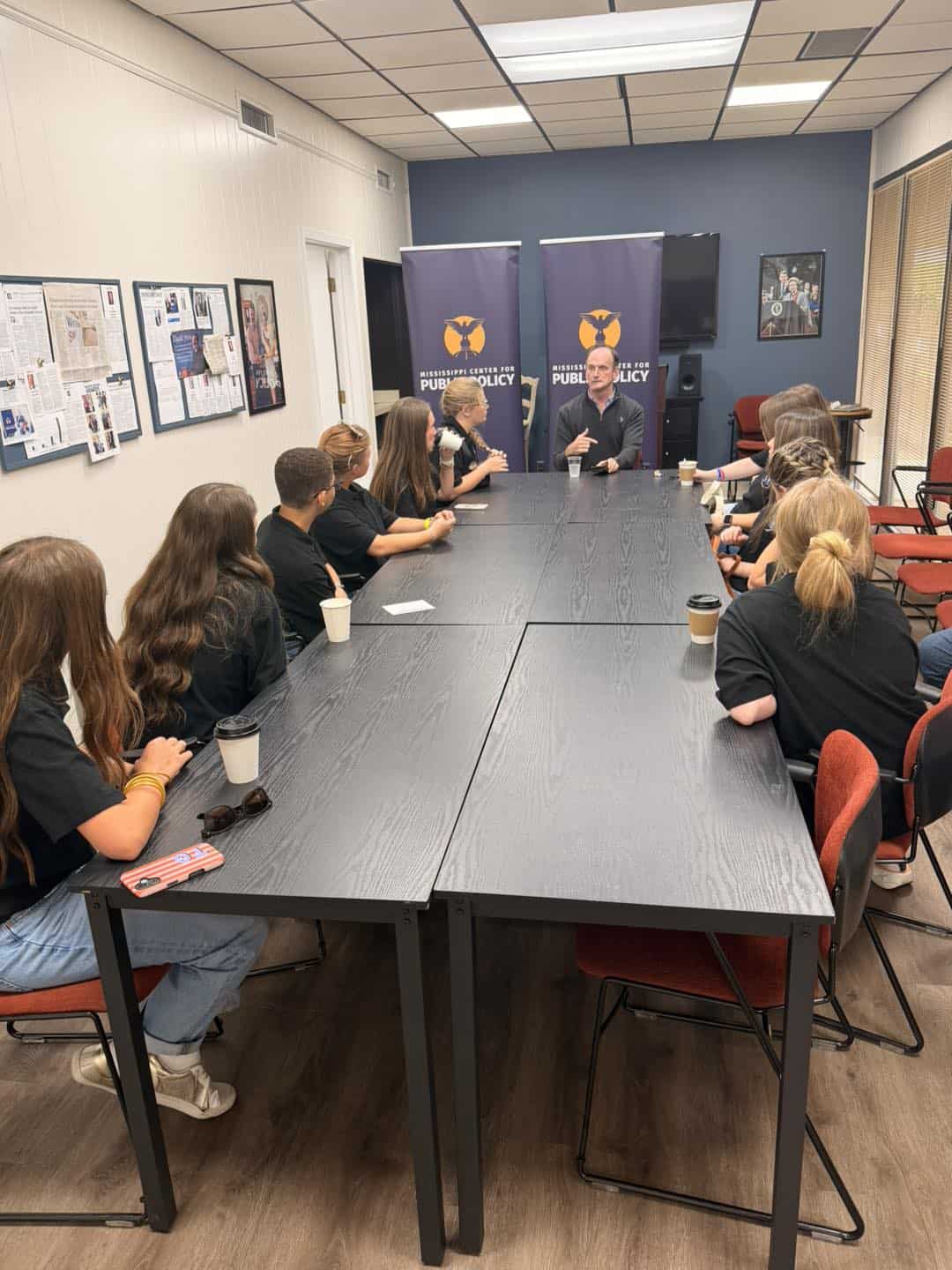
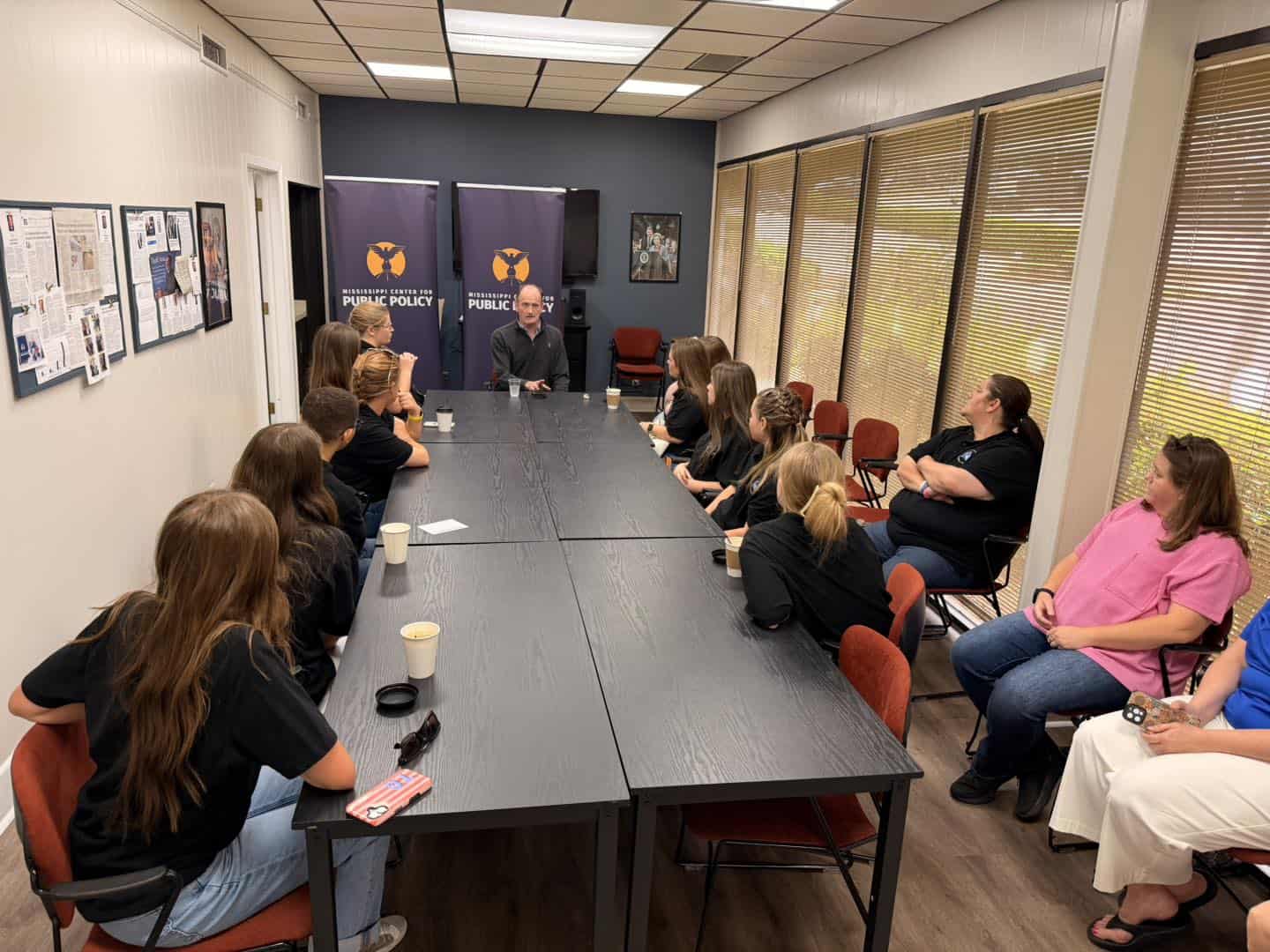
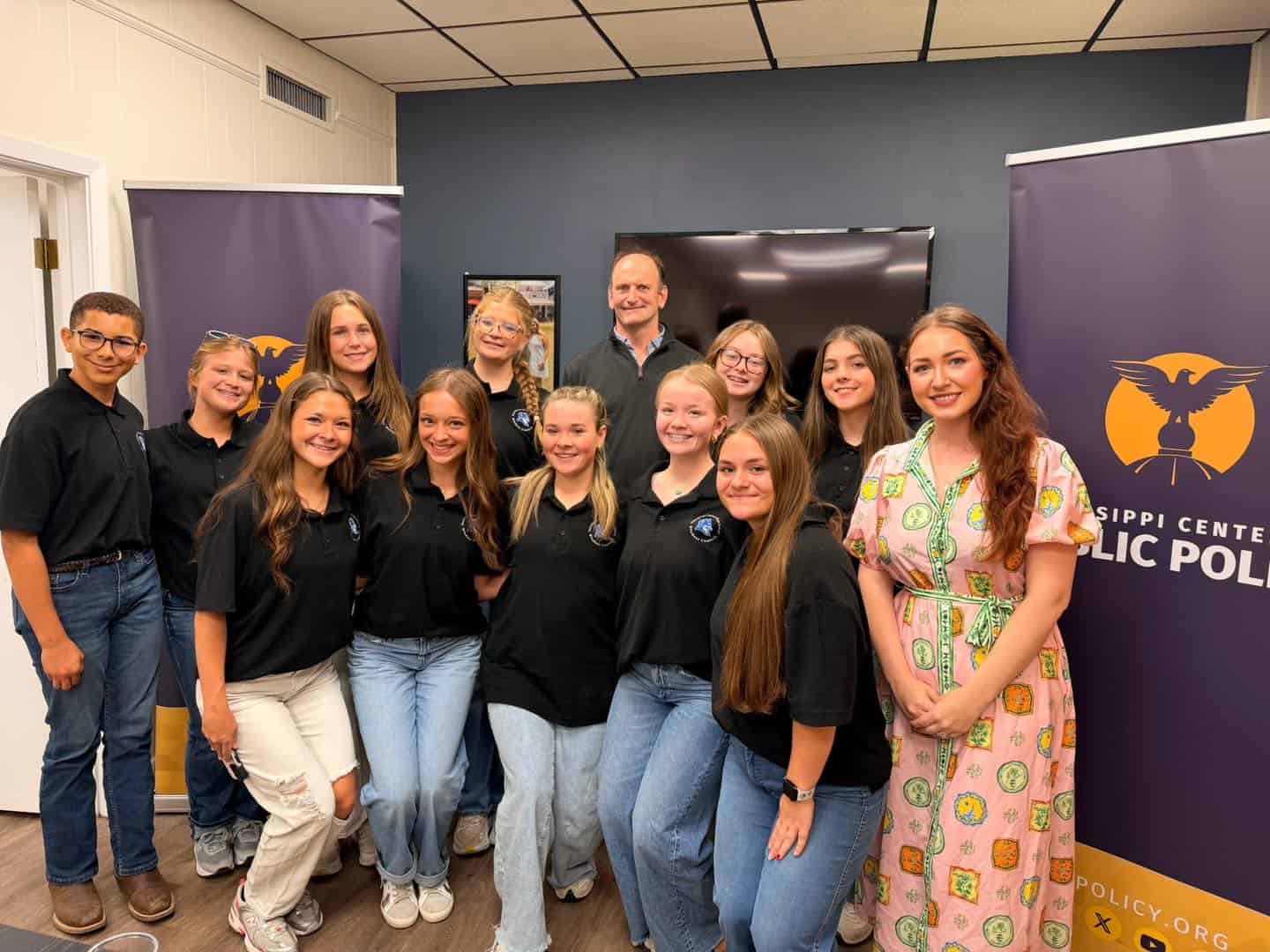
In April, we had the opportunity to welcome students from Pearl River County High School’s Student Council to our office during their visit to Jackson.
As part of a broader trip to tour the State Capitol and meet with legislators, the group made time to sit down with Douglas Carswell and our team to learn more about the role of a public policy organization and the work we do at the Mississippi Center for Public Policy.
The visit centered around a roundtable discussion covering how think tanks operate, the principles that guide our work, and how policy ideas move from conversation to implementation. Students engaged directly with our team, asking thoughtful questions about the challenges facing Mississippi, the importance of free markets and limited government, and the practical side of advancing policy solutions.
What stood out most was the level of engagement—from both the students and the educators accompanying them. The discussion was curious and encouraging, reflecting a strong interest in understanding how ideas shape real-world outcomes.
Opportunities like this matter. Creating space for young people to ask questions, engage with policy, and better understand the institutions shaping their state is an important part of building informed, thoughtful leaders for the future.
We are grateful they chose to spend part of their time with us, and we look forward to seeing where their leadership journeys take them.

While others debate these ideas from a distance, we’re in the room teaching them.
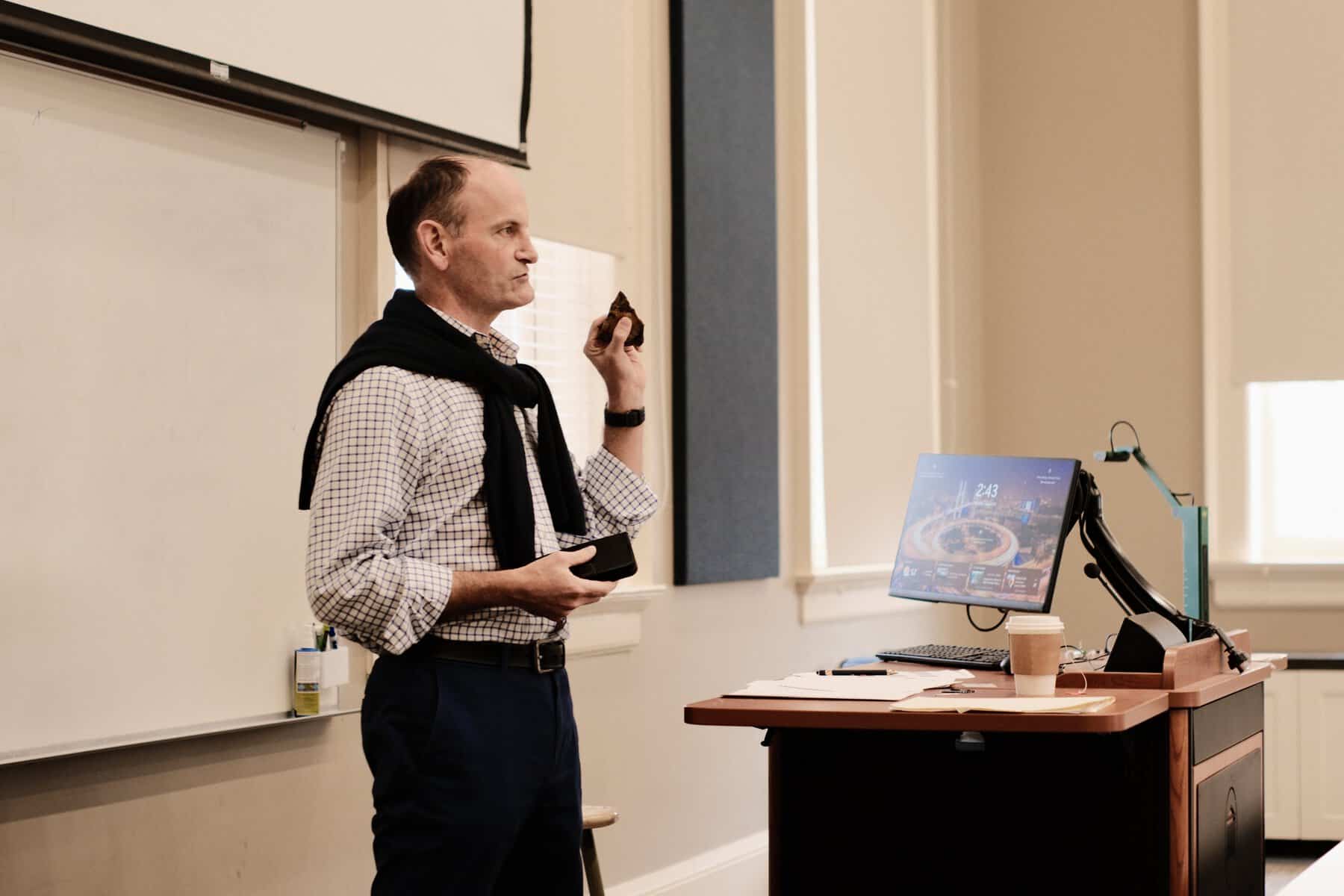
This semester, Douglas Carswell was invited to serve as a guest lecturer at the Declaration Center for Freedom Studies at the University of Mississippi—spending the semester working directly with students on the principles that make societies prosper.
Week after week, he made the drive to Oxford to lead conversations on free markets, limited government, and individual liberty—not as abstract theories, but as ideas with real-world consequences. Students were challenged to think critically, engage deeply, and wrestle with the foundations of a free and flourishing society.
Free markets. Limited government. Individual liberty.
The next generation isn’t just hearing about these ideas—they’re being trained in them, challenged by them, and equipped to carry them forward. In a time when many institutions are moving away from these principles, opportunities like this matter more than ever.
Not slogans. Not trends.
Real ideas, taught in real classrooms, to the next generation of leaders.
This is how you build something that lasts.


ALEC's Rich States, Poor States index now has Mississippi at 24th for economic outlook. The trend lines, and the policy choices behind them, explain why.
The latest Rich States, Poor States index has just been published by ALEC, and for anyone who cares about the direction of our state, it makes for encouraging reading.
Mississippi now ranks 24th in America for economic outlook. That is a forward-looking measure, built from fifteen different state policy variables — tax burden, regulatory environment, labor law, and more. A decade ago, the idea of Mississippi sitting in the top half of that table would have been difficult to imagine. Today, we are there — and we are still climbing.
Three trends worth noting
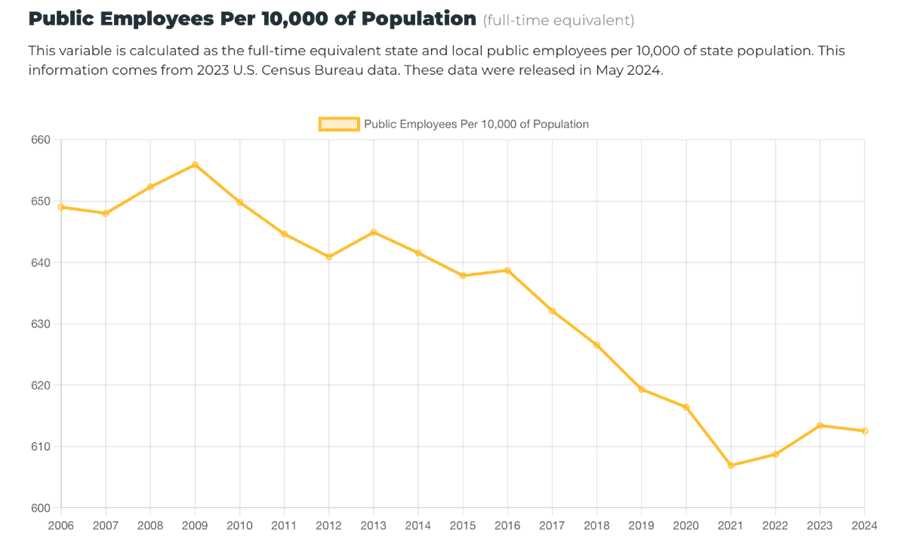
Public sector shrinking, private sector growing. The number of public sector employees in Mississippi is falling — which means the private sector, the part of the economy that actually generates wealth, is becoming more prominent. That is a structural shift, not a one-off.
Public Employees Per 10,000 of Population (full-time equivalent)
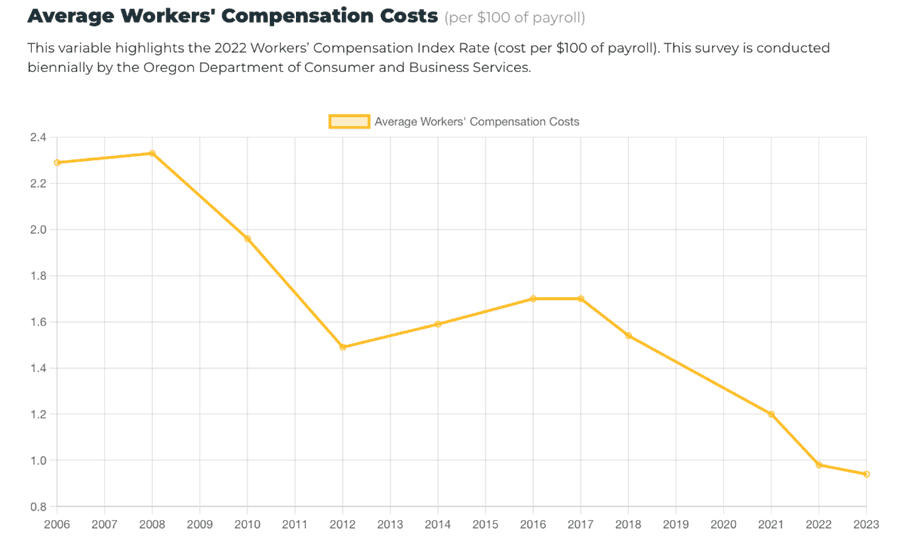
The cost of doing business is falling. The non-wage costs of hiring people in Mississippi have come down steadily. That is one of the reasons so many firms are now choosing to invest here rather than somewhere else.
Average Workers' Compensation Costs (per $100 of payroll)
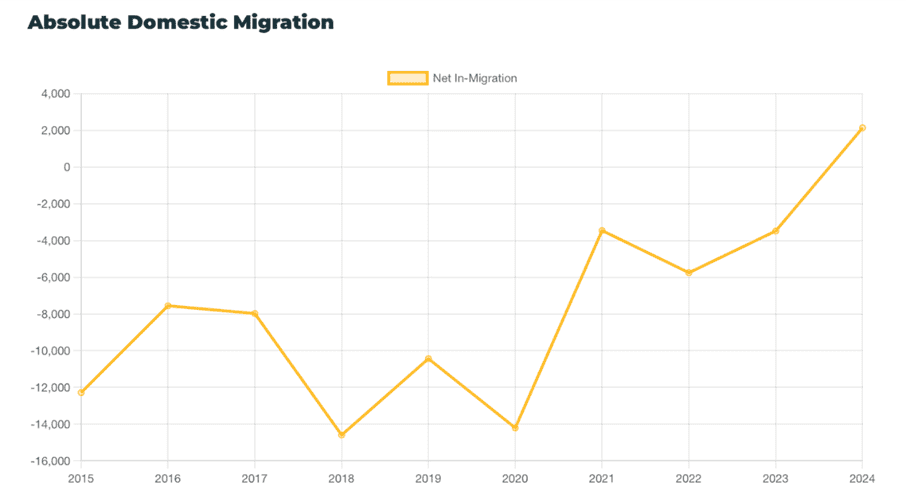
More people are moving in than out. This may be the most important of all. For too long, young Mississippians moved to Birmingham, Nashville, or Austin to find better opportunities. Now, at last, the trend is reversing. More people are moving to Mississippi than leaving it.
Absolute Domestic Migration
How we got here
None of this happened by accident. It is the cumulative result of half a decade of serious policy reform — and at every stage, opposition was loud.
In 2021, Mississippi enacted serious labor market reform — making it easier for people to work, to train, and to move between careers.
In 2022, we replaced an old, progressive tax code with a flat tax.
Year after year, we have kept energy costs among the most affordable in the country — a quiet advantage that every family and every employer benefits from.
In 2024, we passed education funding reform so that the money at last follows the child.
In 2025, we enacted the historic elimination of the state income tax — a policy that only a few years ago was dismissed as politically impossible.
And in 2026, we have begun to take on the thicket of red tape that has held back our healthcare economy.
Every one of these reforms was resisted. Each was said, at the time, to be too ambitious or too politically risky. Each now stands as part of the answer to why Mississippi is moving up the rankings.
How laws actually pass
Ideas do not turn into law without people willing to fight to make it happen. Sycophancy might get you into the signing ceremony. It takes robust advocacy to ensure that there is a bill to be signed in the first place.
The rest of the country is beginning to notice. Mississippi is no longer the state that others use as a punchline. We are becoming a state that others are studying.
There is a great deal still to do. But the direction of travel is clear — and you have helped set it.
Amazon has just announced another multi-billion-dollar data center project in Mississippi — the latest in a flood of inward investment now pouring into our state.
But here’s the thing worth reflecting on: even AI-related investments on this scale are only a fraction of what is flowing into data centers and AI infrastructure across the country. What is happening in AI is not just another tech cycle. It is going to be absolutely massive — and genuinely transformative in ways that will touch every kind of institution.
You would not know that from much of the media coverage. I’ve lost count of the number of articles warning about catastrophic job losses, mass unemployment, and whole industries being wiped out. The narrative has been relentlessly negative. But I think it is wrong — and I am not alone in thinking so.
Speaking at a recent event in Jackson, the author Matt Ridley explained something called the Jevons paradox. Named after the nineteenth-century economist William Stanley Jevons, the idea is counterintuitive but well-established: when something becomes cheaper or more efficient to use, people do not simply consume less of it — they consume more. Efficiency generates demand rather than redundancy.
So, too, with AI. Yes, it may make legal advice or specialist expertise far more affordable and widely available. But that does not mean lawyers and professionals will be put out of work. It means people will seek legal advice far more often than they did when access was expensive and limited. Making intelligence radically cheaper will not make smart people redundant. It will unleash more of it.
We are already beginning to see the first signs of an AI productivity boom. I am convinced that the people and organizations that embrace AI and use it effectively will not simply do the same things faster. They will become hyper-productive — able to produce, communicate, research, and act at a level that was simply not possible before. That is not a recipe for fewer jobs. It is a recipe for more output, more value, and more opportunity.
Running a think tank, I find myself thinking a great deal about what AI means for organizations like MCPP. Over the past forty years, the liberty movement in America has built an impressive infrastructure — dozens of policy institutes in Washington and one in virtually every state. That network has done enormous good. But there is a challenge that comes with maturity and growth.
As organizations get larger, productivity per person can fall. What begins as a lean, mission-driven operation can gradually become more corporate. The original focus blurs.
Without constant effort to guard against it, there is a real danger that — rather like a rain dancer claiming credit for precipitation — organizations end up claiming agency for things that would have happened anyway. My hunch is that some of the established donor groups are aware of all this.
AI, I believe, is a way to reinvigorate the liberty movement in all sorts of wonderful ways. It might even, whisper it softly, be a little disruptive — in the best possible sense.
Small organizations that use AI well can now be more effective than much larger ones that do not. The capacity of a campaign group should never be measured by the size of its payroll — and AI is only going to make that point blindingly obvious. Again, I suspect donors in search of better bang for their buck will grasp this.
Here at MCPP, we have started to use AI in lots of new and creative ways. We are working on our first animated children’s cartoon, based on our children’s book What Makes America Special. We have enormous amounts of data, and AI now allows us to use it in smarter ways to identify and reach exactly the people we need to be talking to. MCPP already has perhaps the largest owned audience of any conservative organization in this state — and AI means we are experimenting with new ways to extend our communication reach even further.
AI will never replace the personal relationships that sit at the heart of public policy work. But what it can do is free us up to spend more time on exactly those human connections — the conversations, the trust-building, and the relationships with legislators and opinion-formers that no algorithm will ever replicate. The multi-billion dollar data centers now dotted across states like Mississippi are only one of the ways in which the AI revolution is making itself felt here. The deeper transformation — the one that will reshape how organizations like ours think, communicate, and campaign — is only just beginning. We intend to be at the front of it.
Something significant is happening in America's South, and it deserves more attention.
While New York and California are losing residents, states like South Carolina and Alabama are gaining population at a record pace - and alongside that growth, it is southern states like ours that are generating some of the most impressive economic numbers in the country.
A recent JL Partners poll found that 36 percent of Americans now expect the South to lead economic growth over the next decade. That puts it well ahead of the West Coast (23 percent), the Northeast (21 percent), and the Midwest (19 percent). Young graduates are even more bullish: nearly four in ten name the South as the region most likely to grow fastest in the coming decade.
The data backs up the optimism.
Real GDP growth in 2024 tells the story clearly. Mississippi and South Carolina grew at 4.2 percent. Alabama and Arkansas at 3.8 percent. Tennessee at 3.0 percent. All surpassed the national rate of 2.8 percent. Between 2020 and 2024, 78 percent of all U.S. jobs added to the economy were located in the South. The region's population has grown by seven million since 2020 — and the pace appears to be accelerating.
Manufacturing is a key part of the picture. U.S. industrial output has roughly doubled since the Reagan era, and much of that expansion went South rather than overseas. Alabama alone has added over 50,000 auto jobs since 2000. Combined, Alabama and Mississippi now produce more vehicles annually than Italy or the United Kingdom.
Finance is following manufacturing. Charlotte, Dallas, Miami, and Nashville have become major financial hubs. JPMorgan Chase now employs more people in Texas - around 31,000 - than in New York.
Even higher education is shifting. SEC universities have seen a 91 percent surge in out-of-state undergraduate applications between 2014 and 2023, with many of those students coming from the Northeast.
What explains it?
The answer is policy. Southern states like Mississippi have built environments that are straightforwardly more attractive for businesses and workers alike.
Taxes are lower. Several southern states have no income tax — Texas, Florida, and Tennessee among them - while Mississippi and South Carolina are on a path to eliminating theirs entirely.
Regulatory burdens are lighter: South Carolina recently repealed a range of Certificate of Need rules that had constrained its healthcare economy, a stark contrast to California's expanding compliance requirements.
Labor markets are more flexible, with most southern states operating as right-to-work states. Occupational licensing restrictions are being reduced, making it easier for people to enter the workforce. And electricity costs are significantly lower, in part because the South never adopted the rigid renewable mandates that have driven up prices in the Northeast and California.
This is, in many ways, a natural experiment in governance. Fifty states, trying different approaches side by side - and some are producing markedly better results than others. The South appears to have found a formula that works.
None of these policy wins happened by accident. They were the result of years of sustained advocacy - and you have been a vital part of that. Your support has helped make the case for lower taxes, lighter regulation, and greater economic freedom. The results speak for themselves.
Imagine facing arrest simply for posting sharp or critical comments online. Picture police at your door for expressing opposition to mass immigration. Envision a country where you could be imprisoned for years without a jury ever deciding your guilt.
This isn't dystopian fiction - it's the reality unfolding in Britain today, my former home and once part of the free world.
Earlier this year, parents Maxie Allen and Rosalind Levine from Hertfordshire were arrested in front of their children over disparaging remarks made in a private parents' messaging group. They were among the estimated 10,000 people arrested in Britain this year for online posts - more than in communist China.
Of course, not all those arrested are sent to prison. But plenty are. Lucy Connolly received a 31-month jail sentence after posting online, including a call for “mass deportation now.”
Lucy Connolly and others have received “exemplary” sentences - in other words, instead of the British courts dispensing justice dispassionately, they have handed down arbitrary sentences designed to make an example of people, as one might expect in a third-world country.
For most people arrested in these cases, the process itself - months of uncertainty, reputational damage, family stress and the inability to earn a living - is intended to be the punishment. Again, this is redolent of what you might find in a third world country, rather than the home of Magna Carta.
Clause 39 of Magna Carta declares that no free person shall be punished “except by the lawful judgment of his peers or by the law of the land” - enshrining the right to trial by jury. Yet recently, Britain’s Justice Secretary David Lammy has proposed reforms that would severely limit jury trials, restricting them largely to the most serious offenses (such as murder, manslaughter, and rape) while moving many others to judge-only hearings.
If these changes proceed, someone in Britain could be arrested, prosecuted, and imprisoned for years for something they said online - all without ever facing a jury of fellow citizens.
Is Britain still a free country? A generation ago, the question would have seemed absurd. Today, it hangs in the balance. Truly free societies do not treat their citizens this way.
England, birthplace of common law, no longer applies the law equally. In some cases, individuals have received longer sentences for online speech than others convicted in serious child grooming gang scandals.
Just last week, Luke Yarwood was sentenced to 18 months in prison for anti-immigration posts viewed only 33 times. That same period saw Demiesh Williams, who beat a man to death in a supermarket queue dispute, receive five years and three months.
Why should Americans care? Because Britain serves as a stark warning of how quickly a once-free society can slide into anarcho-tyranny: lax enforcement against repeat offenders, yet draconian crackdowns on law-abiding citizens who speak out.
To understand why the British state has turned against its own people, consider what occurred just last week on the other side of the world in Australia.
During a Hanukkah celebration on Bondi Beach, two Pakistani men - one an immigrant to Australia, the other his son - massacred 16 people for being Jewish.
Now reflect for a moment on how the Australian authorities responded.
Did Australian authorities announce any review of how such extremists entered the country—or how radical views took hold among those raised here? No word of it.
Instead, Prime Minister Albanese quickly reaffirmed that “diversity is Australia’s strength,” while pushing for tighter gun laws and stronger hate-speech restrictions.
Rather than scrutinize immigration or integration failures, the focus shifted to limiting firearms access and curbing free expression.
Officially, these speech curbs aim to stop antisemitic mob chants - like those heard outside the Sydney Opera House after Hamas’ October 7, 2023, atrocities.
You don’t need powers of prophecy to grasp that Australia’s new free speech restrictions will end up being used to lock up those that complain about Muslim migration more than they’ll ever be used to tackle extremist Islam.
Instead of acknowledging and facing up to the problem of radical Islam, the authorities in Australia are trying to make it as much about tackling "hate" and "Islamophobia".
Now do you begin to see why the authorities over in Britain have turned Soviet on their own citizens?
The British public now sees the real-world consequences of mass third-world immigration - roughly 4 million arrivals in the five years since I left - and they don’t like what they see.
Before Elon Musk’s acquisition of X, the state could suppress dissent through algorithmic censorship. Now, with that avenue limited, targeted prosecutions and heavy sentences have become the tool of choice. The situation is that dire.
Jury trials are being curtailed - not merely to clear backlogs (the official reason), but because juries often acquit those with dissident views, frustrating state efforts to silence opposition.
So how should America respond as Britain and other Western nations drift toward autocracy?
- Cherish and defend the First Amendment. Despite criticisms, the U.S. remains far stronger on free speech than most of the world, thanks to the Founders. Protect the Constitution fiercely, ensuring that even offensive or foolish speech remains free.
- Stop treating allies as America’s equals if they mistreat their own citizens: If Britain, Australia, and others start behaving like banana republics, treat their governments accordingly. Why should the United States provide defense subsidies and a diplomatic premium to a regime that fall so far short of Western standards of behavior?
- Secure your borders. Control immigration, or governments will control their citizens to suppress complaints about the fallout from uncontrolled borders.
- Stand with dissidents. During the Cold War, Ronald Reagan supported Soviet dissidents like Natan Sharansky, whose moral backing proved vital.
- Support dissidents: During the Cold War, Ronald Reagan made it clear that the United States stood with Soviet dissidents like Natan Sharansky. As Sharansky explained in his brilliant book, that moral support was crucial in the fight against tyranny. The US State Department should proactively identify and assist dissidents in Britain and elsewhere, in some cases offering asylum to those persecuted by their own governments.
A year ago, I half-jokingly suggested that if Britain deteriorated further, Donald Trump could offer every Brit under 30 the right to work in America, triggering a collapse-inducing exodus. That notion no longer feels entirely far-fetched.
For decades, Mississippi has been the punchline in national discussions about economic performance - often ranked at the bottom in income, education, and opportunity.
But something remarkable has happened in recent years: the Magnolia State is undergoing a genuine resurgence, driven not by federal handouts or gimmicks, but by principled free-market reforms.
A major national publication, the Washington Examiner, recently spotlighted this transformation in a feature titled "Mississippi Turning." The article notes that Mississippi has achieved more economic growth in the past five years than in the previous 15 combined.
This isn't hyperbole; recent data from the Bureau of Economic Analysis shows Mississippi posting some of the nation's strongest GDP growth rates, including a 4.2% real GDP increase in 2024 that ranked second nationally.
What’s fueling this engine? Bold structural changes that prioritize freedom, competition, and low barriers to opportunity.
First, labor-market reforms have opened doors for workers and entrepreneurs. In 2021, Mississippi enacted universal recognition of out-of-state occupational licenses, allowing skilled professionals to bring their talents here without jumping through needless bureaucratic hoops. The state has also slashed red tape on in-state licensing requirements, eliminating hundreds of hours of mandatory training for many everyday jobs. These changes have attracted talent, put downward pressure on remaining barriers, and made it easier for Mississippians to earn a living.
Second, historic tax reform is putting money back in people's pockets. Starting with the largest tax cut in state history in 2022, Mississippi phased in a flat 4% income tax. In 2025, lawmakers went further, enacting legislation to reduce the rate to 3% by 2030 and trigger annual cuts thereafter until the state income tax is fully eliminated—the first such move by a state in decades. This pro-growth policy rewards work and ambition while making Mississippi more competitive for businesses and families.
Third, a commitment to reliable, low-cost energy has made the state a magnet for investment. By resisting costly subsidized green mandates, Mississippi has kept electricity prices among the nation's lowest, powering energy-intensive industries like data centers and advanced manufacturing. Major announcements, including billions from companies like Amazon Web Services, underscore how affordable energy translates into jobs and capital inflows. Since 2020, the state has attracted tens of billions in private investment, fueling record-breaking economic development.The results speak for themselves: explosive GDP growth, surging personal incomes, rising university enrollments, and—for the first time in generations—net in-migration as people choose to move to Mississippi rather than away. Recent years have seen positive net migration, reversing long-standing outflows and signaling a brighter future.
This turnaround didn't happen by accident. It's the direct consequence of free-market ideas championed by policymakers and advocates who refused to accept the status quo. Mississippi is no longer just catching up; it's becoming a national model that other states are watching closely.
As we close out another productive year, moments like the Washington Examiner's recognition remind us that principled, steady work pays off. Mississippi is proving that freedom works—creating a freer, more prosperous place for all its citizens. Other states should take note: lower taxes, fewer regulations, and reliable energy are the path to revival.