
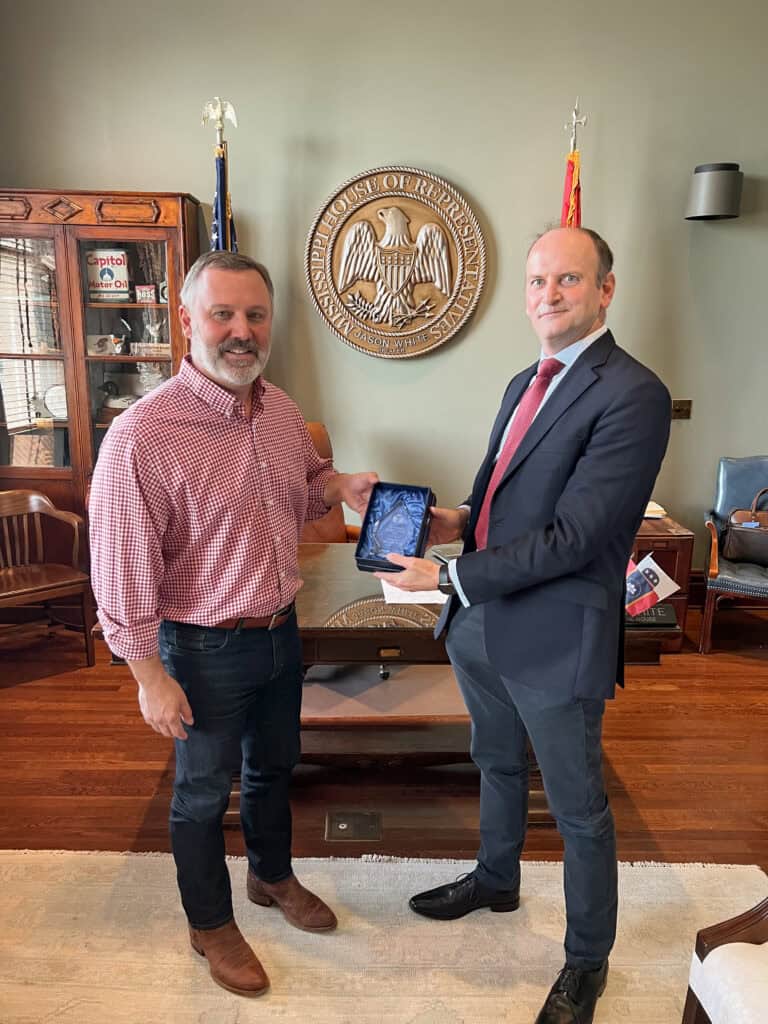
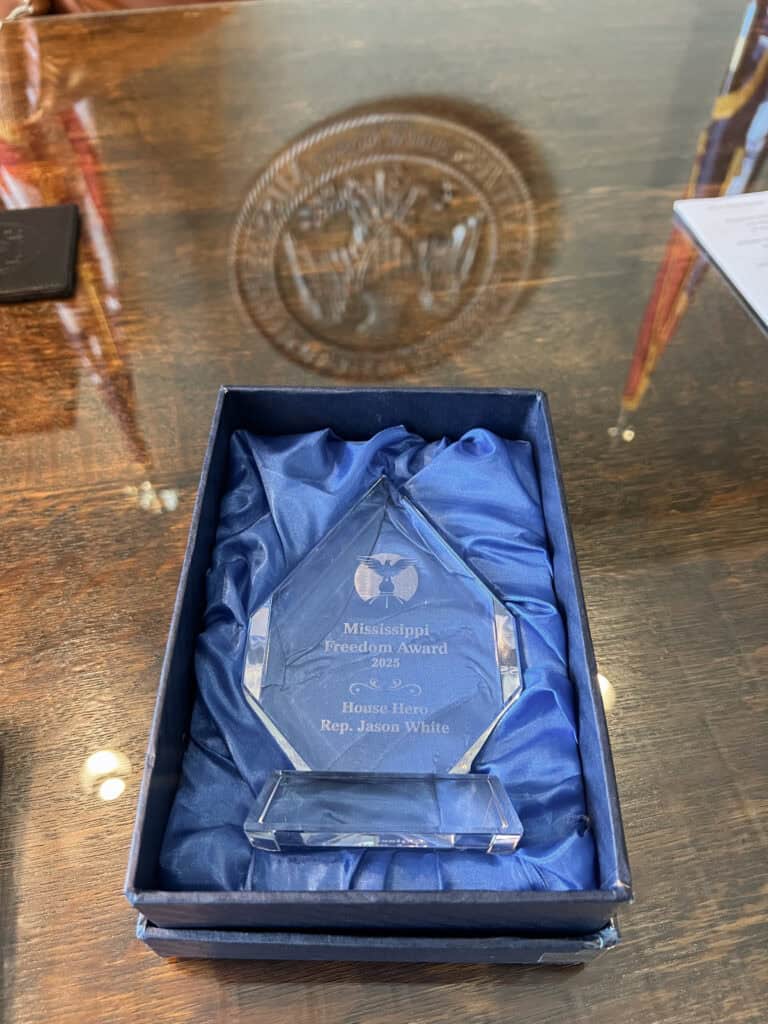
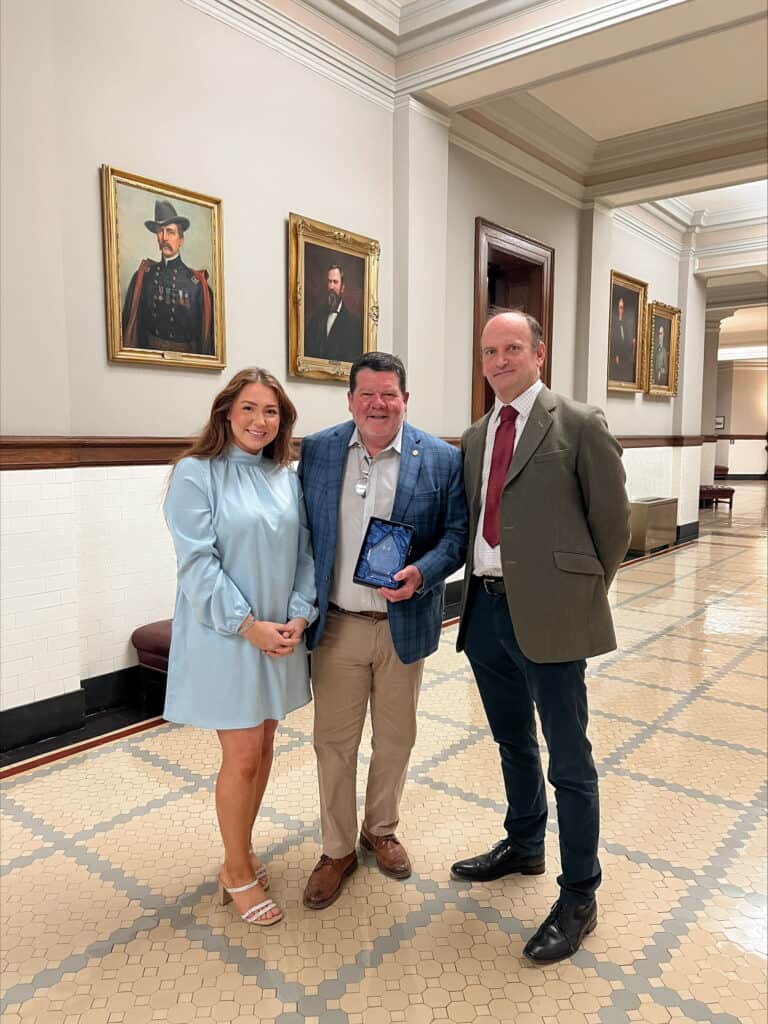
Jackson, Miss. — The Mississippi Center for Public Policy (MCPP) proudly announces the recipients of the 2025 Mississippi Freedom Awards—an annual tradition that honors the lawmakers who boldly champion liberty, economic growth, and individual rights during the legislative session.
“This year, we set an ambitious agenda: eliminate the income tax, expand school choice, push back against divisive DEI initiatives, and reduce the red tape stifling healthcare,” said MCPP President Douglas Carswell. “Thanks to courageous leadership in the Legislature, we’ve secured historic victories for Mississippi families.”
Among the honorees are several standout lawmakers:
- Representative Trey Lamar led the successful charge to eliminate the state income tax. Working closely with Speaker Jason White, Lamar’s transparent and thoughtful approach exemplified what pro-growth policymaking should look like.
- Representative Jason White, Speaker of the House, is recognized as the 2025 House Hero for uniting and leading on key reforms, most notably the income tax overhaul. His steady leadership continues to chart a path for prosperity.
- Senator Angela Hill, named the 2025 Senate Hero, took bold action to fight harmful DEI mandates and stood firm for educational and individual liberty.
- Representative Jansen Owen was honored for his tireless efforts to expand school choice in Mississippi through HB 1435, pushing a policy that would bring Mississippi in line with neighboring states.
- Representative Hank Zuber III was recognized for his long-standing work to reform healthcare regulations and push back on outdated Certificate of Need laws, aiming to improve access and competition in the state’s healthcare system.
- Representative Sam Creekmore earned recognition for his focused efforts to cut red tape and streamline processes that hinder economic development. With a pragmatic and solutions-oriented mindset, Creekmore worked to identify and remove bureaucratic barriers that stall progress across sectors—particularly in healthcare and infrastructure. His commitment to smart, conservative reform has made him a valuable force in the push for a more efficient and responsive government.
“These lawmakers didn’t just vote the right way—they led the fight,” MCPP noted in a statement. “When others hesitated, they stood firm for freedom.” While not every legislative priority crossed the finish line this year, the victories achieved mark serious momentum for pro-growth reform. With income tax elimination and anti-DEI legislation now enshrined into law, Mississippi continues to position itself as a beacon of freedom and innovation in the South.







Last week I went to Washington, and had meetings at the White House, Congress (Senate & the House), as well as with various think tanks.
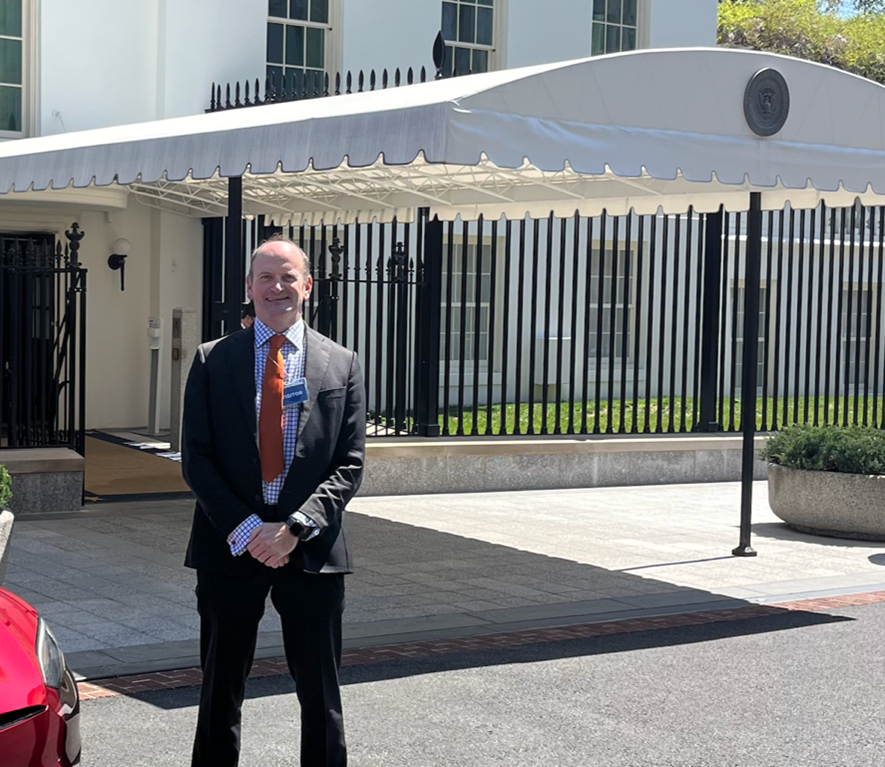
I gave a presentation about Mississippi income tax elimination to Americans for Tax Reform, too.
Mississippi is the 2nd fastest growing state in America, with the 5th fastest increase in personal income. We have just passed legislation to abolish the income tax, and have received record levels of inward investment.
That means there is tremendous interest in our state, and what our pro-growth policies have started to achieve.
It was an honor to talk about the Mississippi success story, with so many positive policy wins. I was really struck by the strong support for the Magnolia state and pro-growth policies.
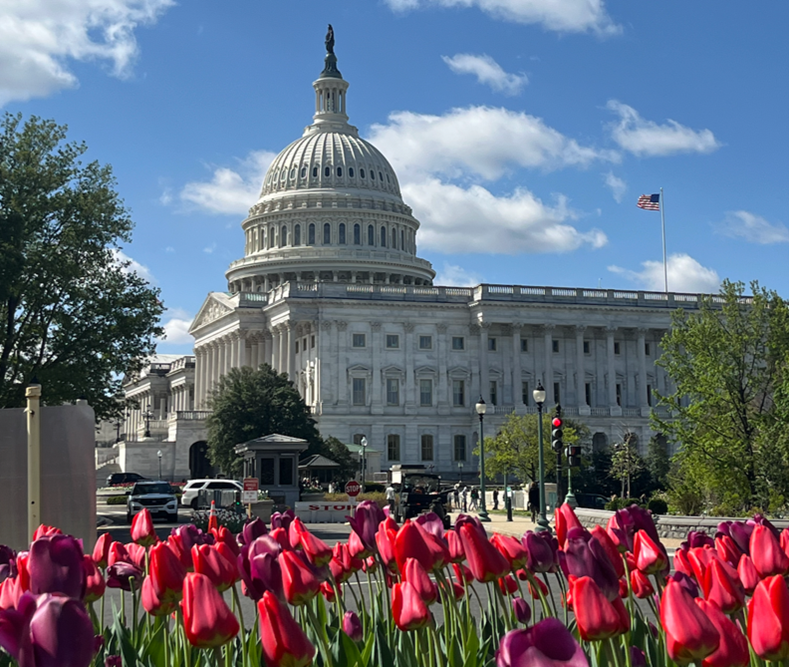
Those I talked to in Washington are very aware of Mississippi’s successes. (Even more so now). I suspect this interest will only increase.
When I flew home from Washington, I felt so proud of our state.
Imagine what Mississippi could achieve if we used our conservative super majority to go even further with pro-growth policies?
The news about Mississippi just keeps on getting better!
First, the Mississippi House passed a bill to allow public to public School Choice. Not far behind is a bill that would allow a form of public to private School Choice.
A few days before that, the House passed a proposal to eliminate the income tax. Then they went and passed a bill to repeal lots of protectionist red tape that restricts the healthcare economy in our state. They even found time to pass a bill to remove the absurd law that prevents adults in our state from buying wine online.
Even the Senate went and passed a bill that has the potential to stamp out Diversity, Equity & Inclusion (DEI) ideology in our public universities.
It would be premature to start celebrating these wins for freedom. Each of these bills still needs to be voted through by both chambers before heading to the Governor’s desk. But it is hard to think of a year in which at this stage in the legislative session the prospects of reform shone as brightly as they do today.
After years of seeing free market reforms killed by vested interests in committee, our lawmakers suddenly seem to be giving conservative voters conservative policies.
For decades, vested interests at the state Capitol were able to stifle change. This helps explain why Mississippi was often thought of as 50th out of 50 states. Perhaps it is time to think again?
As Governor Tate Reeves keeps pointing out, Mississippi has momentum. In the second and third quarters of last year, our state had one of the fastest growing per person incomes and per person outputs of any US state.
Yes, you read that right. Mississippi was one of the fastest growing states in America.
This new growth data might only be a snapshoot, rather than a trend. However, if our legislature really does pass all of the measures listed above, Mississippi will be on an upward trajectory for sure.
Of course, even as you read this, an army of lobbyists with their snouts in the Jackson trough are frantically trying to kill off these proposed changes.
The absurdly named “Parent’s Campaign” has gone into overdrive to try to prevent giving actual parents more choice. Fake conservatives are thinking up a hundred reasons why we cannot afford tax cuts. Those Tate Reeves calls the “coalition of the status quo” are trying desperately to keep things the way they are.
Perhaps most dangerous of all are those commentators who have spent years excusing inertia by implying that Mississippi can only manage to make one change at a time. We will hear plenty of fatuous arguments that the state legislature only has the bandwidth to implement change at a snail’s pace. Some will tell us that this is the Mississippi way. Nonsense. Never accept excuses for mediocrity.
If the state legislature in Arkansas and Alabama can cope with tax cuts, school choice and deregulation at the same time, so can we.
A great deal of the credit for this reformist momentum is due to Speaker Jason White and his cadre of conservative lawmakers. We must pray that the Speaker and his team hold their nerve. Let us cheer on Speaker White as he faces down the vested interests that want to hold Mississippi back. Let us call out the hypocrisy of the smug, self-satisfied anti-school choice activists that sent their own kids to private school. Playing nicely with such people never works, so don’t.
Real conservative lawmakers who want to see Mississippi grow can vote for these changes in the knowledge that we have a President and a primary base behind them all the way!
How much do you imagine it costs to send a child to public school in Hinds County every year? $5,000 per year? Maybe $10,000? $15,000?
Actually, according to data from the Mississippi Department of Education, when you divide the number of students attending school by the total expenditure, in 2023-24 Hinds County spent $16,589 per student.
That is more than twice the average private school fees in our state. Indeed, $16,589 is not far off what it would cost to send your child to a top private school.
Now ask yourself if each child in Hinds County is getting a top education for that $16,589? Of course not. A large chunk of the kids can’t read or do basic math. One in three of them regularly skip school.
So, why not give families in Hinds County the right to take a portion of that $16,589 and allocate it to a school of their choice?
It’s not just Hinds County. The same question could be asked in Madison ($17,037 spent for every public school pupil per year) or Rankin ($15,198 per pupil per year), or Canton ($18,683) or De Soto ($13,820).
Even if you take the Department of Education’s own more conservative figure for per pupil spending (which includes all the ‘no-show’ students), Mississippi still spends an average of $14,676 per student.
Despite all that money, 4 in 10 fourth graders in Mississippi public schools cannot read properly. Eight in 10 eighth grade kids in Mississippi were not proficient in math in 2022. One in 4 kids routinely skips school.
Nor has $14,676 per student spending translated into better teacher pay. Notwithstanding recent pay increases, our teachers still earn significantly less than they did in 2010, when you adjust for inflation.
If you happen to be one of the fortunate families happy with the public education options available, great. No need to change and no one is proposing any changes that will affect you. But why not allow those families unhappy how things are the freedom to take their tax dollars to a school that best meets their needs?
Suggesting this provokes outrage not from parents, but from various vested interests who like things the way they are. They like a system that puts the $14,676 they get for your child into their administration budget, rather than the classroom. School superintendents making more than the Governor want to keep control of their multimillion dollar budgets for a reason. It’s a boondoggle for bureaucrats.
School Choice will not impoverish public schools. The legislation that Speaker Jason White is proposing would allow families control over the state portion of funding, not locally raised revenues or federal dollars.
In Hinds County, for example, that would mean families being able to allocate no more than $6,700 of the $16,589 overall per pupil funding. (Rather than depleting Hinds County public schools’ budget, actually it would make Hinds County better off in terms of per pupil spend.)
Giving families control over $6,700 of the state funds will not mean a flood of kids coming into your well run school district. Why not? Because the legislation proposed specifically gives school boards the final say on capacity.
What anti School Choice campaigners really fear is not the “wrong” kids coming to your school. What they fear is that you start wondering what the heck they’ve been doing with the $14,676 they get for your child or grandchild every year.
All of the arguments we are now hearing against School Choice in Mississippi have been heard in each of the surrounding states that have since adopted School Choice.
Alabama’s new Educations Savings Account program, which has just opened for applications, has been wildly oversubscribed. The program provides $7,000 funding per student attending a participating private school, while those enrolled in home education programs are eligible for $2,000 per student.
Arkansas allows all K-12 students access to an Education Savings Account from 2025, into which the state government pays the state portion of per pupil funding ($6,600 per year). Families will be able to use this $6,600 money they are given to pay for their child education, including private school tuition. Arkansas also allows public to public school transfers, allowing districts to define capacity.
Louisiana’s GATOR program starts in 2025-26 and establishes an Education Savings Account for those on low incomes, with the details are still being finalized as the law only recently passed. Louisiana already has public to public School Choice.
Texas and Tennessee, too, are at this very moment debating legislation that would create a universal Education Savings Account for families in those states, too.
None of the scare stories we now hear in Mississippi materialised in any of these neighboring states. None of these states has been bankrupted like the critics claimed by letting mom and dad have parent power. Instead, all the evidence suggests School Choice has started to improve education outcomes.
Another week, another massive investment project was unveiled in Mississippi. On Thursday, Governor Tate Reeves announced that a $10 Billion data center is coming to Meridian. One deal alone isn’t proof that the economy is taking off, but it does add to a pile of evidence suggesting that Mississippi could be on the cusp of a new era of growth. If Mississippi keeps going the way data from the Bureau of Economic Analysis suggests we are moving, this state won’t be 50th out of 50 for much longer.
Is it too far-fetched to imagine young people wanting to move to Oxford, Starkville, Laurel, or the Coast, the way they currently want to go to Austin or Nashville?
Encouraging, too, is Mississippi’s political leadership at the start of the new legislative session.
Income tax abolition, essential if we are to be competitive, is now the number one priority for the Governor and the Speaker, Jason White. School choice, the only sure fire way to improve education standards and prepare young people for the world of work, is on Speaker White’s priority list for this legislative session. Removing red tape, particularly as it restricts the healthcare economy, is also being actively considered, with the State Board of Health firmly committed to change.
These changes are essential if our state is to seize this once-in-a-generation opportunity. But even now the forces of inertia are trying to stop change. If they succeed, Mississippi will stall.
(Almost) everyone now says they support income tax elimination. Yet some are quite clearly only paying lip service to the idea, desperately seeking to avoid passing legislation this session that commits to actual elimination. At the same time, they talk up the idea of cutting the grocery tax as a deliberate distraction strategy, knowing full well that cutting the income tax would have vastly more impact.
While Mississippi considers school choice, we are surrounded by states that are actually doing it. Tennessee is in the process of passing the legislation this week. Yet the forces of inertia in Mississippi say we need more time to consider Education Savings Accounts. Really? Can you not look across the state line at Arkansas or Alabama to see how it is transforming education for the better? Perhaps your call for “more time” just an excuse?
Maybe, like the disgraceful School Superintendent in Madison County did this week, the forces of inertia circulate false claims about school choice? (No, public to public school choice does not take away local tax dollars, since it only involves the state portion of the budget. No, private schools do not lack accountability. They are more accountable than any public school.)
The sort of misleading claims made by the Madison School Superintendent are attempts to prevent change by those that think they, not pesky parents, know best for your child. The forces of inertia are also lobbying aggressively in the legislature to kill off reforms that will remove health care regulation that intentionally limits the number of providers. The truth is that for years all of those against lower taxes, less regulation and opposed to school choice in our state have been able to get their way. That is why Mississippi has not grown the way Alabama or Texas have. I’m optimistic that this time the forces of inertia can be overcome. Why?
Firstly, it is increasingly obvious that Mississippi could be doing things differently. You only need to look across the river at Arkansas under Sarah Huckabee Sanders (tax cuts, school choice, red tape removal), or Alabama (ditto), or at almost any southern state to see it. Secondly, Trump. The 47th President is committed to tax cuts, red tape reduction and school choice. This will help tilt opinion in our state.
Imagine for a moment that you are a local Republican party office holder keen to catch the eye of the new White House administration. Perhaps you want an appointment or some kind of endorsement? Do you really imagine Donald J. Trump would pick you out in such a crowded field if you have been anti-tax cuts? Do you honestly think Team Trump would say, “Yes, Mr. President, this local guy in Mississippi who killed off School Choice is our guy”? If nothing else, self-interest will move the dial towards the right agenda in Mississippi over the next four years.
Finally, I think inertia can be overcome because of Elon Musk.
Something weird has happened since Elon bought X / Twitter. Politics is now increasingly unfiltered. Even if you are one of a majority of folk that don’t use X, you will have felt the effect of this form of unfiltered politics. The forces of inertia can be petulant. They can lobby and bully to try to stop change. But they cannot any longer escape the consequences of trying to stop change. Cheer up! 2025 is going to be awesome. Mississippi is on the cusp a great change.
Remember when Japan was predicted to overtake America?
Back in the 1980s, Japan was the coming country. Japan’s economy had enjoyed decades of rapid growth. Her exports where everywhere, and with inventions like the Sony Walkman, it looked as though Japan was the technological future, too.
America looked like a power in decline. Forty years ago, many traditional US industries were failing. Crime seemed out of control.
By the mid 1990s, Japan’s GDP was 71 percent that of the US - and the gap looked to be closing. One “expert”, Herman Kahn predicted that Japan would surpass America as the world’s largest economy by 2000.
Today? Japan’s economy is a quarter the size of America’s. Japan hasn’t produced much innovation since the Tamagotchi (Don’t ask). Despite all the talk about Japanese electronic wizardry, the great digital innovations of the past few decades have happened on this side of the Pacific.
Today, of course, we’re told that the great ascending power is not Japan, but China. China’s economic growth over the past 40 years has been phenomenal. In industry after industry, Chinese exports have crushed the competition. China, unlike Japan, is not just an economic competitor but a strategic rival to the United States, pursuing an aggressively expansionist policy in the Pacific, south Asia and parts of Africa.
By 2021, China’s GDP was almost 80 percent that of the US and the experts were telling us China would overtake America within a couple of decades.
But look at what has happened since. China’s economy seems to have peaked as a percentage of US output. China has even more debt-induced malinvestment than Japan had during the 80s asset bubble.
Chinese demographics (current Total Fertility Rate 1.02) are in an even worse shape than Japan’s (TFR 1.30). And China’s fiscal position is unlikely to improve with all of President Xi’s imperial ambitions to fund.
As recently as 2008, Europe’s economy was about the same size as the United States’. Today, America’s economy is twice the size of Europe’s. Looking at the number of large companies established over the past 50 years on either side of the Atlantic. Home Depot, a single US company, eclipses all the new businesses created in the European Union since 1974.
So why are Japan, China and Europe all in their different ways underperforming America? Because each are, in their different ways, reverting back to a type of political economic tradition far less successful than America’s.
Japan, superficially Western in so many ways since 1945, has behind that façade a strongly corporatist political economy. A handful of well-connected conglomerates are able to dominate markets, but shielded from internal competition, they don’t innovate. (To appreciate how stifling this is, try to imagine what America might be like, for example, if IBM was the only computer company, with all the competitors kept out.)
China, after a brief move towards market liberalization begun by Deng Xiaoping, is reverting to what you might think of as a Ming tradition. Dissent is stamped on. A bureaucratic elite micromanages and controls. The sclerotic effects are already being felt.
Europe, repeated rescued from an indigenous form of autocracy by the Anglosphere powers (1704, 1815, 1914, 1944, Cold War), is tragically reverting to type. Today, a courtly elite enthroned in Brussels attempts to regulate and control ever more aspects of social and economic life across the Continent, destroying it in the process (Mercifully, Britain escaped from this in 2016 and might yet return to a more Atlantic tradition).
To flourish, the United States needs to stay true to the political and economic model envisaged by the Founders; limited government, lower taxes and liberty. The good news is that with the new administration in Washington, this may well be about to happen. Elon Musk is determined not only to cut federal spending (something America urgently needs to do to avoid bankruptcy). He is looking to turbo charge productivity growth, moving people from the public to the private sector, and radically cut red tape. Reports of America’s relative decline seem to me to be wildly exaggerated. If Musk and co deliver half of what they are promising, we might just be on the cusp of an extraordinary period of progress and innovation in America. The divergence between America and the rest of the world is only going to accelerate.
I feel an overwhelming sense of privilege to be onboard!
Parental choice is the only certain way to raise standards and counter left- wing values in the classroom. MCPP has a plan to make this happen in Mississippi.
Mississippi is already surrounded on three sides by states that have school choice. Arkansas, Alabama and Louisiana have all now passed legislation to give families control over their child’s share of the education budget. However, perennial efforts to achieve something similar in Mississippi through Education Savings Accounts, or ESA's, have failed. Each time a universal ESA proposal has been attempted the legislation dies. We would love to see a universal program of publicly funded ESA's in Mississippi, which families could use to pay for school, but I believe the chances of such legislation passing anytime soon are slim.
That’s why MCPP is pursuing a different three step strategy to achieve universal school choice in our state:
- Step One – An individual budget for every student: During the last legislative session, MCPP spearheaded efforts to secure a school-funding formula in order that every public school student now has a personalized education budget.
We did so knowing that once each student has a personalized budget, it becomes much easier to argue that they should then be allowed to take their budget to a school of their choice. We have achieved this.
- Step Two – Public-to-public school choice: Thanks to a bill (HB 1341) passed in the last legislative session, military families, including those in the National Guard, are able to send their children to a traditional public school of their choice—if it has capacity.
We are openly pushing for legislation in the 2025 session to allow each student to take their personal budget to a public school of their choice, giving every family in Mississippi the right that military families enjoy. Responsible conservative policy means allowing school boards to have the final say over capacity and giving strong safeguards to school so that they do not have to take students with a history of disciplinary problems.
- Step 3 – Parental Choice Tax Credit: Tens of thousands of families in our state choose not to send their children to public school, either because they homeschool or they send their children to private school. We believe they should be able to claim a refundable income tax credit to help them with expenses, like tuition and fees.
We have a carefully costed plan for a Parental Choice Tax Credit that would achieve this, building on the tax credit system we already have. Interestingly, the Republicans in Washington, D.C., have indicated that they might pass a similar tax credit federally. These three steps would ensure universal school choice in our state—and give families in Mississippi the choices that families now have in neighboring states. The good news is that Mississippi is already halfway to making this happen!
Morton Blackwell, the great conservative activist, likes to say that “In politics nothing moves unless it’s pushed”. MCPP is happy to push – and to push hard …. even if it upsets one or two anti-school choice activists. It’s what we exist to do.
We are open about our goal and our strategy for achieving school choice because we know that sunlight is the best disinfectant. There’s no need for mystery and opaque maneuverings. Nor will we shy away from engaging directly those that might like to stop parental choice by stealth. If school choice is opposed by lawmakers that sent their own kids to private school, we won’t hesitate to ensure that Mississippi knows.
Over the course of the coming months as we head into the 2025 legislative session, I will be sure to update you on progress – and I’ll be sure to inform you who supports and who opposes parental choice! This is a fight we can win!
Donald Trump is the most pro-school choice President in history. “As president”, he has said, “I will establish the national goal of providing school choice to every American child”. “If we can put a man on the moon and win two world wars, then I have no doubt that we as a nation can provide school choice to every disadvantaged child in America”.
Unfortunately, Mississippi has made little progress towards school choice due to a tiny handful of anti-school choice Republicans. Even though three of our surrounding states, Alabama, Arkansas and Louisiana, now have school choice, we still don’t. The biggest obstacle to the education reforms we need is the current Senate Leader, Lieutenant Governor Delbert Hosemann. He has taken every opportunity to thwart efforts to achieve more parent power.
Initially, Mr. Hosemann took to claiming that school choice would be unconstitutional. This is an erroneous argument, as a carefully prepared legal briefing note we circulated shows. Having conceded that there is, indeed, no constitutional barrier to school choice, our Lieutenant Governor began to search for alternative excuses. Schools might not have the capacity, seems to be his latest one.
That is why the draft bill we worked on ensures school boards get the final say as to their capacity. No one is forcing them to take more kids. Another excuse crumbles….. One by one the arguments invoked by anti-school choice Republicans to justify their inertia have been dismantled. But it still appears that the will to give Mississippi families the parent power they have in our neighboring states just isn’t there.
Why is a Republican Lieutenant Governor in a conservative state teaming up with progressive activist groups, like the Parents’ Campaign, and briefing leftist media outlets like Mississippi Today to thwart reform? Mr. Hosemann, I gather, has indicated he is flat out opposed to a tax credit. This means Mr. Hosemann is very likely to be on a collision course with the next President, whose team, I understand, is literally finalizing plans for a federal tax credit right now. Will Mr. Hosemann continue to oppose a tax credit?
Mr. Trump has made it clear he will abolish the federal Department of Education. Trump does not intend to dismantle power in DC only to see it handed over to local bureaucrats in Jackson. He would like to see parents have control over their child’s education. If a handful of local Republicans continue to kill off school choice (“It died in committee”, is likely to be their next excuse), I suspect that the conspicuous absence of invitations to Mar-a-Lago may become the least of their worries.
In a fight between anti school choice Republicans and Team Trump, I imagine Trump will win. He’d certainly have support from the local conservative base who have voted conservative for years but not always got a great deal to show for it. Perhaps part of the problem is that one or two of our anti school choice Republicans have an unfortunate habit of never wanting to engage with anyone with different ideas to their own. That can become a problem if you don’t actually have very many ideas of your own. I’m not sure that a policy on four semesters a year, or cell phone usage in schools, quite cuts it ….
Those that get endorsed by Trump to run in 2027 will, I imagine, be Republicans that actually support the new President’s agenda in the coming months, particularly the 2025 session. There’s still time to get on board with school choice in Mississippi.
“All political lives end in failure” observed the British Prime Minister, Harold Macmillan. His did. So, too, will Joe Biden’s.
Forced out after four years, it is difficult to think of a single significant achievement by the Biden administration. Biden’s legacy will be higher national debt and a more divided America. But is it really the case that political lives always end in failure?
Watching the recent movie about Ronald Reagan, it was obvious that after two terms in office, the Gipper’s accomplishments clearly outweighed any defeats. Reagan’s legacy was a buoyant economy, stronger America and the defeat of Soviet communism.
If Biden’s legacy is of extreme failure, and Reagan’s of remarkable success, many politicians don’t seem to leave much of a legacy at all, good or bad. Like footprints on a beach at low tide, tomorrow it will be as though they were never there at all.
Many politicians fail to leave much of a legacy for the simple reason that they hold office but have little idea what to do with it. That’s not, of course, what they tell themselves in the early days. In the afterglow of their election victory, surrounded by staffers, and praised by smooth-tongued lobbyists, political leaders busy themselves with the business of government.
Yet often the urgent squeezes out the important. Once in office, they end up playing the role of Senator, Congressman, or state Governor, like an actor in a movie handed their lines by someone else.
Rather than implementing a blueprint that matters, they are distracted by the trivial. Instead of delivering difficult messages, they delude themselves that another press conference about blah blah is vital.
Rare is the type of politician who can make the political weather, rather than respond to it. Many politicians fail to leave a legacy because they fool themselves that they are responsible for things that would have happened anyhow. Or they imagine that they will be fondly remembered for things that happened on their watch.
How many Mississippians remember who was governor when the Nissan factory came to Mississippi? How many credit whoever happened to be in office? Any politician in our state wanting to leave a real legacy needs to address those things that have kept our state 50th out of 50 for too long.
First is education. Mississippi needs a wholesale reform of education, with school choice and parent power. With so many surrounding states implementing universal school choice, change is possible. The first wave of Mississippi leaders to actually come out and lead on this will be seen to deliver historic changes for the better.
Second is the state economy. Mississippi’s economy continues to be weighed down by a relatively high tax burden and red tape. Despite cutting the state income tax, Mississippi families and businesses still pay more than in surrounding states. Certificate of Need laws hold back the healthcare economy in our state. State leaders that lead on lower taxes and deregulation would stand out nationally and historically.
These are the issues that will define the future of our state. Our state leaders will be defined by if and how they address them. State leaders that address these issues will leave a giant legacy. Those that don’t, won't be a household name in their own home.