
As the legislative session moves into its final stretch, the focus at the Capitol is beginning to shift.
Major policy bills are clearing their final hurdles, others have quietly fallen away, and attention is now turning toward the biggest issue left unresolved: the state budget.
Here’s a look at what moved last week — and what it means for Mississippi.
Modernizing Alcohol Laws: A Shift Toward Freedom and Local Control
Lawmakers advanced two notable alcohol-related measures:
- Direct-to-consumer liquor shipping
- A local option for Sunday alcohol sales
While these may seem like small changes, they reflect a broader policy shift.
For years, Mississippi’s alcohol laws have been shaped by outdated restrictions and one-size-fits-all rules. These proposals move in a different direction — toward greater individual choice and local decision-making.
Instead of statewide mandates, communities would have more authority to decide what works best for them, and consumers would have more flexibility in how they purchase products.
It’s a step toward modernization — and toward trusting Mississippians to make their own decisions.
Workforce Development: Cutting Red Tape and Strengthening Opportunity
Another important development this week was the passage of legislation to create a state-run Office of Apprenticeship.
This change would shift oversight away from the federal government and place it at the state level.
Supporters argue this will:
- Reduce federal bureaucracy
- Improve coordination with Mississippi employers
- Strengthen workforce pipelines in key industries
At its core, this is about making workforce development more responsive to Mississippi’s actual economic needs — not a federal template.
As our state continues to grow and attract new investment, aligning workforce training with real-world demand will be critical.
The Biggest Issue Ahead: Budget Negotiations
With most policy deadlines now behind us, the Legislature is turning its attention to the state budget — a process that is already underway.
Lawmakers are working to finalize a $7+ billion budget, and early signs point to familiar challenges:
- Ongoing tension between House and Senate leadership
- Competing priorities on spending and fiscal strategy
- Questions about how to avoid last year’s late-session breakdown
The budget will define the final weeks of the session — and how it’s handled matters.
A disciplined, transparent approach to spending is essential to maintaining Mississippi’s recent economic momentum.
Could a Special Session Be Ahead?
Given the dynamics already in play, there is growing discussion about the possibility of a special session if lawmakers are unable to reach agreement before adjournment.
Mississippi faced this situation just last year, when unresolved budget negotiations required lawmakers to return to Jackson to finish their work.
If that happens again, it will raise important questions about process, priorities, and how major decisions are being made.
For a deeper look at this issue, you can read Douglas Carswell’s most recent piece outlining the case for a potential special session on education reform:
The Case for a Special Session - Mississippi Center for Public Policy
Looking Ahead
The final phase of the legislative session is often where the most consequential decisions are made.
With policy debates largely settled, the focus now shifts to:
- Final budget negotiations
- Potential end-of-session compromises
- And whether lawmakers can complete their work within the regular session
Track Legislation in Real Time
If you’d like to follow along as bills move through the process, you can track key legislation throughout the session using the Mississippi Center for Public Policy’s bill tracker.
Bill Tracker - Mississippi Center for Public Policy
Yesterday marked one of the most important procedural deadlines of the legislative session.
It was the deadline for committees to report general bills and constitutional amendments originating in the other chamber.
While it may sound technical, this deadline has a very real impact on which policies still have a chance of becoming law this year.
Here’s what that deadline means — and one bill we’ve been watching closely this week.
Another Major Deadline at the Capitol
At this point in the session, bills that passed one chamber must be taken up by committees in the other chamber.
If a committee did not vote a bill out before yesterday’s deadline, that legislation is effectively dead for the year.
In other words, this moment significantly narrows the field of legislation still moving through the Capitol.
Committees decide which proposals continue forward — and which ones stop here.
Every year, this deadline quietly determines the fate of dozens of bills.
A Bill We're Watching: HB 1072 — Portable Benefits for Independent Workers
One bill we’ve been watching this week is HB 1072, the Voluntary Portable Benefit Plan Act.
The bill addresses a growing part of Mississippi’s workforce: independent contractors and gig workers.
Across many industries — from trucking and construction to healthcare and app-based services — more workers are earning income on a per-project or contract basis. But unlike traditional employees, many independent workers do not have access to benefits like retirement savings, paid leave, or health-related savings.
HB 1072 proposes allowing voluntary portable benefit accounts for these workers.
Under the bill:
- Hiring parties could voluntarily contribute funds to a contractor’s portable benefit account
- Contractors themselves could also contribute
- And those funds could be used for things like healthcare expenses, retirement savings, paid leave, or emergency savings
Importantly, the benefits would belong to the worker — not tied to any single employer.
That portability is key for workers who earn income across multiple contracts or platforms.
Reducing Barriers for the Modern Workforce
One of the biggest barriers today is legal uncertainty.
In many cases, businesses hesitate to offer voluntary benefits to independent workers because doing so could risk triggering employment classification laws — potentially forcing those workers to be treated as employees.
HB 1072 attempts to address that problem by clarifying that voluntary benefit contributions do not automatically change a worker’s independent status.
That kind of policy clarity can reduce red tape and allow new benefit structures to develop for a workforce that doesn’t always fit traditional employment models.
What Comes Next
HB 1072 passed the House earlier this session and is now awaiting consideration in the Senate.
As with many bills at this stage of the session, its future will depend on whether Senate committees choose to move it forward as the legislative calendar continues to tighten.
We’ll continue watching how lawmakers approach this issue and what steps Mississippi may take to adapt policy for an evolving workforce.
Why These Deadlines Matter
Legislative deadlines can sometimes feel procedural, but they play a major role in shaping the outcome of a session.
Each deadline narrows the list of bills still alive — focusing attention on the proposals lawmakers ultimately decide to advance.
As the session moves forward, I’ll continue tracking the policies that survive these milestones and what they could mean for Mississippi.
Track Legislation in Real Time
If you’d like to follow along as bills move through the process, you can track key legislation throughout the session using the Mississippi Center for Public Policy’s bill tracker, linked below.
Thanks for following along as the session continues to unfold. I’ll keep monitoring what’s happening at the Capitol and sharing the developments that matter most for Mississippi.
This week at the Capitol has been quieter on major headline legislation, but that doesn’t mean meaningful policy conversations aren’t happening.
One bill worth highlighting right now is HB 1944 — a proposal that focuses on strengthening private support for Mississippi families and nonprofit organizations serving vulnerable communities. Here’s what it does — and why it matters.
What HB 1944 Would Do
HB 1944 proposes expanding Mississippi’s existing tax credit structure for certain charitable contributions.
In simple terms, the bill would increase the amount of tax credits available to businesses that contribute to qualifying nonprofit organizations — including those that provide services for children in foster care and other educational or support programs.
Rather than expanding government programs, this approach encourages private investment in community-based organizations that are already doing critical work across our state. It’s a policy model rooted in a simple principle: when the private sector and nonprofit community are empowered, families benefit.
Why This Matters
Mississippi has no shortage of organizations stepping in to serve children, support struggling families, and strengthen communities. Many of these groups operate on tight budgets and rely heavily on private donations.
By expanding tax incentives for charitable giving, HB 1944 aims to:
- Encourage additional private-sector support
- Strengthen the capacity of nonprofits serving vulnerable populations
- And reduce reliance on expanding state bureaucracy
It’s not a sweeping reform bill — but it reflects an important policy approach: supporting solutions that flow through civil society rather than exclusively through government expansion.
What Comes Next
HB 1944 is currently moving through the legislative process and will continue to be evaluated in committee.
As with any tax policy change, lawmakers will weigh its fiscal impact alongside its potential community benefit. We’ll continue monitoring its progress and evaluating how it fits within broader conversations about tax policy, charitable giving, and support for Mississippi families.
Looking Ahead
Not every week at the Capitol is defined by high-profile floor fights. Sometimes progress shows up in targeted policy adjustments that strengthen institutions outside of government.
As always, I’ll keep breaking down what’s moving — and what’s not — in plain language. If you’d like to follow legislation in real time, you can track bills throughout the session using the Mississippi Center for Public Policy’s bill tracker.
Thanks for staying engaged and informed. I’ll continue tracking these developments and keeping you updated as reform moves forward.
Earlier this month, on February 4, the Governor signed HB 3 into law.
While it may not have grabbed major headlines, this legislation represents one of the most meaningful healthcare policy shifts of the session.
HB 3 — targeted reform of Mississippi’s Certificate of Need (CON) laws — is now officially law.
And while it is not full repeal, it is a real step in the right direction. Here’s what that means — and why it matters.
What HB 3 Does
For decades, Mississippi’s Certificate of Need laws have required hospitals and healthcare providers to receive government approval before expanding facilities, adding services, or making certain major investments.
In practice, that system can slow growth, limit competition, and make it harder for new providers to enter underserved areas.
HB 3 makes several important changes:
- It raises the dollar thresholds that trigger government approval.
- It creates targeted exemptions.
- And importantly, it begins modernizing a regulatory framework that has not kept pace with today’s healthcare realities.
This bill does not eliminate the CON system entirely. But it does loosen restrictions that have long limited flexibility in our healthcare market.
The Most Important Piece: A Research Mandate
One of the most significant elements of HB 3 is something that hasn’t received as much attention:
The bill directs further study into what it would look like for Mississippi to repeal CON requirements in certain contexts — particularly for rural hospitals.
That research matters.
Mississippi has long struggled with access to care in rural communities. Many areas face hospital closures, limited specialty services, and long travel times for treatment. These gaps contribute to what many refer to as “medical deserts” — areas where patients simply don’t have reasonable access to care.
We also know that Mississippi consistently ranks near the bottom nationally in key health outcomes — and access, competition, and flexibility in our healthcare system are all part of that conversation.
If repealing or further scaling back CON laws for rural hospitals could help expand services, attract providers, or stabilize struggling facilities, that is a policy discussion worth having seriously and thoughtfully. HB 3 opens the door to that conversation.
Why This Is a Step Forward
Large reforms rarely happen all at once.
More often, they happen in phases — modernizing thresholds, creating exemptions, and eventually rethinking the system more broadly.
HB 3 represents progress. It shows lawmakers are willing to revisit long-standing regulatory structures and ask whether they are still serving Mississippi patients well.
We will continue to advocate for broader reform, particularly where it could expand access in underserved communities. But this is a real and measurable step toward a more flexible, patient-focused healthcare system. And it’s now law.
What Comes Next
Now that HB 3 has been signed, attention turns to implementation — and to the research it mandates regarding potential additional reforms.
We’ll be watching closely to see:
- how agencies implement the new thresholds and exemptions
- how the rural healthcare research is conducted
- and what recommendations ultimately come from that work
Healthcare access is not an abstract policy issue in Mississippi. It affects families in every corner of our state.
If reform can help strengthen rural hospitals, reduce barriers to care, and improve outcomes, that’s a conversation worth continuing. As always, I’ll keep breaking it down in plain language and keeping you updated as the session moves forward.
Track Legislation in Real Time
If you’d like to follow along as bills move through the process, you can track key legislation throughout the session using the Mississippi Center for Public Policy’s bill tracker.
Thanks for staying engaged and informed. I’ll continue tracking these developments and keeping you updated as reform moves forward.
Yesterday was one of those days at the Capitol that quietly reshapes the rest of the legislative session.
It was the final day for committees to report general bills originating in their own chamber, a deadline that determines which ideas move forward and which ones are effectively ended for the year. And yesterday, we saw both outcomes play out in stark contrast. Here’s what happened — and why it matters.
Committee Deadline Day — Where Bills Live or Die
By February 3, committees must vote on bills that originated in their own chamber. If a bill does not pass out of committee by that deadline, it is done for the year.
This is not a procedural footnote — it is one of the most consequential moments of the session.
Committee chairs control the agenda. If a bill is not brought up, not debated, or not voted out, it never reaches the full Senate or House for consideration. For many proposals, this is where momentum either materializes — or disappears entirely. Yesterday was that moment for several major bills.
Education Reform Update: HB2 Dies in Senate Committee
Yesterday afternoon, the Senate Education Committee met and took up HB2, the Mississippi Educational Freedom Program Act.
The bill was gaveled up late in the day, on deadline day. The chairman asked whether there was any discussion. There was none. He then asked if there were any votes in favor. There were none. Finally, he asked for votes against — and the committee voted unanimously to kill the bill.
The entire process took less than a minute.
With that vote, HB2 is dead for this legislative session.
This matters — not just because of the outcome, but because of what it represents.
HB 2 passed the House after full debate. It was one of the most closely watched education proposals of the session. But it never received discussion, amendment, or debate in the Senate committee charged with reviewing it.
That is how committee power works — and why this stage of session is so decisive. While this is a significant setback for education reform this year, the underlying issues that HB2 sought to address have not gone away. We’ll continue tracking where the conversation goes next and what lessons lawmakers — and the public — take from how this unfolded.
A Win for Healthcare Reform: HB3 Heads to the Governor
Yesterday also brought a very different outcome on healthcare reform.
HB3 passed the Legislature and has been sent to the Governor’s desk.
HB3 makes targeted reforms to Mississippi’s Certificate of Need (CON) laws — rules that control when hospitals and medical providers can expand, add services, or make major investments. These regulations have long been criticized for slowing growth, limiting competition, and making it harder for providers to respond to patient needs.
While HB3 does not fully repeal the CON system — something we continue to believe Mississippi should do — it represents a meaningful step in the right direction. The bill raises cost thresholds that trigger government approval, creates limited exemptions, and begins modernizing a regulatory framework that has not kept pace with today’s healthcare realities.
Importantly, HB3 passed before the committee deadline — meaning these reforms are no longer theoretical. If signed by the Governor, they will take effect. Progress does not always come all at once. Sometimes it comes in hard-won steps. This is one of them.
What Comes Next
With committee deadlines now behind us, the shape of the rest of the session is clearer.
The bills still alive are the ones that cleared their first major hurdle. The ones that didn’t — like HB2 — will shape future conversations, even if they are no longer moving this year.
I’ll continue watching:
- the Governor’s action on HB3
- how lawmakers respond to the education committee’s decision
- and which remaining bills advance as crossover deadlines approach
As always, I’ll keep breaking it all down in plain language — no jargon, no spin.
Track Legislation in Real Time
If you’d like to follow along as bills move through the process, you can track key legislation throughout the session using the Mississippi Center for Public Policy’s bill tracker.
Thanks for staying engaged and informed. I’ll be back next week with another update from under the dome — and as always, I’ll keep breaking things down in plain language as the session continues.
As the legislative session settles into its next phase, the pace at the Capitol has shifted. With the deadline for introducing new bills now behind us, lawmakers are no longer filing new ideas. Instead, attention has turned almost entirely to committee meetings — where bills are discussed, changed, and ultimately decided.
Yesterday gave us a clear snapshot of where things stand: education reform and healthcare policy are now in Senate committees, and a few other reform-focused bills are starting to stand out.
Here's what you need to know.
Where Things Stand in the Legislature
Now that bill filing is complete, committees are doing the real work of session.
Before any bill can ever reach the House or Senate floor, it has to make it through the committee it's assigned to. Committees can rewrite bills, delay them, vote them down, or move them forward. In practice, this is where many bills quietly die, and where the most important decisions are made.
Put simply: this is where momentum is built or lost.
Education Reform Update: HB2 Awaits Senate Consideration
After passing the House last week, HB2, the Mississippi Educational Freedom Program Act, is now in the Senate Education Committee.
At this point, the bill is waiting to be taken up by the committee. The Senate Education Committee is scheduled to meet today, January 28, and HB2 could be discussed at that meeting.
HB 2 is aimed at expanding educational options for families while keeping participation voluntary and preserving local decision-making for school districts. Now that the bill has moved to the Senate, what happens in committee will largely determine whether it continues moving forward or stalls. We'll be watching closely.
Healthcare Regulation: HB3 Moves to Senate Public Health
On the healthcare front, HB3, the bill dealing with Mississippi's Certificate of Need laws, is now in the Senate Public Health and Welfare Committee. Certificate of Need laws control when hospitals and medical providers can expand, build, or offer certain services. HB3 would make some targeted changes to those rules, including raising the dollar thresholds that trigger government approval and creating limited exemptions.
This bill does not eliminate the CON system, but it does represent another attempt to loosen regulations that can limit healthcare access and competition. As with most legislation at this stage, whether these changes move forward—and how strong they end up being—will be decided in committee.
Procurement Reform to Watch: SB2250
One bill that stood out this week is SB2250, authored by Senator Angela Hill, which focuses on how government agencies award public contracts. At its core, SB2250 is about fairness and transparency. The bill prohibits state and local governments from giving preferential treatment based on race, ethnicity, or sex when awarding public contracts, reinforcing the principle that government contracts should be awarded based on merit, qualifications, and value—not identity-based criteria.
The bill also strengthens competitive bidding requirements, tightens the use of no-bid contracts, and improves reporting and oversight so the public has a clearer picture of how government agencies are spending money.
This kind of reform doesn't always grab headlines, but it matters. Clear rules and open competition help ensure that government agencies award contracts based on merit and value, rather than favoritism or backroom deals. That kind of structure protects taxpayers while keeping the government focused on its core responsibility: spending public dollars wisely within its own operations.
SB2250 represents a practical, policy-driven step toward better accountability in government spending, and it's a bill we'll continue to follow as it moves through the Senate.
What I'll Be Watching Next
As committees continue meeting, I’ll be keeping a close eye on:
- whether HB2 is taken up by the Senate Education Committee
- how HB3 moves through Senate Public Health and Welfare
- and which other reform-minded bills begin to gain real traction
This is the point in session where the list of “possible” bills gets much shorter—and where outcomes start to take shape.
Track Legislation in Real Time
If you’d like to follow along as bills move through the process, you can track key legislation throughout the session using the Mississippi Center for Public Policy’s bill tracker.
Thanks for staying engaged and informed. I’ll be back next week with another update from under the dome—and I’ll keep breaking down what’s happening in plain language as the session continues.
If you’ve been following along the past couple of weeks, you know things have been moving fast at the Capitol. This week marked an important turning point in the legislative session: the deadline for introducing new bills has officially passed.
That deadline matters more than it might sound. Up until now, lawmakers have been focused on filing ideas. From here on out, the focus shifts to debating, amending, and voting on the bills that actually made it in before the clock ran out. While hundreds of bills were filed before the deadline, history tells us that only a small number will ultimately advance and become law.
In other words, the session is moving from volume to substance — and that’s when the real decisions begin. Below is a look at where things stand, with updates from both chambers, a closer look at education reform, and a notable win for conservative governance and responsible budgeting.
The Bill Deadline — Why This Moment Matters
For a bill to become law, it first has to pass committee and then receive a floor vote in its originating chamber. If it passes there, then the process repeats in the other chamber before the bill is sent to the Governor.
Over the past two weeks, the Legislature introduced hundreds of bills across both chambers. Now that the filing deadline is behind us, lawmakers have to start narrowing their focus to the proposals that are still alive and moving through committee. This is often the point in session where priorities become clearer. Some ideas gain momentum, others quietly stall, and attention begins to center on the bills that have a real path forward.
What’s Happening in the House
With bill introductions wrapped up, the House is beginning to shift gears. Committees are starting to sort through the large volume of legislation that was filed, and the emphasis is now on which bills will actually move to the floor.
Education policy has remained one of the most active areas in the House so far, with HB 2 emerging early as a major focus. Beyond education, House members have filed legislation touching healthcare regulation, state spending, and a variety of local issues. Many of those proposals are now waiting for committee consideration as the House works through its priorities. The next few weeks will tell us a lot about which of these ideas have the support to move forward.
A Senate Update — And a Clear Conservative Win
The Senate has moved more quickly into floor action, particularly on government structure and budget-related reforms.
This week, the Senate voted unanimously to pass SB 2017, a bill that eliminates 22 obsolete state boards and commissions — entities that no longer serve an active or necessary purpose. This is a straightforward example of conservative governance in action. Clearing out boards and commissions that exist only on paper helps streamline state government, reduce unnecessary bureaucracy, and cut structures that cost taxpayers money without delivering results.
At a time when Mississippians are rightly focused on responsible spending, SB 2017 is a reminder that reform doesn’t always require new programs — sometimes it means finally letting go of old ones.
Credit is due to Lieutenant Governor Delbert Hosemann for prioritizing this legislation, and to Senator Tyler McCaughn for authoring SB 2017. This bill represents a shared commitment to leaner, more efficient government.
Education Reform Update: HB 2 Moves Forward
Education reform continues to be a central conversation at the Capitol, and HB 2, the Mississippi Educational Freedom Program Act, remains one of the most closely watched bills this session.
Last week, the House Education Committee took up HB 2 and voted to advance the bill by a 14–11 vote, sending it to the full House for consideration. Later that week, the House debated the bill on the floor, where it passed by a narrow 60–58 vote.
The close margin underscores just how significant — and closely watched — this legislation has become. With House passage complete, HB 2 now heads to the Senate, where it will receive further consideration in the weeks ahead.
Lawmakers have also made adjustments along the way. Notably, provisions related to teacher and assistant teacher pay are being separated into standalone legislation. That change allows education pay raises to be debated and voted on independently, rather than being tied to the broader school choice debate. HB 2 would allow parents greater flexibility to direct their child's share of state education funding toward the learning environment that best fits their needs.
Certificate of Need: Incremental Movement, Limited Reform
Certificate of Need reform remains an important priority, and while we would prefer broader repeal of Mississippi’s CON laws, the Legislature is currently considering more limited, targeted changes.
One bill to watch is HB 3, which revises certain Certificate of Need provisions and increases the dollar thresholds that trigger CON requirements. The bill also creates specific exemptions and directs further study of potential reforms related to dialysis units and psychiatric care. While HB 3 does not represent comprehensive CON reform, it reflects continued legislative willingness to revisit how healthcare access and competition are regulated in Mississippi. We’ll continue to evaluate which proposals meaningfully move the state toward greater flexibility and improved patient access—and which fall short of that goal.
Supporters argue that easing these restrictions could increase competition and expand access to care, particularly in underserved areas.
What I’ll Be Watching Next
With the bill deadline behind us, attention now turns to floor votes, committee deadlines, and which reforms ultimately make it to the Governor’s desk. I’ll continue tracking education reform, healthcare regulation — including ongoing conversations around Certificate of Need — and efforts to make state government leaner, more efficient, and more accountable.
I'm also watching early conversations around restoring Mississippi's citizen-led ballot initiative process, an issue that could resurface later in session.
Track Legislation in Real Time
Want to follow along as bills move through the process? You can track key legislation throughout the session using the Mississippi Center for Public Policy’s bill tracker.
Thanks for taking the time to stay informed and engaged. I’ll be back next week with another update from under the dome — and as always, I’ll keep breaking things down in plain language as session continues.
The Mississippi Legislature is now through its first full week of the 2026 session, and activity at the Capitol has ramped up quickly. Hundreds of bills have already been introduced, committees are taking shape, and we’re starting to see which issues are likely to take priority in the weeks ahead.
Education policy has clearly emerged as a major focus, alongside early movement on healthcare regulation and the state budget. Below is a look at what’s happening in the House and Senate, followed by a closer look at one education proposal that has quickly become a focal point of debate at the Capitol.
House Update
The House spent the first full week of session in high-volume filing mode, with hundreds of bills introduced and referred to committee. That’s typical at this stage, but the sheer volume gives an early sense of how active this session is shaping up to be.
Education policy has been a clear area of focus. HB 2, the Mississippi Educational Freedom Program Act, is the most sweeping education proposal introduced so far and has quickly become a central topic at the Capitol. Beyond education, House filings have touched on a wide range of issues, including healthcare regulation, local projects, and state spending. Most of these proposals have not yet reached hearings or floor debate, but together they offer an early look at the priorities lawmakers are beginning to surface.
Senate Update
The Senate moved more quickly into policy work during the opening days of session, particularly on education-related bills.
Several measures addressing teacher pay, student transfers between school districts, and retired educators returning to the classroom passed committee and have now been sent to the House. With those bills now in House hands, attention will turn to whether and how they move forward. At this stage, these bills have not yet reached the floor, but their early movement through committee suggests that education policy will remain a central focus as session continues.
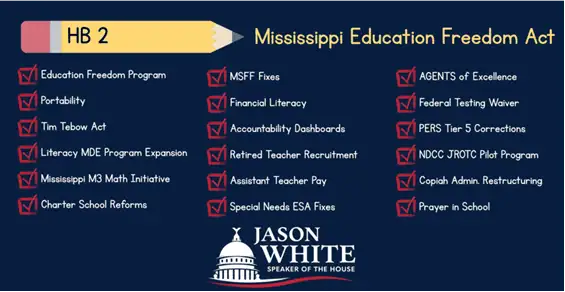
Bill Spotlight: HB 2 — Mississippi Educational Freedom Program Act of 2026
HB 2 represents the most comprehensive education reform proposal introduced so far this session. At its core, the bill is designed to expand educational options for Mississippi families by giving parents more flexibility in how and where their children are educated.
The legislation would create a new education freedom program that allows eligible families to direct education funding toward the learning environment that best fits their child’s needs.
As expected for a bill of this scale, HB 2 has sparked strong reactions. Supporters view it as a long-overdue step toward empowering parents and improving outcomes, while critics have raised concerns about its potential impact. That debate isn’t unusual for a proposal that challenges long-standing systems. What’s undeniable is that HB 2 has pushed education reform to the forefront of the conversation this session.
Growing Support Beyond the Capitol
Momentum around education reform isn’t limited to lawmakers.
Last week, 101 Mississippi business leaders signed a letter urging the Legislature to move forward with a strong school choice program, pointing to the connection between education, workforce readiness, and the state’s long-term economic growth and success.
Support has also come from outside the state. U.S. Secretary of Education Linda McMahon praised Mississippi's effort, saying she was “thrilled to see Mississippi advancing an ambitious school choice expansion in their 2026 session,” and noting that giving parents options is key to improving education outcomes.
National education organizations have echoed that sentiment, highlighting Mississippi as a state to watch as these discussions move forward. Taken together, these voices underscore just how significant this moment is for education policy in Mississippi.
Other Bills We’re Watching
While education has dominated early headlines, several other policy areas are beginning to take shape as well.
In healthcare, a small number of bills have been introduced that create targeted exceptions to Mississippi’s Certificate of Need laws. These proposals stop short of broad reform, but they do suggest a continued interest in revisiting how healthcare access and competition are regulated.
On the budget side, lawmakers have introduced a large number of appropriations bills for state agencies, local projects, and infrastructure. At this point, these reflect individual funding requests rather than a broader fiscal framework. More substantive budget discussions are expected later in the session. We’re also keeping an eye on early activity related to public purchasing and procurement, though no comprehensive reform proposals have emerged yet.
What Comes Next
As the session moves forward, we’ll be watching closely to see:
- How HB 2 progresses through committee and what changes, if any, are proposed
- Whether education reform efforts expand beyond HB 2 into additional legislation
- When broader conversations around healthcare regulation and fiscal policy begin to take shape
We’ll continue to track developments and share important updates as they happen.
Track Legislation in Real Time
Want to follow along as bills move through the process? You can track key legislation throughout the session using the Mississippi Center for Public Policy’s bill tracker.
Thanks for following along this week as the legislative session continues to take shape. I’ll be back next Wednesday with another update on what’s happening at the Capitol and what it means for Mississippi.
We made it through the first day of the Mississippi legislative session, and just like that, the Capitol is buzzing again.
Over the next few months, lawmakers will debate, negotiate, amend, and vote on policies that directly impact Mississippi families, workers, and businesses. Keeping up with what’s happening under the dome can feel overwhelming, especially when things move quickly and change by the hour.
That’s why I’m excited to introduce Dispatch from the Dome, a new weekly update from the Mississippi Center for Public Policy. Each Wednesday during the legislative session, I’ll break down what’s happening at the Capitol in clear, straightforward terms. What’s moving, what’s stalled, and what matters most.
Today’s update is a simple one. We’ve officially kicked things off. Below is a snapshot of what’s happened so far in the House and Senate as lawmakers begin setting priorities and filing legislation that will shape the weeks ahead. Let’s dive in.
House Update
As of the close of Day One, the House had filed one bill so far, HB 1, which revises the number of chancellors in the Third Chancery Court. Other than that, things were fairly quiet on the policy front, which is pretty typical for the opening day of session. That said, there’s already movement happening behind the scenes. Speaker Jason White and his leadership team held a caucus meeting on Day One focused on school choice, and there’s strong anticipation that the House will introduce its school choice legislation today (Wednesday, January 7th). We’re encouraged by what we’re hearing and will be watching closely as details are released.
Senate Update
The Senate wasted no time getting to work, moving quickly on several education-related bills on Day One. A handful of measures were introduced and have already cleared committee, signaling that education is shaping up to be a major focus early in the session.
Here’s a quick overview of what’s been filed so far:
- SB 2001 would provide pay raises for school teachers, assistant teachers, and college faculty.
- SB 2002 would remove the requirement that a student’s current school district approve a transfer before that student can move to another district. This bill is intended to be a "public-to-public" school choice option.
- SB 2003 revises current provisions for retired educators who want to return to work in the classroom.
It’s still very early, but the pace in the Senate suggests we’ll see continued movement on education issues in the days ahead. As always, we’ll be following these bills closely as they move through the process.
What We’re Watching
Because this is just the very beginning of session, many major policy priorities have not been formally introduced yet. At this point, we haven’t seen bills filed related to several Mississippi Center for Public Policy priorities, including certificate of need reform, broader school choice proposals beyond the Senate measures, or long-term budget policy.
That’s not unusual for Day One. Many of these conversations are still happening behind the scenes, and legislation often starts to appear more quickly once lawmakers settle into the rhythm of session. We’ll continue keeping a close eye on what’s filed and will flag important developments as they happen.
Track Legislation in Real Time
Want to follow along as bills are introduced and move through the process? We’ve made it easy. You can track key legislation throughout the session using the Mississippi Center for Public Policy’s bill tracker, which highlights proposals we’re monitoring and explains why they matter.
Thanks for following along this week. I’ll be back next Wednesday with another update on what’s happening under the dome and what it means for Mississippi.