
Lawmakers across the country often insist on making “investments” in economic programs to help fill a perceived need for skilled workers. But such efforts often put the needs of the state and favored industries ahead of the needs of individuals -- and they miss big picture questions in the process.
This critical view should be taken about the newly passed UPSKILL program, which is expected to cover tuition and fees associated with getting a certificate or degree at a Mississippi public community or junior college. The program, in House Bill 562, passed with unanimous support from lawmakers and the governor signed it into law.
Initially, the program will be exclusively for Mississippians overcoming opioid addiction, hence the funding source of the program starts with money from $50 billion opioid settlement to state, local, and tribal governments. Republican Sen. Nicole Boyd told her colleagues that the program will be good for people in recovery.
“It is the program where we encourage those that are over age 24 to up-skill and get into high priority work sectors,” she said, according to the Magnolia Tribune.
The Design Problem: Labor Market First, Person Second
But UPSKILL’s eligible programs will be determined annually by the state’s review of employer demand and workforce shortages — essentially, what the labor market needs. That sounds sensible, but in practice those designations are heavily influenced by major employers who want a trained workforce pipeline at public expense. The program could function as a publicly-subsidized labor supply program for specific private employers without those employers contributing to its cost.
Crucially such an approach underemphasizes, and even ignores, the fact that each person is born with unique gifts and talents. Asking what the labor market needs and then pushing people into state-sanctioned boxes is the reverse of what should be happening.
A person with a gift for artistry, writing, craftsmanship, early childhood education, or caregiving work might find little room in a program built around HVAC, welding, and construction certifications. The program, therefore, treats people as inputs to an economic system rather than as individuals who deserve respect for escaping addiction and now have distinct contributions to make.
The state might (and probably will) eventually justify the program’s existence and call for its expansion as students apply for funding to gain a certificate or degree in an approved field and shortages in some areas are ameliorated. But in such an analysis, there’s no accounting for quality of life, e.g., if a person finds himself in a job he never wanted just because money was available to meet the need.
The Community Problem: What the State Crowds Out
It’s also worth noting that the program creates a transactional connection between a person and an employer-defined credential, but it severs and discourages the community connections important to the growth and wellbeing of a person, especially one in recovery. The state stipend is $500, which would be a manageable dollar amount for local charities, churches, civic organizations to offer, if they were so inclined.
UPSKILL’s enabling legislation intends participants to tap into other government assistance programs, including Temporary Assistance for Needy Families (TANF) to provide up to $250 for “emergency aid, childcare stipends or transportation assistance (bus vouchers or gas cards).”
That leaves no room for local charities and organizations to engage. If they were invited to, they could offer things the state is not offering: mentorship, peer cohorts, community check-ins, drug rehab integration circles, stuff that goes beyond a program and several hundred dollars. Recovery communities know that sustainable reintegration requires more than a job; it requires belonging.
The state program also has the deleterious effect of creating an expectation that the state will step in to offer money and support services, because that’s what the state does, as proven by this program. One could reasonably ask, “where does the state’s role stop and the community effort begin?”
A person who has spent ten years in a low-wage job, never touched drugs, but lacks the credential to move up — isn’t he or she equally deserving of support? The program’s initial gatekeeping, driven by the funding source, creates a hierarchy of deservingness that puts former addicts ahead of people who also struggle.
None of this is to say the problem UPSKILL is trying to solve isn’t real. Mississippi has thousands of job openings and communities hollowed out by addiction. The state stepped in precisely because communities, churches, and civic organizations hadn’t filled the gap at scale. That’s worth acknowledging honestly. It’s also worth understanding why. Is it possible that the state government’s broad list of programs, decades in the making, played some part in the lack of persistence of non-governmental organizations to meet local needs?
The critique isn’t that the need doesn’t exist — it’s that the state’s instinct to solve it by building a pipeline for employers, rather than building up people, reflects a persistent confusion about what investment in human beings actually looks like. It also avoids the bigger questions about systemic problems that Mississippi, and many other states, must begin to understand.
— Wayne Hoffman is President of the public policy education and advocacy organization, Level Up Humanity, and is a research fellow of the Mississippi Center for Public Policy.
ALEC's Rich States, Poor States index now has Mississippi at 24th for economic outlook. The trend lines, and the policy choices behind them, explain why.
The latest Rich States, Poor States index has just been published by ALEC, and for anyone who cares about the direction of our state, it makes for encouraging reading.
Mississippi now ranks 24th in America for economic outlook. That is a forward-looking measure, built from fifteen different state policy variables — tax burden, regulatory environment, labor law, and more. A decade ago, the idea of Mississippi sitting in the top half of that table would have been difficult to imagine. Today, we are there — and we are still climbing.
Three trends worth noting
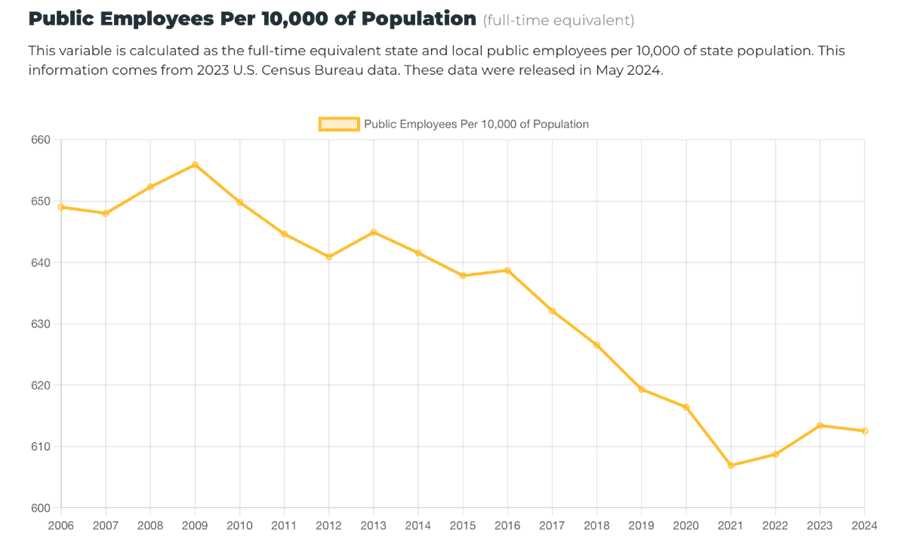
Public sector shrinking, private sector growing. The number of public sector employees in Mississippi is falling — which means the private sector, the part of the economy that actually generates wealth, is becoming more prominent. That is a structural shift, not a one-off.
Public Employees Per 10,000 of Population (full-time equivalent)
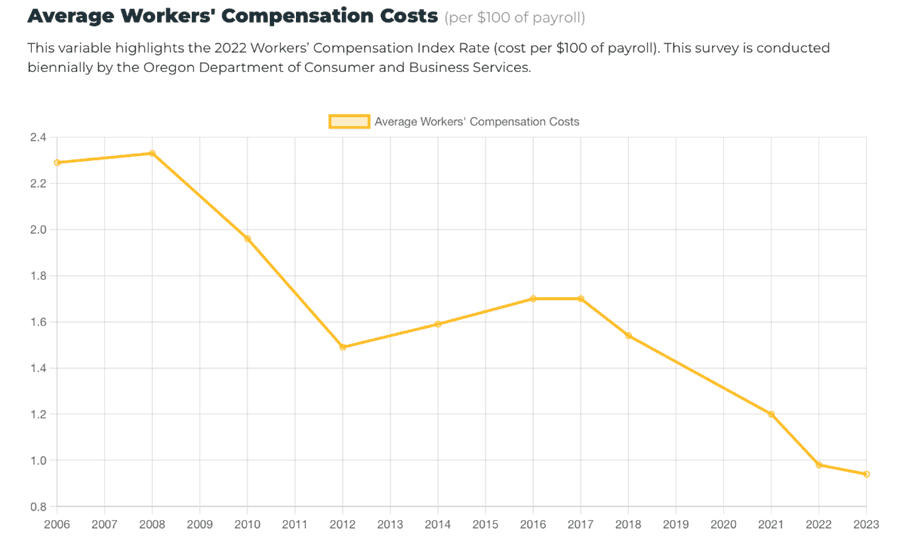
The cost of doing business is falling. The non-wage costs of hiring people in Mississippi have come down steadily. That is one of the reasons so many firms are now choosing to invest here rather than somewhere else.
Average Workers' Compensation Costs (per $100 of payroll)
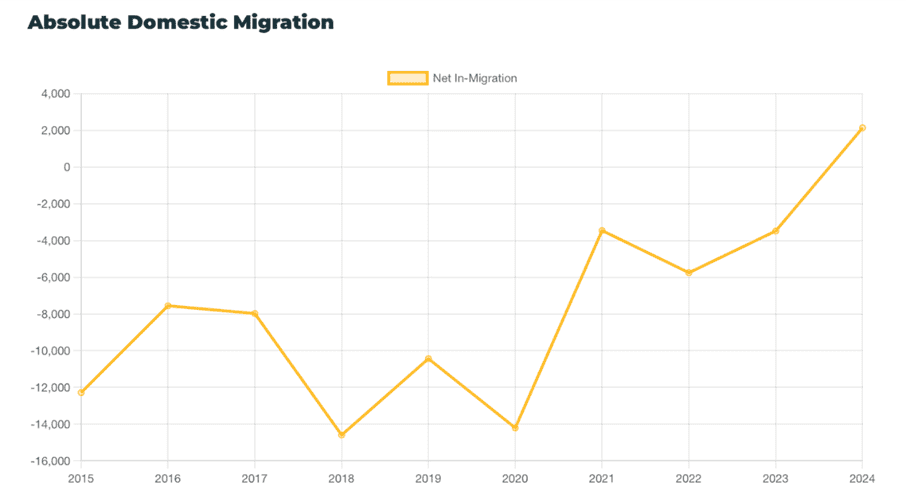
More people are moving in than out. This may be the most important of all. For too long, young Mississippians moved to Birmingham, Nashville, or Austin to find better opportunities. Now, at last, the trend is reversing. More people are moving to Mississippi than leaving it.
Absolute Domestic Migration
How we got here
None of this happened by accident. It is the cumulative result of half a decade of serious policy reform — and at every stage, opposition was loud.
In 2021, Mississippi enacted serious labor market reform — making it easier for people to work, to train, and to move between careers.
In 2022, we replaced an old, progressive tax code with a flat tax.
Year after year, we have kept energy costs among the most affordable in the country — a quiet advantage that every family and every employer benefits from.
In 2024, we passed education funding reform so that the money at last follows the child.
In 2025, we enacted the historic elimination of the state income tax — a policy that only a few years ago was dismissed as politically impossible.
And in 2026, we have begun to take on the thicket of red tape that has held back our healthcare economy.
Every one of these reforms was resisted. Each was said, at the time, to be too ambitious or too politically risky. Each now stands as part of the answer to why Mississippi is moving up the rankings.
How laws actually pass
Ideas do not turn into law without people willing to fight to make it happen. Sycophancy might get you into the signing ceremony. It takes robust advocacy to ensure that there is a bill to be signed in the first place.
The rest of the country is beginning to notice. Mississippi is no longer the state that others use as a punchline. We are becoming a state that others are studying.
There is a great deal still to do. But the direction of travel is clear — and you have helped set it.
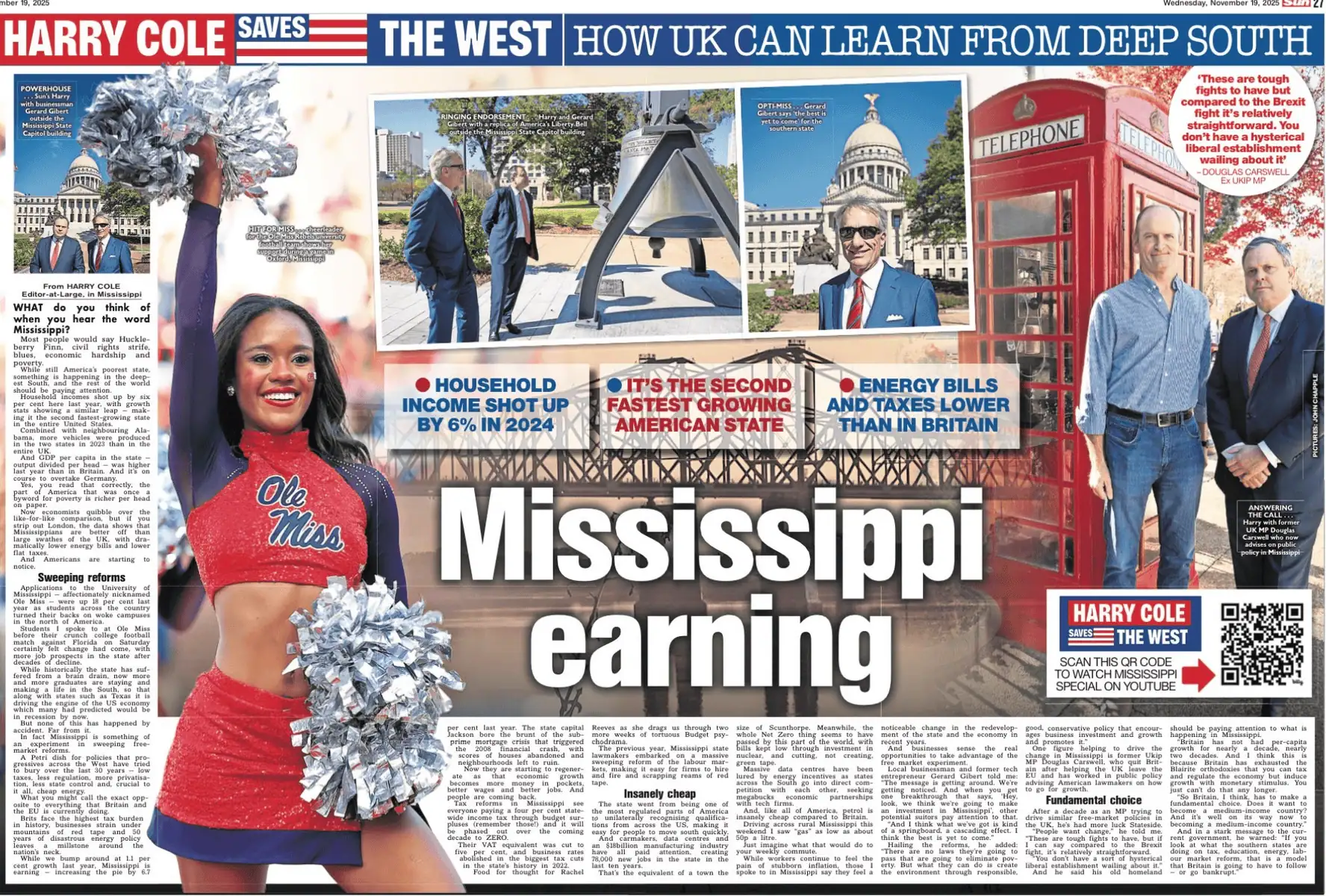
Something remarkable has happened here in Mississippi. The state that for most of the last century sat at the bottom of nearly every American economic table has, quietly, pulled ahead of the United Kingdom in GDP per capita. Last week, Governor Tate Reeves highlighted the fact on X/Twitter in his characteristically Southern style - and the tweet went viral.
It is a moment worth pausing over — and worth understanding because what Mississippi has achieved over the past five years is not an accident or down to luck. It is the product of a deliberate, sustained program of free-market reform that few governments successfully deliver.
I first noticed that Mississippi was overtaking Britain in terms of output per person back in 2023, and wrote about it for both The Atlantic and The Sunday Times. The reaction from British commentators at the time was a familiar scramble for excuses — purchasing power parity adjustments, Ukraine, Covid — anything, in fact, other than the policy choices Britain itself had been making for thirty years.
Now the claim that Mississippi has overtaken the UK is no longer disputed. A new report from the Institute of Economic Affairs last week asked British voters to guess where the UK would rank among America’s fifty states on GDP per capita. On average, they placed their country seventh. In reality, as the report showed, the UK ranks fifty-first — dead last, below every single U.S. state, including Mississippi. More than a quarter of respondents said they felt “shocked” when shown the truth. Alas, facts do not care about British feelings.
I am glad Governor Reeves has now put the spotlight on this again. But to me the more interesting question is not how far Britain has fallen. It is how far Mississippi has climbed.
For most of the last hundred years, the Magnolia State always seemed to be last. Our per capita income was the lowest in the Union. Serious investment passed us by. But recent years have seen a decisive shift.
In 2021, Mississippi passed meaningful labor market reform, making it easier for people to work, train, and switch careers. In 2022, we replaced an old tax code with flat tax reform - a clear signal that Mississippi had stopped apologizing for letting people keep more of what they earn.
Year after year, we have kept our energy among the most affordable in the country — a quiet advantage that every family and every employer benefits from. As other parts of the world that embraced aggressive renewable energy policies grapple with rising costs, Mississippi’s more measured energy approach is looking increasingly wise.
In 2024, we passed education funding reform that finally lets the money follow the child, putting more of it into the classroom. In 2025, we took the historic step of passing legislation to eliminate the state income tax altogether — a policy that only a few years earlier had been dismissed as impossible. And in 2026, we have begun cutting through the thicket of red tape that has held back our healthcare sector for too long.
No single one of these reforms was enough by itself to turn the state around, but together this package of free-market reforms is enough to lift the trajectory of an entire state. And these reforms compound. Labor market liberalization makes tax reform more potent. Lower taxes make affordable energy more valuable. Better schools raise the human capital on which all of it depends. This is what a real politics of growth looks like — not a single heroic leap, but a steady accumulation of practical wins, year after year.
This is why our numbers have moved. It is why they will keep moving.
If you want to know why Britain is floundering, imagine what Mississippi might be like if we had had Bernie Sanders in charge for the past twenty years. Taxes there are too high. Regulation is intrusive. Immigration is out of control. Energy costs are sky-high. Britain has been run by a succession of Bernies, and it’s been a disaster.
Mississippi shows the alternative. The policies that lifted this state from the bottom of the American table are not secret. They are practical, proven, and available to any government willing to pursue them with the courage and patience they require.
The world is starting to notice Mississippi’s success. So should we.
Something significant is happening in America's South, and it deserves more attention.
While New York and California are losing residents, states like South Carolina and Alabama are gaining population at a record pace - and alongside that growth, it is southern states like ours that are generating some of the most impressive economic numbers in the country.
A recent JL Partners poll found that 36 percent of Americans now expect the South to lead economic growth over the next decade. That puts it well ahead of the West Coast (23 percent), the Northeast (21 percent), and the Midwest (19 percent). Young graduates are even more bullish: nearly four in ten name the South as the region most likely to grow fastest in the coming decade.
The data backs up the optimism.
Real GDP growth in 2024 tells the story clearly. Mississippi and South Carolina grew at 4.2 percent. Alabama and Arkansas at 3.8 percent. Tennessee at 3.0 percent. All surpassed the national rate of 2.8 percent. Between 2020 and 2024, 78 percent of all U.S. jobs added to the economy were located in the South. The region's population has grown by seven million since 2020 — and the pace appears to be accelerating.
Manufacturing is a key part of the picture. U.S. industrial output has roughly doubled since the Reagan era, and much of that expansion went South rather than overseas. Alabama alone has added over 50,000 auto jobs since 2000. Combined, Alabama and Mississippi now produce more vehicles annually than Italy or the United Kingdom.
Finance is following manufacturing. Charlotte, Dallas, Miami, and Nashville have become major financial hubs. JPMorgan Chase now employs more people in Texas - around 31,000 - than in New York.
Even higher education is shifting. SEC universities have seen a 91 percent surge in out-of-state undergraduate applications between 2014 and 2023, with many of those students coming from the Northeast.
What explains it?
The answer is policy. Southern states like Mississippi have built environments that are straightforwardly more attractive for businesses and workers alike.
Taxes are lower. Several southern states have no income tax — Texas, Florida, and Tennessee among them - while Mississippi and South Carolina are on a path to eliminating theirs entirely.
Regulatory burdens are lighter: South Carolina recently repealed a range of Certificate of Need rules that had constrained its healthcare economy, a stark contrast to California's expanding compliance requirements.
Labor markets are more flexible, with most southern states operating as right-to-work states. Occupational licensing restrictions are being reduced, making it easier for people to enter the workforce. And electricity costs are significantly lower, in part because the South never adopted the rigid renewable mandates that have driven up prices in the Northeast and California.
This is, in many ways, a natural experiment in governance. Fifty states, trying different approaches side by side - and some are producing markedly better results than others. The South appears to have found a formula that works.
None of these policy wins happened by accident. They were the result of years of sustained advocacy - and you have been a vital part of that. Your support has helped make the case for lower taxes, lighter regulation, and greater economic freedom. The results speak for themselves.
Too many young people still leave Mississippi to chase opportunities elsewhere. MCPP is on a mission to help change that - by creating the conditions for real, sustained growth so our children and grandchildren choose to stay, build lives, and thrive right here in our state.
The good news? Mississippi is no longer a laggard, but leading.
Thanks to free-market reforms, we're now one of the fastest-growing states in the nation. Over the past five years, we've seen more economic growth than in the previous 15 combined. In 2024, Mississippi ranked #2 nationally in real GDP growth. Historic tax cuts have put more money back in families' pockets, flexible labor laws and affordable energy have attracted over $40 billion in investments since 2020, and fiscal discipline has kept us on solid ground.
Building on this remarkable momentum, the Mississippi Center for Public Policy recently launched our latest paper at an event in Jackson: Mississippi Momentum: A Blueprint for Lasting Prosperity.
This blueprint outlines targeted, practical reforms to accelerate our progress and secure long-term prosperity. Key proposals include:
- Universal school choice through a phased-in Education Savings Account (ESA) program - starting with thousands of students and expanding to make every family empowered to choose the best education path for their child.
- Healthcare freedom by partially repealing Certificate-of-Need (CON) laws and granting full practice authority to Advanced Practice Registered Nurses - reducing costs by up to 15% and improving access, especially in rural areas.
- Conservative spending to limit government growth to inflation plus population increases, protecting our tax cuts and generating surpluses for future relief or priorities.
- Welfare-to-work requirements for able-bodied adults on TANF and SNAP, promoting self-reliance and drawing on successful models from other states.
- Merit-based procurement reforms to ensure transparent, competitive public contracts focused on price, quality, and expertise - ending favoritism and waste.
These ideas are already shaping the policy conversation in Mississippi. Many of the reforms outlined in this blueprint are now central to debates at the Capitol. While important work remains, the direction is clear: Mississippi can continue to grow faster, compete harder, and lead the nation in pro-growth reform.
Readers can access the full “Mississippi Momentum: A Blueprint for Lasting Prosperity” at mspolicy.org/publications/msmomentum/
I hope you find our latest paper inspiring and useful.
As someone who moved 4,000 miles with my family to make our home in the Magnolia State, I am more certain than ever that Mississippi can lead the way for other states in America to follow.

A small win for freedom in Mississippi! Governor Tate Reeves recently signed HB3, a law that reforms the state’s Certificate of Need (CON) rules.
CON is basically a government approval process healthcare providers (like hospitals) must go through before they can add certain services, build new facilities, buy expensive equipment, or make big expansions.
HB3 makes some modest changes, allowing more flexibility for some specific providers. It also raises the dollar threshold for capital spending requiring approval.
Perhaps the most significant part of the bill is that it mandates the Mississippi Department of Health to do a study over the course of this year into the feasibility of letting smaller hospitals skip CON when providing kidney dialysis treatment and adult psychiatric services.
While HB3 does not give us the reforms Mississippi needs, it is a step in the right direction. In a legislative session that has seen most significant reforms killed in the Senate, this is one rare example of a free market reform in the 2026 session.
For decades, Mississippi has been the punchline in national discussions about economic performance - often ranked at the bottom in income, education, and opportunity.
But something remarkable has happened in recent years: the Magnolia State is undergoing a genuine resurgence, driven not by federal handouts or gimmicks, but by principled free-market reforms.
A major national publication, the Washington Examiner, recently spotlighted this transformation in a feature titled "Mississippi Turning." The article notes that Mississippi has achieved more economic growth in the past five years than in the previous 15 combined.
This isn't hyperbole; recent data from the Bureau of Economic Analysis shows Mississippi posting some of the nation's strongest GDP growth rates, including a 4.2% real GDP increase in 2024 that ranked second nationally.
What’s fueling this engine? Bold structural changes that prioritize freedom, competition, and low barriers to opportunity.
First, labor-market reforms have opened doors for workers and entrepreneurs. In 2021, Mississippi enacted universal recognition of out-of-state occupational licenses, allowing skilled professionals to bring their talents here without jumping through needless bureaucratic hoops. The state has also slashed red tape on in-state licensing requirements, eliminating hundreds of hours of mandatory training for many everyday jobs. These changes have attracted talent, put downward pressure on remaining barriers, and made it easier for Mississippians to earn a living.
Second, historic tax reform is putting money back in people's pockets. Starting with the largest tax cut in state history in 2022, Mississippi phased in a flat 4% income tax. In 2025, lawmakers went further, enacting legislation to reduce the rate to 3% by 2030 and trigger annual cuts thereafter until the state income tax is fully eliminated—the first such move by a state in decades. This pro-growth policy rewards work and ambition while making Mississippi more competitive for businesses and families.
Third, a commitment to reliable, low-cost energy has made the state a magnet for investment. By resisting costly subsidized green mandates, Mississippi has kept electricity prices among the nation's lowest, powering energy-intensive industries like data centers and advanced manufacturing. Major announcements, including billions from companies like Amazon Web Services, underscore how affordable energy translates into jobs and capital inflows. Since 2020, the state has attracted tens of billions in private investment, fueling record-breaking economic development.The results speak for themselves: explosive GDP growth, surging personal incomes, rising university enrollments, and—for the first time in generations—net in-migration as people choose to move to Mississippi rather than away. Recent years have seen positive net migration, reversing long-standing outflows and signaling a brighter future.
This turnaround didn't happen by accident. It's the direct consequence of free-market ideas championed by policymakers and advocates who refused to accept the status quo. Mississippi is no longer just catching up; it's becoming a national model that other states are watching closely.
As we close out another productive year, moments like the Washington Examiner's recognition remind us that principled, steady work pays off. Mississippi is proving that freedom works—creating a freer, more prosperous place for all its citizens. Other states should take note: lower taxes, fewer regulations, and reliable energy are the path to revival.
Click here to read the Washington Examiner article.
The future for our state looks bright. In just the past five years, Mississippi has seen more economic growth than in the entire fifteen years before that combined.
We’re on track to phase out the state income tax entirely, allowing families to keep more of what they earn. Mississippi has attracted a surge of new investment, and for the first time in years, our workforce participation rate is finally heading in the right direction.
Zoom out, and the picture gets even better. Contrary to the endless gloom from the pundits, the American economy has consistently outperformed expectations for decades. Since the late 1990s, the U.S. has delivered strong, steady growth that few forecasters saw coming.
But there is one dark cloud on all our horizons that we cannot forever ignore; US national debt.
As of today, US national debt stands at $38 trillion (with a capital T).
To grasp how enormous a single trillion really is, try this:
- One million seconds ago was just last week, right before Halloween.
- One billion seconds ago was early 1994, when Clinton was president and the internet was dial-up.
- One trillion seconds ago was roughly 30,000 BC, deep in the Stone Age, when humans were still chasing mammoths.
Now here’s the gut-punch: that $38 trillion mountain of debt has roughly doubled in just the past ten years.
Costly foreign wars, mega bailouts, COVID giveaways and all those federal entitlement programs LBJ said would “end poverty”, eventually add up. (Incidentally, living standards for America’s poorest citizens are light-years higher than when those programs launched in the 1960s (indoor plumbing, air conditioning, smartphones, modern medicine), but the number of people dependent on government assistance is larger than ever).
Rather than pay for all that using tax receipts, the US government has borrowed, issuing IOUs. Today we spend more money servicing all those IOUs than we do on defense.
As my fellow Brit, the historian Niall Ferguson, likes to point out, any great power that spends more on debt servicing than on defense risks ceasing to be a great power. That was true of the Romans and the British, the Habsburgs and the Dutch.
What must America do to avoid a similar fate?
When President Trump was first elected, Elon Musk and Vivek Ramaswamy launched the Department of Government Efficiency (DOGE) with an ambitious target: to reduce annual federal spending by $2 trillion.
Because mandatory entitlement programs - Social Security, Medicare, and Medicaid - remained largely untouched, DOGE hasn’t come close to achieving that yet. The federal deficit has barely budged.
Where, one might ask, are all those Tea Party types that railed against federal overspending ten years ago as the debt to GDP ratio went from 90 percent in 2010 to 125 percent today?
If the US cannot rein in the growth of the debt, the only other way to avoid going the way of the Romans is to try to make the GDP part of the equation rise faster. In other words, to try to grow our way out of the debt.
In order to stabilize debt-to-GDP at the current 125 percent of GDP, America will need to achieve real GDP growth of about 4 - 5 percent for the next 10 to 20 years. With the advent of AI and robotics, as Elon Musk suggests, it could be done.
Put it another way; without an AI / Robotics induced growth surge, US debt will hit 150 – 170 percent of GDP by 2050. Mamdani-economics would then become the least of our worries, as inflation and tax rises became inevitable whoever held office.
The older I get, the more I think that there are two fundamental things that the federal government needs to get under control: mass immigration and the deficit. Do that, and states like Mississippi have a bright future. Don’t, and all the good that we might do will only matter at the margins.