
The Mississippi Hemp Cultivation Task Force’s draft report released on in November that stops short of a specific policy recommendation for the legislature, but provides useful information for potential legislation.
Mississippi is one of only three states where hemp cultivation is illegal and the legislature could take up the issue in January, when it returns to Jackson for the annual regular session.
Hemp is derived from strains of the cannabis sativa plant with low amounts (0.3 percent content or less) of the psychoactive substance in marijuana known as THC. The plant can be cultivated for its fiber, which can be used in insulation, rope, textiles, and other products.
The seeds are also a good source of protein and are edible by humans or animals. The flowers of the plant can be used for cannabidiol, or CBD oil production with possible benefits still being studied by scientists both in Mississippi and nationwide.
The report admits that some states who began pilot hemp cultivation programs under the 2014 Farm Bill — such as Kentucky, Oregon, North Carolina and Virginia — are at “some advantage,” but would still have to reconcile their programs with draft federal regulations that came out on October 31.
These new rules govern hemp cultivation nationally after the2018 U.S. Farm Bill authorized the growing and sale of hemp.
The report says that the state will have the advantage, as a possible late adopter of hemp cultivation, in having the benefit of other state’s experiences.
Economics
Hemp, according to the report, has some pitfalls when it comes to whether Mississippi farmers could effectively cultivate it for profit.
Supply chains for hemp-related products are not mature, according to the report. Also, verification issues with keeping crops below the legal 0.3 percent THC threshold and what to do if a crop goes “hot” and tests over that standard.
The report also says Kentucky’s program quickly spawned 70 licensed processors. There is also a Charleston, Mississippi-based company, Kengro, which imports Kentucky hemp for processing to fiber for animal bedding products for Ecofibre, an Australian-based company that does business in both CBD oil and hemp fiber/seed markets.
Projections from the state’s two agricultural universities, Mississippi State and Alcorn State, suggest that fiber or grain production, and especially combined production, could offer an economically viable alternative to other staple Mississippi crops such as corn, cotton, and soybeans. Researchers used data from Kentucky and Missouri and adjusted it for Mississippi.
Growing hemp for grain and fiber would be the state’s most profitable crop next to cotton grown in the Delta.
The report also says that more states approving hemp production means supplies will increase while prices will drop.
Agronomy
According to the report, finding hemp strains that will grow in Mississippi’s climate will be a huge obstacle to cultivation and finding such strains could take several years.
Also, there are no approved pesticides or herbicides authorized by the U.S. Food and Drug Administration.
The report says much research still needs to be conducted on hemp, including:
- Crop protection products to control weed competition, disease and insects.
- Improved harvesting and post-harvest management techniques.
- The effects of environmental on THC level to ensure producers don’t exceed regulatory thresholds.
- Product development.
Law enforcement and regulation
The report says that law enforcement personnel and canine officers are unable to discern the difference between marijuana and legal hemp except with laboratory analysis.
Among the concerns about hemp cultivation include:
- Inability to distinguish between legal hemp and marijuana (greater than 0.3 percent THC content) on the side of the road.
- Law enforcement officers would be unable to conduct arrests and prosecutors would be unable to prosecute marijuana cases, as in areas of Florida, Georgia, Ohio and Texas where simple possession of marijuana cases aren’t being prosecuted.
- A backlog at the Mississippi Crime Laboratory of 400 exhibits per month.
- It would cost $500,000 for the crime lab to perform THC chemical analyses.
The report also says that since resources of state agencies needed for regulation are under stress, lawmakers much have a plan needed to “support the infrastructure needed to ensure public safety related to hemp cultivation and hemp products.”
The combination of professional and college football, along with a competitive seven-game World Series, helped make October a solid month for sports wagering in Mississippi.
The total taxable revenue for the month was a little more than $12.2 million, an 18 percent increase from October of last year for the state. Those numbers varied by regions, however. The northern and central regions had minimal gains of 5 and 4 percent, while Coastal casinos posted a change of more than 24 percent. Also of note, more than half of the revenue was from baseball.
Because of the timing of the most popular sporting events to place bets on, revenue from sports wagering has– and will – continue to fluctuate greatly by month.
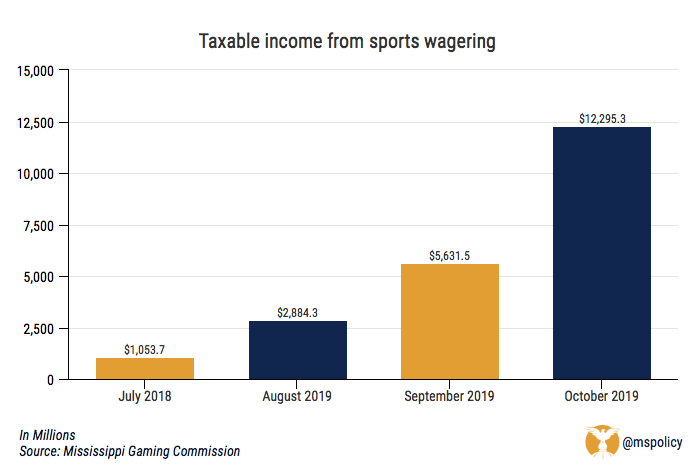
And competition will only continue to increase for money from sports betting since the Supreme Court legalized the practice last year. For now, the Coast has been saved from Louisiana’s inability to pass legislation legalizing sports betting in the Pelican State. They will surely try again.
Other states have moved faster.
In Arkansas, sports betting became legal in July. A year ago, voters approved a ballot initiative legalizing sports betting and the Oaklawn Racing Casino Resort in Hot Springs, is the first to welcome betters. While the timeline is still to be determined, a casino closer to home, Southland Gaming & Racing in West Memphis, is expected to begin collecting wagers soon. Competition has swallowed a lot of the revenue Mississippi once experienced, and this would likely add further pains to Tunica area sports betting operations.
Tennessee could also add to those pains, but they have some work to do. The state passed an online-only sports betting bill earlier this year, but it has many issues – requiring sportsbooks to buy official league data to settle in-play wagers, a very expensive entry point and high taxes, and a ban on prop bets in NCAA games. Much work remains before the Volunteer State is taking bids.
Legislation was introduced in Alabama this year, but it did not move and most consider sports betting a long-shot with our neighbors to the east.
While competition and the general ebb and flow of sporting events people like to place wagers on will always remain, Mississippi’s requirement that you must be in a casino to place bets greatly limits the pool of those who will legally bet.
As we see, it can be a boon during the World Series or March Madness, but generally speaking a person in Jackson isn’t going to drive to Vicksburg to place a bet on a random baseball game in July. They will continue to bet illegally because bookies are not going to disappear overnight.
While Mississippi made a positive first step in being ahead of the curve when it comes to sports betting, all of the data shows that states need to create an avenue for individuals to bet online to generate the most revenue.
Last week, Americans celebrated Thanksgiving with family, turkey, football, and – more likely than not – shopping. Early reports show that Americans began the official 2019 holiday season with record retail purchases.
And while a great deal of the focus will be the continued shift away from brick-and-mortar to digital, we can also use the time to acknowledge the best news: it is easier than ever to purchase common household goods.
Did you purchase a television on Black Friday? Today, TVs are universal, and if you don’t have one it is likely because you made the conscious decision not to have a TV in your house, not because you can’t afford it.
That’s because TVs, like most commonly owned goods, have declined dramatically in price. A 23” color TV in 1968 cost $2,544 (in 2018 dollars). Based on the average hourly wage in the manufacturing sector, also in today’s dollars, it would take 125 hours of labor to afford that purchase. Last week, 32” smart TVs were available for $99, or less than 5 hours of labor. And this doesn’t take into account the technological advances of TVs in 2019.
When we see stories about wages being stagnant or new generations being worse off than their parents, we miss one very important item: purchasing power. Yes, government regulated items like education and healthcare have increased much faster than inflation, yet that’s not true of most consumer goods, as shown in the chart below.
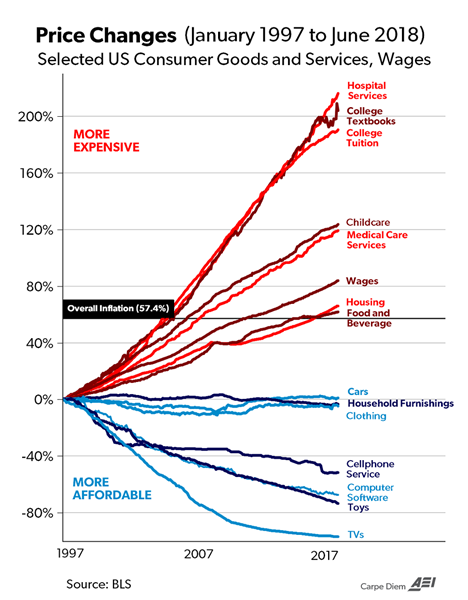
We have the ability to purchase more items, and we are likely buying items of greater than quality.
Need something else to be thankful for? The cost of your Thanksgiving dinner slightly declined from the past year, continuing a 30-year trend.
“The main course on many Thanksgiving tables, the turkey, costs slightly less than last year,” a new story from Human Progress found. “In 2019 the average nominal cost of a Thanksgiving turkey stands at $20.80 for a 16-pound bird. That’s roughly $1.30 per pound, a 4 percent decrease from last year. And that’s before adjusting for inflation!”
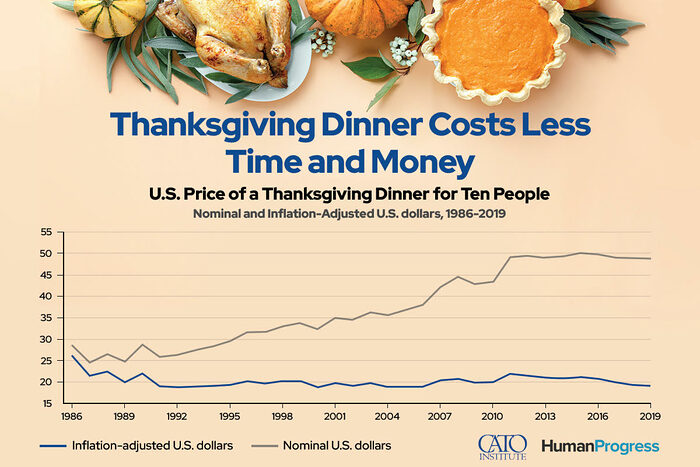
And if you traveled last week, you’ll also be happy to know that air travel continues to get safer.
Our well-being is improving, and it’s expanding to more and more Americans. Something we rarely hear about, or talk about. Maybe we should.
The Mississippi Hemp Cultivation Task Force voted Wednesday to approve the release of their final report to the legislature on December 2.
The task force says in the executive summary that while there is both positive potential and significant risks for hemp cultivation in the state, there could be additional costs for taxpayers.
Mississippi is one of only three states where hemp cultivation is illegal and the legislature could take up the issue in January, when it returns to Jackson for the annual regular session. The task force’s report was designed to give the legislature information on how to craft legislation on legalizing hemp cultivation.
Hemp is derived from strains of the cannabis sativa plant with low amounts (0.3 percent content or less) of the psychoactive substance in marijuana known as THC. The plant can be cultivated for its fiber, which can be used in insulation, rope, textiles and other products.
The seeds are also a good source of protein and can be eaten by humans or used for animal feed. The flowers of the plant can be used for cannabidiol, or CBD oil production with possible benefits still being studied by scientists nationally and at the University of Mississippi Medical Center.
One of the roadblocks for Mississippi hemp cultivation cited by the task force is nearly gone after the U.S. Department of Agriculture presented a draft of regulations on October 31. These new rules govern hemp cultivation nationally after the 2018 U.S. Farm Bill authorized the growing and sale of hemp.
The comment period for the draft rule closes on December 30.
In addition to legislation, Mississippi officials would also have to submit a hemp cultivation plan to the USDA for approval before hemp could be grown in the state.
The problems the task force’s report spotlighted with hemp cultivation include:
- Current oversupply of hemp in the market.
- Lack of infrastructure and supply chain to get the products to market.
Mississippi Agriculture Commissioner Andy Gipson said licensing fees in the 47 other states that legalized it for commercial, research, or pilot programs hasn’t been enough to cover the costs related to regulation, such as hiring new personnel and testing.
He said those type of costs have added up to $500,000 in additional spending in Kentucky, a state Gipson said is the most advanced nationally in its hemp cultivation program.
Mississippi law enforcement agencies lodged the same complaints in the draft report as they have throughout the process. These concerns include:
- Inability to distinguish between hemp and marijuana on the side of the road.
- Law enforcement officers would be unable to conducts arrests and prosecutors would be unable to prosecute marijuana cases.
- A backlog at the Mississippi Crime Laboratory of 400 exhibits per month.
- It would cost $500,000 for the crime lab to perform THC chemical analyses.
According to Gipson, the state’s crime lab meets federal standards for drug testing.
Kentucky could be a model for Mississippi. Since the first pilot program launched in 2014, the number of planted acres has grown from 33 to 6,700 and the number of approved growers have increased from 14 at the program’s inception to 978 in 2019.
State law requires licenses for growers and processers, which include background checks. They also have to consent to inspection by program officials and law enforcement at any location where hemp or related products are grown, handled, stored or processed. Global Positioning System (GPS) coordinates have to be provided to the Kentucky Department of Agriculture before hemp is planted.
Lottery tickets will go on sale next week in Mississippi a short 15 months after the legislature legalized a state lottery in the 2018 special session.
Mississippians will be able to purchase scratch-off tickets beginning on November 25 at one of more than 1,200 retailers statewide. Power Ball and Mega Millions tickets, the multi-state games known for big payouts that have at times surpassed $1 billion, will go on sale later in 2020.
But you need to be older in Mississippi than most other states to purchase lottery tickets. The minimum age is 21. Arizona, Iowa, and Louisiana are the only other states that require you to be 21 to buy tickets. You have to be 19 in Nebraska. Every other state sets 18 as the age minimum.
That includes Arkansas and Tennessee. Mississippi’s other neighbor, Alabama, is one five states that do not have a state lottery.
The bulk of lottery profits in Mississippi – the first $80 million – will be directed toward infrastructure projects. Additional money will go toward education, which is traditionally the primary funding recipient from most lotteries.
Mississippi took a long and windy road toward a lottery
In 1992, voters in Mississippi cleared the way for a lottery by amending the state constitution to allow for a lottery, but there was little interest from the legislature over the next two plus decades. Especially with the creation of casinos along the Coast and Mississippi River and the revenue that gaming promised.
But that changed in 2018. For years, stories regularly ran of Mississippians crossing state lines to purchase lottery tickets as jackpots crept up. Popular support appeared to be on the side of a lottery. Many Republicans were outspoken in their support. And Gov. Phil Bryant came out in favor of a lottery and it became a solution for more transportation funding. And in August of last year, the legislature legalized a lottery in Mississippi.
But even that wasn’t easy. The House initially voted against the lottery conference report in a bipartisan vote of 61 opposed and 53 in favor. Legislators got another stab at it and it passed the House 58 to 54 on the second vote. It was an odd-looking board with the speaker and speaker pro tempore voting against it, but in the end the bill was adopted.
And Mississippians will soon be buying lottery tickets. If they’re 21.
Mississippi’s real gross domestic product outpaced the national and Southeastern average for the second quarter of 2019.
Mississippi’s GDP grew by 2.3 percent compared to the first quarter of the year. This was part of a national trend that saw growth among all 50 states. The national average was 2 percent and the Southeast average, which does not include Texas, was 1.7 percent. Texas posted the strongest numbers in the country at 4.7 percent.
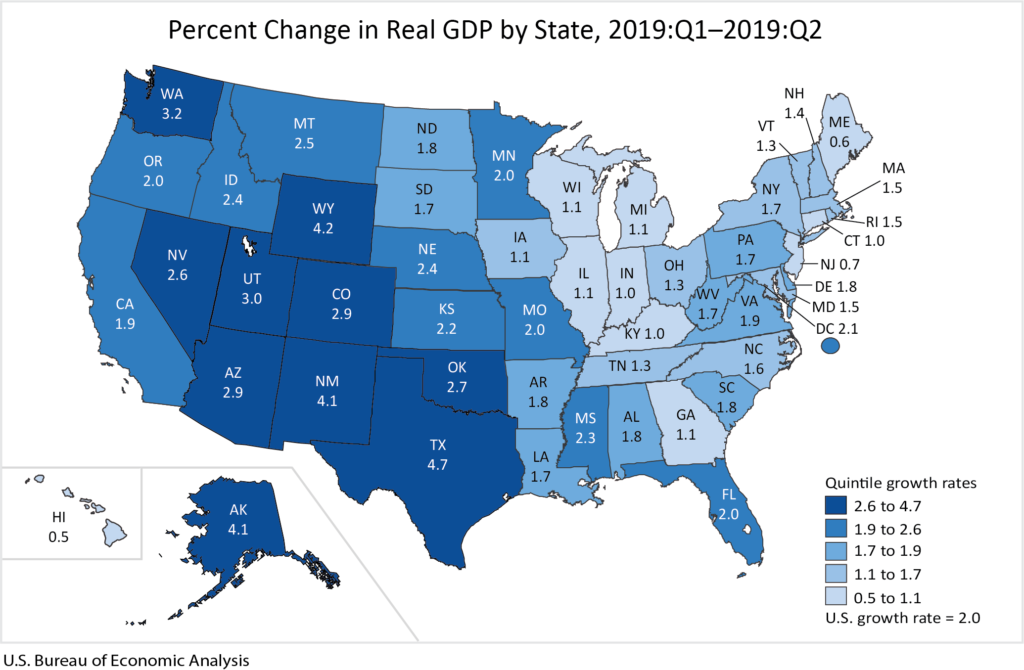
Professional, scientific, and technical services and real estate were two of the leading contributors to the GDP growth. Mississippi’s numbers, however, were below others in both sectors. Mining, which helped many western states see big gains, increased by 23.5 percent nationally.
A look inside Mississippi’s numbers reveals noticeable positives for the state, and areas that need improvement.
- Mississippi outpaced the Southeastern average in agriculture (and related industries), utilities, construction, durable goods manufacturing, retail, and finance.
- Mississippi trailed the Southeastern average in real estate and professional, scientific, and technical services.
- While wholesale trade was down nationally, Mississippi saw smaller loses than Southeastern and national numbers.
- Mississippi had the 3rd highest growth in government, behind only Maryland and New Mexico.
- Mississippi’s percentage of the U.S. GDP has been 0.6 percent for the last six quarters.
Percentage change in GDP, Southeast states
Mississippi led every Southeastern state in change of GDP. Florida was the only other Southeastern state above 2 percent. Kentucky had the lowest change, with a growth rate of 1 percent.
| State | Change | Rank |
| Alabama | 1.8 | 26 |
| Arkansas | 1.8 | 25 |
| Florida | 2.0 | 17 |
| Georgia | 1.1 | 44 |
| Kentucky | 1.0 | 46 |
| Louisiana | 1.7 | 29 |
| Mississippi | 2.3 | 14 |
| North Carolina | 1.6 | 32 |
| South Carolina | 1.8 | 23 |
| Tennessee | 1.3 | 38 |
| Virginia | 1.9 | 21 |
| West Virginia | 1.7 | 27 |
In the first quarter of 2019, Mississippi’s GDP grew by 1 percent compared to the Southeastern average of 2.6 percent.
Today’s technology has helped usher in what is commonly referred to as the sharing economy. This is a broad term we use for an economic system where services are provided in exchange for a fee, via a third-party facilitator.
The most common examples of the sharing economy are ridesharing and homesharing apps, such as Uber, Lyft, Airbnb, or HomeAway. On the surface, escorting people around town in a car or renting out a spare bedroom aren’t exactly technologically advanced ideas.
It is the digital platforms or apps that have centralized the process and provided a certain level of comfort as a virtual middleman that has led to the explosion we are witnessing.
We see this in many other areas of our life as well. Peer-to-peer websites or apps, whether it’s Yelp, Facebook, Google reviews, and others, do a better job of providing feedback to potential customers than any government inspector.
Sure, government grades restaurants, but most people make their decisions on where to eat based on feedback from past customers. If an establishment was dirty, you’d read about it there, rather than from a government grade.
A common example of a profession that depends on positive feedback is home bakers, who are part of the rapidly growing cottage food industry. In deference to the incumbents who have paid a regulatory price, Mississippi limits what you can sell, where you can sell it, and how much you can make before you bow to the government and seek permission.
While many have attempted to warn us of the dangers of cookies or brownies baked at home in a non-government approved kitchen, we can find high-quality food via reviews from happy (or unhappy) customers.
Once again, we’ve always had word of mouth reviews among friends, but technology has helped bring that to the masses, elevated peer reviews, and forced businesses to bring greater attention to customer satisfaction.
In fact, if you suffer from repeated negative reviews, you will no longer be able to rent your house on Airbnb, nor will you be able to drive for Uber.
All of this is occurring naturally, rather than with the help of government. The response from those whose industry has been interrupted is not surprising. But it is unfortunate how government has attempted to intervene in the free market in too many instances.
When Uber first made its way to Mississippi, the reaction from many localities was to enact strict regulations. After all, the taxis had spent years building their industry cartel working alongside government. Now, you had a group doing it without government’s blessing.
One of the most egregious examples of an overzealous government was in Oxford, a college town who has a greater need for this service than most. They coordinated with the local taxi companies on regulations that effectively banned ridesharing options.
Today, Uber and Lyft operate freely in Mississippi thanks to the legislature pre-empting municipalities and opening ridesharing statewide. It is clear that the legislature’s work is not done in supporting consumers and entrepreneurs in the face of local government interference.
A map of current Airbnb rentals is a good indicator of places people want to visit. One might assume those governments would want to welcome visitors, but we have seen Gulfport and Biloxi take adverse actions, with Starkville considering new regulations that would limit the number of nights you could rent your house and enforce a residency requirement.
Meaning, you can’t buy a house and rent it out, something relatively common in a college town with SEC football. The net result would be fewer options for visitors.
The incumbent companies will complain that the playing field isn’t level with the new technologies. If that’s the case, we should regulate down, rather than up. We should make it easier for everyone to do business safely. Yes, it should be easy to rent out your house. Just like it should be easy to open a new hotel.
All of these new technologies are inherently positive. They are positive for the entrepreneur, who may need supplemental income and flexibility with their job so they can pursue an education and/or care for family. Regulating up and making it harder for these services to exist will hurt the people who need jobs the most. And they are a positive for the consumer who now has new options in what they can choose.
This is voluntary exchange and we should be encouraging it.
This column appeared in the Clarion Ledger on November 7, 2019.
Voters in Simpson county on Tuesday approved a referendum that will legalize alcohol sales countywide.
According to unofficial reports, 61 percent of voters supported the referendum, meaning Simpson county will soon become a ‘wet’ county.
Mississippi has a hodge-podge of liquor laws as the 1966 law that repealed prohibition provided for local control over alcohol sales. According to PEER, Mississippi has 31 dry counties, with three additional counties that are partially dry. However, most of those counties have some have localities that have either wet municipalities or resort area status, allowing the legal sale of alcohol.
Throughout Mississippi, there has been a strong move in that direction among dry counties as their numbers continue to dwindle.
Proponents of the referendum in Simpson county submitted the necessary 1,500 certified voter signatures for the referendum this past August. Previous efforts had stalled due to lack of signatures.
Dipa Bhattarai is suing the state so she can have the right to earn a living eyebrow threading without having to take hundreds of hours of irrelevant classes. She's not the only one having to jump through unreasonable hoops. Mississippi is one of the least economically free states according to an annual study by the Fraser Institute.
The Fraser Institute released its Economic Freedom of North America 2019 report Thursday and Mississippi was ranked 42nd with a score of 5.3 out of 10, ahead of only Kentucky, California, New Mexico, Oregon, Vermont, Alaska, West Virginia, and New York.
The study measures economic freedom in terms of three categories: government spending, taxes, and regulations and uses data from 2017, the most recent year data was available for all jurisdictions.
Mississippi ranked 44thin government spending, 36th in taxes and 40thin labor market freedom.
According to data from the Bureau of Labor Statistics, 20.5 percent of those employed in the state in work for a division of government, be it federal, state or local.
This figure outstrips manufacturing, retail, and food services.
The non-partisan Tax Foundation rated Mississippi 31stin its annual Business Tax Climate Index, with the state having the 10thlowest corporate tax rate while having a mid-pack (27th) individual income tax rate. The state’s sales tax was 34th highest in the nation while the property tax rate was 37thworst.
According to the Mercatus Center at George Mason University, the state’s regulations contain 117,558 restrictions and 9.3 million words. It’d take an individual 518 hours (or about 13 weeks) to read the state’s administrative code.
New Hampshire and Florida were the top two states in the Fraser Institutereport, which also uses the same metrics to measure economic freedom in states in Mexico and Canadian provinces.
Mississippi was ranked as one of the “Least Free” among the states by the Fraser Institute’s annual report, a place it has been all but two years since 1998. Mississippi’s 42nd ranking was the same as last year, when Mississippi scored a 5.2 out of 10.
Mississippi’s neighbors are doing much better in the rankings, as Alabama was ranked 35th(5.8 total score out of 10), Arkansas 32nd (6.0), Louisiana was ranked 26th (6.3) and Tennessee was third in the study (7.6).
The study was authored by Southern Methodist University economist Dean Stansel; Caminos de la Libertad head of research Jose Torra and Fred McMahon, who is the resident fellow as the Dr. Michael A. Walker Chair in Economic Freedom at the Fraser Institute.
The Fraser Institute, a Canada-based free market group, has conducted the Economic Freedom of the Worldreport for the last 30 years. The primary conclusion of the reports was that “economic freedom is positively correlated with per-capita income, economic growth, greater life expectancy, lower child mortality, the development of democratic institutions, civil and political freedoms, and other desirable social and economic outcomes.”
In the most-free states and provinces in North America, the average per capita income in 2017 was 9.2 percent above the national average compared to 3.4 percent below the national average in the least-free jurisdictions.
The trend line for economic freedom in the U.S. isn’t positive, according to Fraser Instituteresearch.
From 2003 to 2017, the average score for U.S. states in the all-government index fell from 8.23 to 7.92.