
If Mississippi would choose the economic liberty model of limited government and free markets, it would see income growth and poverty reduction.
In simple terms, we’ve advocated for a path to prosperity. That path is built from policies that favor capitalism, free enterprise, robust competition and consumer choice. We do not believe there is another path that leads to durable prosperity, including the path that requires government to involve itself heavily in the orchestration of the economy.
At the end of October, the Fraser Institute, a leading think tank and research institution, published the "Economic Freedom Report for North America." The report measures the degree to which the policies and institutions of states and countries are supportive of economic freedom. The cornerstones of economic freedom are personal choice, voluntary exchange, freedom to enter markets and compete, and security of the person and privately owned property. Forty-two data points are used to construct a summary index and to measure the degree of economic freedom. This report has been published every year since 1986 and is regarded globally as one of the most robust and reliable measurements of economic freedom. Mississippi again ranked in the bottom quartile this year. Among the other states joining Mississippi in that quartile were California, Oregon, Minnesota, New York and Vermont.
Mississippians have very little in common with any of these states. These states are not geographically, politically, historically, or culturally similar to the Magnolia State. In fact, about the only thing Mississippi has in common with these states is its lack of economic freedom.
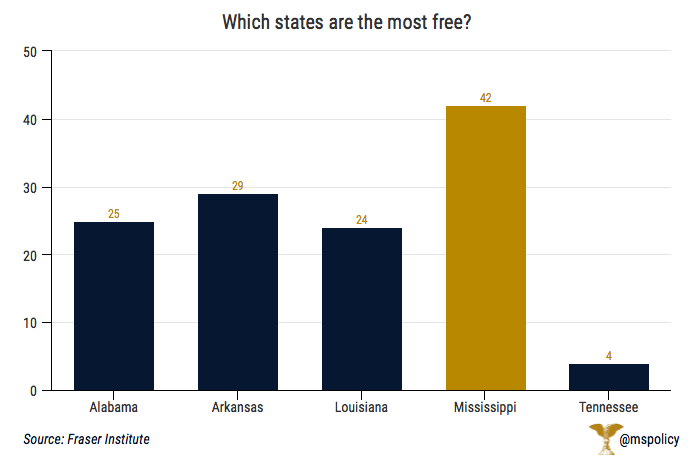
When we looked at the Fraser Index, which ranked Mississippi at #42 in 2018, we also noted that none of our neighbors were ranked as poorly. In fact, the average ranking for our contiguous neighbor states was #21 and no state ranked higher than #29. If you look to the 11 states making up the Southeast, from Virginia to Texas, the average ranking was 17.
Despite our advocacy for policies based on economic freedom, there remain leaders in Mississippi who seem unconvinced. There remain advocates for more and more reliance on the public sector. Many claim Mississippi is uniquely inoculated from experiencing economic growth and poverty reduction through the free market. Some even claim our lack of economic growth and poverty reduction is irrecoverably tied to our history or our geography. If only there was an example of a state that previously had similar economic freedom scores but embraced economic freedom polices over time and significantly improved the lives of its citizens as a result. If only we had data over the past twenty years than could show us how poverty can be reduced and per capita income can be increased in a state like Mississippi when freedom is the central public policy. Rather than one state, we’ve identified two states than serve as shining examples.
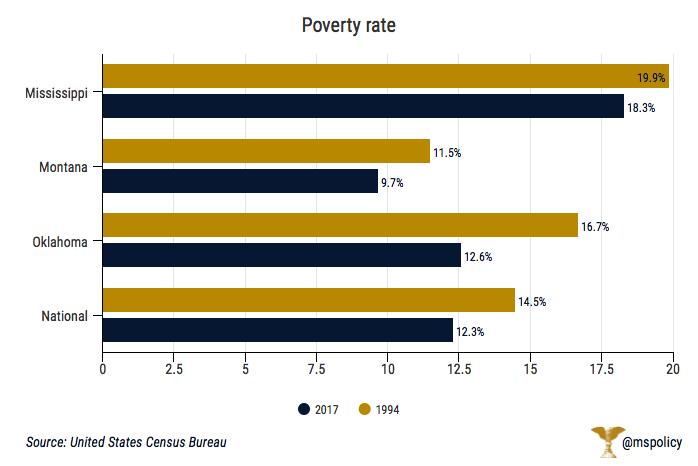
Let’s start by looking at the national poverty rate. In 1994, the rate was 14.5%. Today, the national average is 12.3%, a 15% reduction. In Mississippi in 1994, the poverty rate was 19.9%. Today, the rate is 18.3%, an 8% reduction. In Oklahoma in 1994, the poverty rate was 16.7%. Today, the rate is 12.6%, a 25% reduction. In Montana in 1994, the poverty rate was 11.5%. Today, the rate is 9.7%, a 16% reduction.
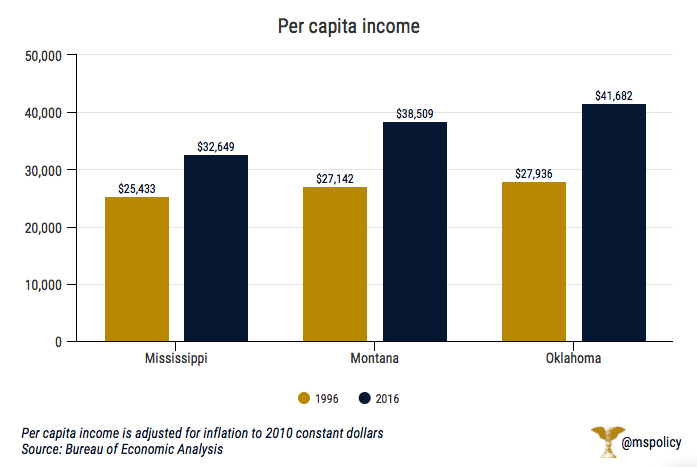
Next, let’s look at per capita income for the three states over a 20-year period. In 1996, the average income in all three states was very similar. In Mississippi, the average income was $25,433 (48thin the nation). Montana had an average income of $27,142 (46th) and Oklahoma $27,936 (45th). Twenty years later, Oklahoma had risen to 28thwith an average income of $41,682. Montana had risen to 38thwith an average income of $38,509. Over that same 20-year period, Mississippi slipped two sports to 50thplace with an average income of $32,649.
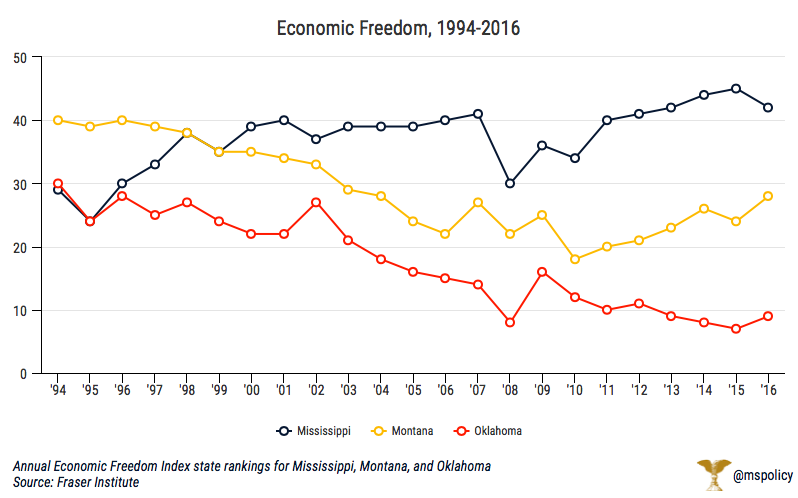
If we go back to the Fraser Institute Economic Freedom Index and plot how each of the three states performed in the same years (1994 to 2016), we see the strong correlation between economic freedom and prosperity. It is stark visual evidence of the power of choosing economic freedom. In 1994, Mississippi was ranked slightly more economically free than Oklahoma and considerably more so than Montana. Over the ensuing 22 years, Mississippi moved steadily away from economic freedom and the results are evident.
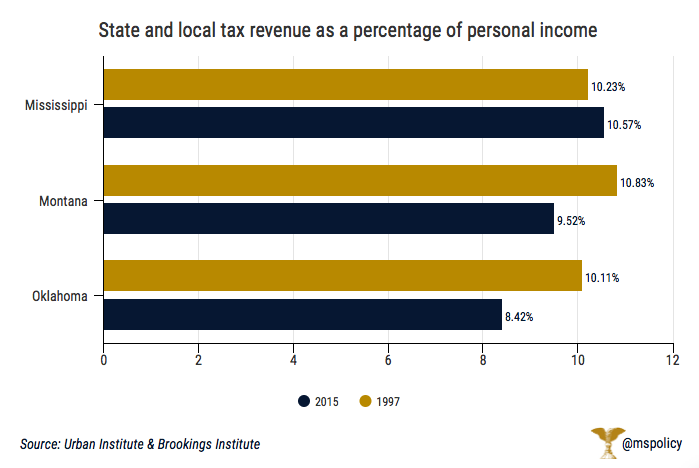
There is another valuable set of data that helps demonstrate the policy point as we compare Mississippi, Oklahoma and Montana. The Tax Policy Center, a joint project of the Urban Center and the Brookings Institute, publishes a report on state and local tax revenue as a percentage of personal income in each state. From 1997 to 2015, the tax burden in Oklahoma fell from 10.11 to 8.42. In Montana, the burden was reduced from 10.83 to 9.52. In Mississippi, the tax burden increased from 10.23 to 10.57. No other state in the Southeast had a burden at or above 10.0. At 10.57, Mississippi finds itself once again in the company of states like California, New York, New Jersey, Minnesota and Illinois.
What is the data and evidence telling us? It is informing us to choose capitalism and free markets. It’s telling us to move away from a “command and control” economic system and start relying more on individual freedom, consumer choice, and private competition. It’s telling us to allocate more resources towards free enterprise and fewer resources towards the political process. If we can start to get Mississippi’s economy growing by adopting policies that prioritize economic liberty, we can experience prosperity.
When states grow, other measures of quality of life are improved. Educational outcomes improve. Crime rates go down. Health measures improve and life expectancy expands. Montana and Oklahoma are real-life examples of how lives can be measurable improved when states make a commitment to economic freedom. They’ve shown us the road map. There is no reason Mississippi can’t take the road to freedom. All it takes is the will and strong leadership to take the first steps.
This column appeared in the Clarion Ledger on December 9, 2018.
Occupational licensing laws force Mississippians to spend time and money to receive permission from the government before they can earn a living.
This is a relatively new phenomenon. In the 1950s, just five percent of the workforce needed a license to legally work. At the time, occupational licensing was largely limited to medical professionals, lawyers, and teachers. However, as we often see when government is involved, license requirements have expanded dramatically.
Today, approximately 19 percent of Mississippians need a license to work. This includes everything from a shampooer, who must receive 1,500 clock hours of education, to a fire alarm installer, who must pay over $1,000 in fees. All totaled, there are 66 low-to-middle income occupations that are licensed in Mississippi.
As new licenses have been added to the books in Mississippi, it is safe to assume that each proponent, usually an occupational licensing board, made the same central argument. We must do this in the name of consumer safety to protect individual citizens. But the reality is often something less altruistic. Mainly, these occupational associations are more interested in building a moat around their industry with the help of government. The harder it is for someone to enter an industry, the less competition and consumer choice the industry incumbents face.
This may artificially raise the wages of industry practitioners by raising the prices of goods and services that require such licenses, but it does so by limiting options and increasing consumer costs. This will often have an outsized impact on low-income Mississippians, who then have to make otherwise unnecessary decisions on what they will or will not purchase.
Just this past year, the Mississippi legislature, with little discussion and few dissenting votes, passed a bill to make it more difficult to become a real estate broker. The proposed law sought to increase the time it would take to become a broker, going from the current one year to three years. Fortunately, Gov. Phil Bryant vetoed the legislation.
Who were the individuals supporting such legislation? Was it the Coalition of Mississippians Against Inexperienced Brokers? A group of citizens negatively impacted by brokers who had just one year of experience? No, it was, naturally, the Realtors Association.
But the bigger problem isn’t just one specific association pushing the legislature to limit competition, it is the cost of all unnecessary and burdensome regulations on Mississippi’s economy.
According to a new report from the Institute for Justice, Mississippi has lost 13,000 jobs because of occupational licensing and the state has suffered an economic value loss of $37 million. To put that into perspective, just by legislative action to rollback unnecessary licenses, we can create two Nissan plants…without spending a dime of taxpayer dollars.
Instead of relying on government, these are the actions that will encourage and promote economic growth in Mississippi. If that is our goal, we need to trust in the benefits of the free market and a “lighter touch” from government and occupational licensing regimes and we need to return to a belief in individual responsibility.
This can be achieved in a number of ways. For example, voluntary certification offers an avenue for reform. This already occurs in many industries and allows private third-parties to set standards for individuals to voluntary subscribe as one level of quality assurance.
One of the more widely recognized private certifications is the Automotive Service Excellence (ASE) certification for mechanics. You can open a garage tomorrow with – or without – the ASE certification and customers may or may not care.
But that decision is left to the entrepreneur and the customer, not to the government or the industry lobbyist or the board of licensure. We can do this with any number of professions currently licensed by the state. If we really want more jobs and fewer people dependent on government, it starts by creating an environment that encourages work; not one that encourages the creation of hurdles and obstacles.
This column appeared in the Madison County Journal on December 6, 2018.
Americans have always been a transient people, often searching for new careers and better opportunities for their family.
Depending on the economy of the day, we see 30 to 40 million Americans move each year. And when they move, they bring their incomes with them. Between 1995 and 2010, some $2 trillion in adjusted gross income went from one state to another.
As a result, some states brought in billions more in incomes over the past 25 years while others lost that amount and then some.
Mississippi lost $132 million in annual AGI. Looking more closely at the state, Desoto county was the big winner, gaining $1.34 billion in annual AGI, mostly all of it from across the border in Shelby county, Tennessee. Rankin ($523 million) and Madison ($912 million) counties were the other big beneficiaries of wealth transfers in the state, but that was mostly from Hinds county, which lost $1.55 billion in annual AGI.
Not surprisingly, the Delta, which is shedding population, also saw big loses in income. The five counties of Bolivar, Coahoma, Leflore, Sunflower, Washington lost between $100 million and $250 million. That wealth was generally lost to either the Jackson metro area or both sides of the Mississippi/ Tennessee state line. Throughout the state, we saw a few areas of growth (such as Lafayette county) or decline (such as Lauderdale and Lowndes counties), but most other places were more or less stagnant. Very little wealth gained, very little wealth lost. And it was usually just in-state transfers.
The only other counties to see wealth gained from out-of-state were Hancock and Pearl River counties, along the Louisiana border. They both gained between $180 and $200 million, mostly from Louisiana.
However, Louisiana stood out as having the biggest losses in the South. The state lost some $8 billion in annual AGI, with more than $500 million shifted toward Mississippi. Among other neighbors, Alabama saw a gain of $2.5 billion and Arkansas saw a gain of $2.6 billion. Tennessee gained over $14 billion - even with the big loses from Shelby county to Desoto county.
Overall, the states that did the best won’t surprise many people. Arizona gained $35 billion in annual AGI, Texas gained $47 billion, and Florida gained $156 billion. That was at the expense of many states, but three in particular lost between $50 and $100 billion each year. This includes Illinois, California, and New York, the biggest loser of all. The Empire State lost $100 billion in annual AGI.
But why? After all, it’s tough to compete with Chicago, New York, San Francisco, and Los Angeles.
Because the states that Americans are moving to, and where they bring their income along, are low and no tax states. Florida and Texas do not charge you for working, while Arizona has a relatively low individual income tax rate. Certainly better than California, though that isn’t saying much.
When New York Gov. Andrew Cuomo was being criticized from both the left and the right for offering between $1.5 and $2 billion in taxpayer incentives to Amazon, he defended the decision saying his state needs to offer incentives to compete with states that don’t have an income tax. If a governor has to say that, it should highlight the lack of competitiveness that state has, regardless of what else it has to offer.
When states have higher tax rates, that naturally allows the state to confiscate more money from taxpayers and gives them the ability to dole out money to their preferred companies. Rather than let the market work, you have selected interests who are insulated from higher taxes at the expense of everyone else.
We all seem to understand the not-so-secret, secret sauce. Low taxes and a light regulatory touch lead to job growth. Americans then move to where there is a combination of good jobs, high quality of life, and reasonable housing costs. And the state’s that are doing things right are the ones who benefit. In other words, prosperity is closely linked to freedom-based public policies. If we want to grow and provide more opportunities in Mississippi, then let’s take the path that makes it easy to start a job, open a business, earn a side income, invest capital, serve customers, compete with incumbent businesses, and keep more of what we earn.
Economic development, incentives via the government, and economic growth, based on free market principles, should not be confused.
Well-meaning public officials, government employees, community business owners and executives, and chamber of commerce cheerleaders have the best of intentions when they propose ideas for economic development. I believe they are genuinely trying to help. I just wish they would stop. When we confuse economic development with economic growth, we make big mistakes in public finance. These two concepts may sound similar but they are, in fact, opposites. An emphasis on one or the other leads to different results.
Those of us interested in seeing economic growth advocate for broad public policies like lower taxes, a reduction of the regulatory burden on businesses, the elimination of double taxation on investments and savings, and a reliable and predictable legal and regulatory environment. In stark contrast, proponents of economic development argue for subsidies, tax abatements, and regulatory relief for specific businesses or industry types in particular regions. The latter believe the economy can be directed by government involvement; the former believe the economy will produce a better outcome when we leave it to the entrepreneurs and consumers to determine the direction.
For those of us with a belief in the durable power of free-markets, the choice is easy. We know, thanks to Adam Smith and 242 years of data, wealth is created by the free exchange between producers and consumers. If we leave markets free and allow the natural incentive of profit-seeking to work, without government trying to influence, direct, guide, orchestrate, manage or nudge, the states maximize their economic growth. Such growth is what drives long-term employment and increased prosperity. When we replace the decisions of entrepreneurs, investors, and consumers in the private market with decisions of politicians, government officials and development boards, we significantly lower the odds of achieving economic growth.
Economic development policy really means the state picking the winners and losers by employing direct subsidies and tax breaks to attract or promote specific businesses or industries. An authentic effort to grow our economy would not focus on giving targeted companies the assistance and resources without providing those to all companies and industries. It is not fair to the current companies in Mississippi, who built their businesses without government help, to find themselves competing with companies subsidized by taxpayers. For too long, Mississippi has followed a policy that supposes “economic development” can be a meaningful driver of economic well-being in the state. It cannot. That policy is a losing one.
The evidence produced from analysis points convincingly to the conclusion that these targeted incentives do not produce long-term benefits in excess of their costs. In many cases, the cost-per-job is extraordinarily high. While some high-profile companies and their political allies may be better off, non-beneficiary companies may lose workers or experience wage increases, or both, and the state’s economic activity as a whole slows.
When political favor seeking is emphasized like this, it thwarts the private sector and tips the scales in favor of those companies and individuals with access to political relationships. It sends a message to the private sector that it should not focus on consumer-oriented actions, like product/service innovation or marketing, and focus resources instead on lobbying, legal representation, and elections. That’s not a recipe for sustained economic growth.
While economic development incentives, like those practiced by the Mississippi Development Authority, may lead to the creation of new jobs; that does not mean such jobs lead to the creation of economic growth. Measuring jobs alone is an insufficient way to measure economic growth. For example, roughly 90% of the Canton-based Nissan plant employees were already employed when that Madison County facility opened. Those new employees were already paying state income taxes. Yet, every job created by the state and local government incentive package was subsidized. In total, roughly $1.3 billion was promised to Nissan. According to data analyzed by Mississippi State University’s Institute for Market Studies, Nissan pays its 6,400 workers at the plant an average of $62,500, which costs taxpayers $203,125 per worker. Had that taxpayer subsidy not occurred and the dollars remained in the private sector, would individuals and businesses have found a better “investment” use? Decades of economic research and free market evidence informs us that private citizens and firms are more effective at allocating resources to their highest uses than is government.
The chief argument around government incentives is that “everyone else is doing it, so we must join the process in order to remain competitive.” That’s the wrong approach. The desire to provide incentives is an acknowledgment that our tax, regulatory, and legal system is not competitive. It says our state has not adopted freedom-based policies. Instead of offering incentives to just a few, our goal should be to create the most business-friendly climate in the country. A public policy based on freedom is how we’ll grow our economy.
Rather than increase the hand of government in our economy, we should trust the “invisible hand” of the market place and the proven incentive of profit and loss for the allocation of resources. It is either folly or hubris to think government can have the knowledge to do that more efficiently than the market. Nobel Prize-winning economist F.A. Hayek once wrote, “The curious task of economics is to demonstrate to men how little they really know about what they imagine they can design.”
This column appeared in the Clarion Ledger on November 2, 2018.
Few people would argue with the beauty of a California sunset. The bright lights of Times Square are tough to compete with. But there is one thing that can top the allure of California or Manhattan: your pocketbook.
While many on the left may argue that a certain class of Americans enjoy the high-tax, high-regulation burdens of our most liberal cities and states, and the perceived protections that go with it, the numbers paint a different picture.
Americans are moving to lower tax states where they are able to keep more of the money they earn. This isn’t a talking point, but a statistical reality based on migration data. Unfortunately, Mississippi is on the wrong side of both taxes and, as a result, in-migration.
Sales, property, and individual income taxes, as a percentage of personal income in Mississippi, are 9.9 percent, according to Cato Institute. That’s pretty high. In fact, only 14 states, including traditional high tax states like California, Connecticut, New Jersey, and New York, fared worse. All neighboring states had lower tax burdens than Mississippi. What effect does this have?
Mississippi had a net migration loss of over 3,500 in 2016. On a per capita basis, this means Mississippi lost 100 residents for every 88 the state gained. This is parallel with migration loses in Louisiana. Alabama and Arkansas were essentially flat in terms of migration while Tennessee added over 13,000 residents. For every 100 residents that Tennessee lost, they added 119.
Tennessee, a state without an individual income tax, is home to one of the lowest tax rates in the country with a tax burden of 6.5 percent. And they are reaping the benefits of smart fiscal policy. The Wall Street Journal reported in May: “Alliance-Bernstein Holding LP plans to relocate its headquarters, chief executive and most of its New York staff to Nashville, Tenn., in an attempt to cut costs…In a memo to employees, Alliance-Bernstein cited lower state, city and property taxes compared with the New York metropolitan area among the reasons for the relocation. Nashville’s affordable cost of living, shorter commutes and ability to draw talent were other factors.”
Twenty-six states had a tax burden of 8.5 percent or greater. Of those 26, 25 had a net out-migration. Only Maine was able to buck the trend. And not surprisingly, of the 17 states that had net migration gains in 2016, all but one has a tax burden of less than 8.5 percent. All totaled, more than 500,000 individuals moved from the top 25 highest-tax states to the 25 lowest-tax states in 2016. Those high tax states lost an aggregate income of $33 billion.
Along with the relatively high individual tax burden, our business tax climate sits at 31st best, according to the Tax Foundation. Not terrible, and actually better than Alabama, Arkansas, and Louisiana, but not great either. The same report had Tennessee at 16.
So what can we do in Mississippi? We can follow the lead of high-growth, low-tax states in the Southeast that have lower taxes, lighter licensure and regulatory burdens, and a smaller government.
This past session, the legislature debated a bill known as the “Brain Drain” Tax Credit. It would have provided a three-year income-tax exemption to recent college graduates who are Mississippi residents. And there was an additional two-year exemption for those who start a business. It passed the House unanimously but died in the Senate without a vote.
States are in competition with one another. We know this because we routinely offer incentives for select companies in the form of subsidies or tax breaks, or we propose eliminating the individual income tax for three to five years for recent college graduates.
While we are always in favor of lower taxes, these moves are just an acknowledgement that our tax burden hurts individual opportunity and the state’s economic growth. We have succeeded in phasing out the lowest income tax bracket. Instead of eliminating the income tax for just a few, we should work on eliminating the income tax for all taxpayers. And instead of offering incentives to just a few, our goal should be to create the most business-friendly climate in the country – for all types, sizes, and industries.
A public policy based on freedom is the recipe high-growth states have adopted. It’s how we’ll grow our economy in Mississippi, too.
This column appeared in the Daily Leader on October 31, 2018.
Mississippi’s freedom ranking moved up a couple spots from the previous year while our overall score actually declined slightly.
Fraser Institute’s “Economic Freedom of North America 2018” again paints a relatively bleak picture for economic freedom in Mississippi. Mississippi has been included among the “Least Free” states, those in the bottom quartile, for all but two years going back to 1998.
“The freest economies operate with minimal government interference, relying upon personal choice and markets to answer basic economic questions such as what is to be produced, how it is to be produced, how much is produced, and for whom production is intended. As government imposes restrictions on these choices, there is less economic freedom,” the report writes.
The data is reviewed among three categories: government spending, taxes, and regulations.
What are these categories important? As the size of government expands, the private sector becomes smaller and is slowly pushed out with government choosing to undertake activities beyond the traditional function of a limited government. As our tax burden and regulations grow, restrictions on private choice increase and economic freedom declines. Mississippi continues to have serious issues in both categories.
And we know what the analysis shows: The freer the state, the more prosperous it is. And the more it is growing in terms of in-migration. The least free, the more people are likely to be leaving in searching of better prospects.
...
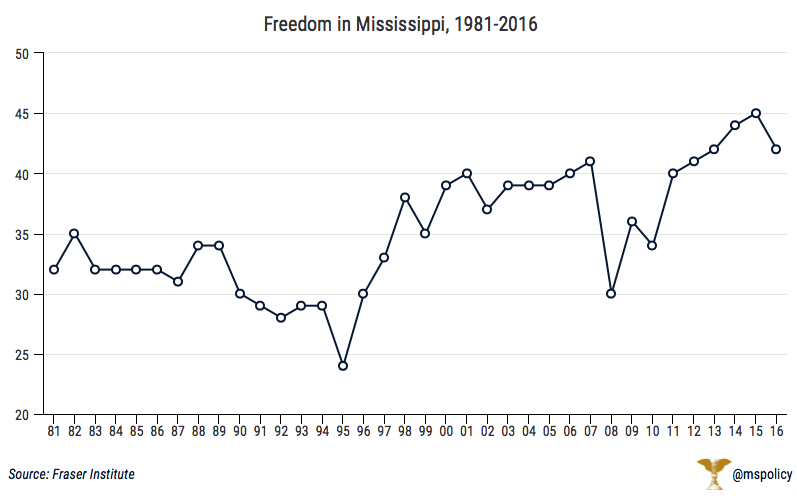
Though Mississippi saw a slight improvement this year in overall rankings, the state has been on the wrong path over the life of the report. When it began in 1981, Mississippi was ranked 32nd. There have been some ups-and-downs along the way, including a peak at 24th in 1995. But overall, the numbers aren’t positive. The ranking of 45th that was released last year was the lowest the state has ever been.
Going back to 1981 and for many years after that, Mississippi did much better in the government spending and taxes categories than the numbers show today. That year, Mississippi had a government spending score of 7.01 and a taxes score of 6.75. This year those scores are 4.25 and 5.85, respectively. Regulations have shown the most positive movement, from 2.27 to 5.23, though still lower than all but seven states.
In 1981, Mississippi earned a score of 5.34. This year it’s 5.11. Only two other states, Kentucky and New Mexico, have experienced decreases from 1981.
….
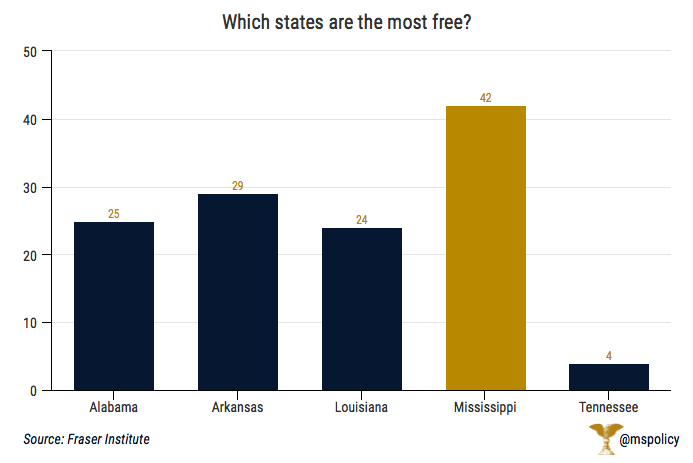
Mississippi performed poorly compared to all neighboring states, and much of the Southeast. Alabama had an overall score of 6.22 (25th), Arkansas had a score of 6.09 (29th), Louisiana had a score of 6.26 (24th), and Tennessee had a score of 7.43 (4th). Those numbers put Tennessee among the most free, placed Alabama and Louisiana in the second quartile, with Arkansas in the third quartile.
When it comes to promoting policies that restrict freedom, Mississippi is sitting on an island. And, unfortunately, paying the price.
….
Overall, this data isn’t far off from a recent report from Cato Institute. Their report, “Freedom in the Fifty States,” put Mississippi 40th overall. A five-spot jump from 2014, but still in the bottom 20 percent.
Some positive trends, but still a long way to go.
Mississippi payrolls have added more than 20,000 jobs over the past year with employment numbers setting a new record.
According to the most recent data from the Bureau of Labor Statistics, there are now 1.17 million people in the state working. That’s a boost from a little less than 1.15 million a year ago. This is a statistically significant employment change of 1.8 percent. Only Tennessee, who saw a 2.1 percent growth, posted better numbers among neighboring states.
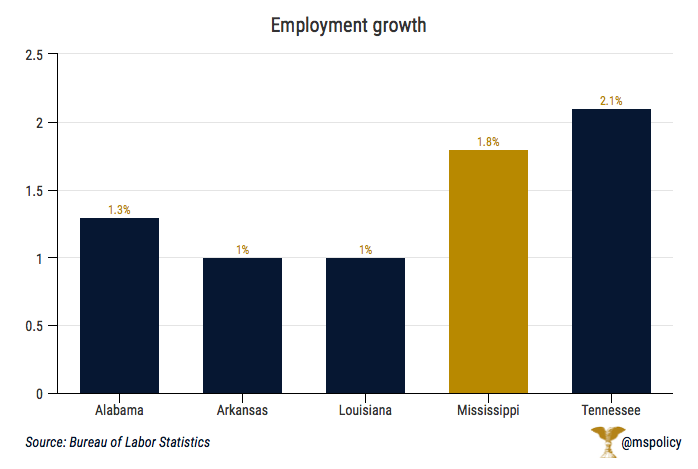
Alabama’s employment grew by 1.3 percent, while employment grew by 1 percent in Arkansas and Louisiana.
Mississippi added jobs in four sectors over the past month. The largest gains were in education and health services (+1,500 jobs) and government (+1,000 jobs). Manufacturing and trade, transportation, and utilities posted slight gains, while professional and business services growth was flat. Construction, financial activities, and leisure and hospitality showed loses over the past month.
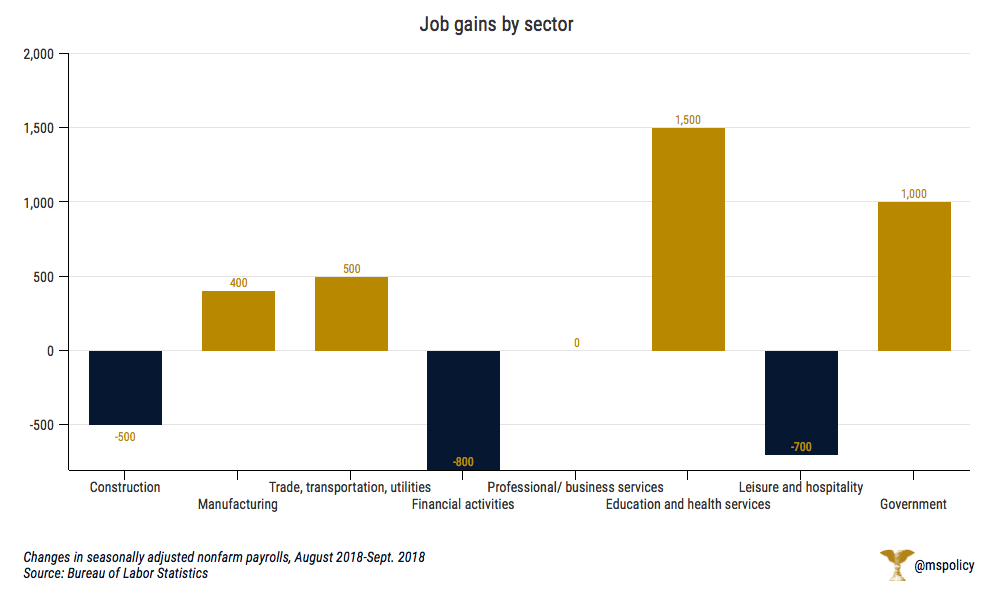
Over the past year, construction (-200) is the only sector to post a decrease in employment. The largest gainer over the past year was professional and business services (+6,400).
Mississippi has also seen a large gain in the public sector, particularly over the past three months. Government has added 2,800 jobs over the past year with 1,600 jobs added alone in the past quarter. Government jobs account for 14 percent of the jobs created in Mississippi over the past year. This is significant because a growing public sector can often stifle the growth of the private sector.
In this measurement, Mississippi far outpaced our neighbors. Louisiana’s government was down 200 jobs last month. Arkansas’s government did not change and Tennessee added 100 government jobs between August and September. Alabama’s government added 300 jobs last month.
Mississippi’s unemployment rate remained steady at 4.8 percent. That is a near record low for the state, but is still the fourth highest in the nation. Only Louisiana, at 5 percent, has a higher rate in the Southeast.
While some may be sad to see Sears head into bankruptcy, it is the free market working.
As Sears goes through bankruptcy, we will likely see nostalgic perspectives on the 130-year-old retailer. But through the ups and downs of retail, one constant remains; consumers decide and the market always wins.
Fifty-years ago, if one had suggested Sears would go bankrupt and just a fraction of their stores would remain open, most sane people would have laughed. Now, we know the rest of the story. Sears started as a mail-order catalog before transitioning into a brick-and-mortar force that grew with suburban America and the boom of indoor malls.
That boom included Jackson, Mississippi. While Sears long had a presence in the city, it would serve as the first anchor for the new Metrocenter Mall in 1978, the state’s largest mall. For years, both Sears and the mall hummed along…until people began to make other choices. In 2012, Sears was the last anchor to leave, effectively ending whatever claim Metrocenter still had at labeling itself a mall.
…..
There has already been – and there will continue to be – stories about mismanagement at Sears or about some other decisions from the past decade or so that necessitated the bankruptcy. But we know what killed Sears. It was the same thing that made Sears into a retail giant – creative destruction. Fighting to give consumers new and better options, Sears created unique and valuable shopping experiences for consumers. Today, other options are causing consumers to spend their money elsewhere. It is the order of things in a free market.
The “elsewhere” might be Wal Mart, which is able to sell goods at a deeper discount than Sears, while also selling groceries. It might be Best Buy or Home Depot/ Lowes, which offer Sears-size stores for a single retail category, providing consumers with far greater choice. Perhaps it’s Amazon, which has put pressure on every remaining retail giant. In the final analysis, nothing remained in the value proposition of Sears that gave people a compelling reason to shop there.
In the end, capitalism gave us better options. Creative destruction, which has been the driving force behind American ingenuity for the past century, ruled the day.
Someone else provided the market with a value proposition that consumers voluntarily decided was better. In much the same way that, once upon a time, Sears provided a better value proposition than general stores or five-and-dimes, which had dotted downtowns in an earlier era. The same creative destruction that made Sears a retail juggernaut would eventually be the reason for its slow death over the past decade.
…..
Sears gave the masses access to affordable household goods largely before anyone else. But the free market, and retail in particular, is about appealing to modern tastes and changing behavior. For many years, Sears had been losing its relevance. Nostalgia is good for writing an obituary, but is largely unhelpful in keeping most businesses open.
No one likes to see a business close, particularly one that has been around for more than a century and likely evokes found memories from early eras. But for consumers in Mississippi and around the country, we don’t have to worry. The market, via you, the consumer, spoke long before Sears filed for bankruptcy protection.
The latest index on labor markets in America shows Mississippi performing well in some measurements, but behind most other states overall.
The report, published by the Fraser Institute, includes a comprehensive analysis of labor market performance by state. It is based on the average of the following eight key indicators:
- annual total employment growth
- annual private- sector employment growth
- total employment rate
- private-sector employment rate
- unemployment rate
- long-term unemployment
- share of involuntary part-time workers
- output per worker (or average labor productivity)
The data was calculated using a three-year average, from 2015 through 2017.
Mississippi was rated 48th overall among the 50 states with a score of 41.4 (out of 100), ahead of just New Mexico and West Virginia. North Dakota, Utah, and Minnesota led the country with scores of 80.4, 78.3, and 75.8, respectively.
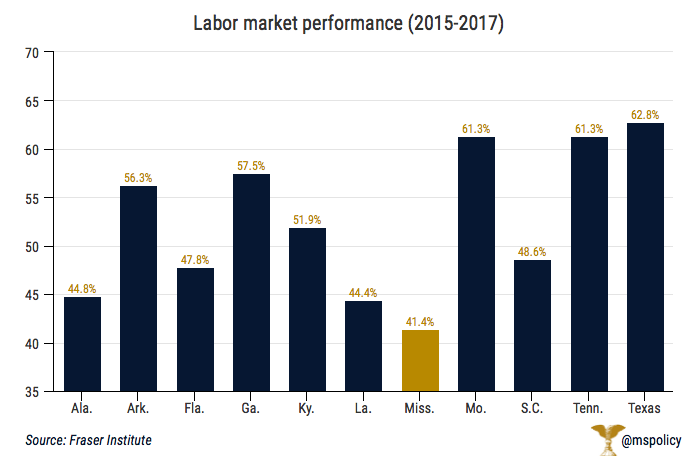
Mississippi’s score placed it last among our neighboring states, and last among SEC states. Tennessee led our neighbors with a score of 61.3 followed by Arkansas at 56.3. Alabama and Louisiana were slightly ahead of Mississippi with scores of 44.8 and 44.4, respectively. Texas led SEC states with a score of 62.8.
Mississippi’s best measurement among the eight categories was job growth, including job growth overall, and more importantly, private-sector job growth.
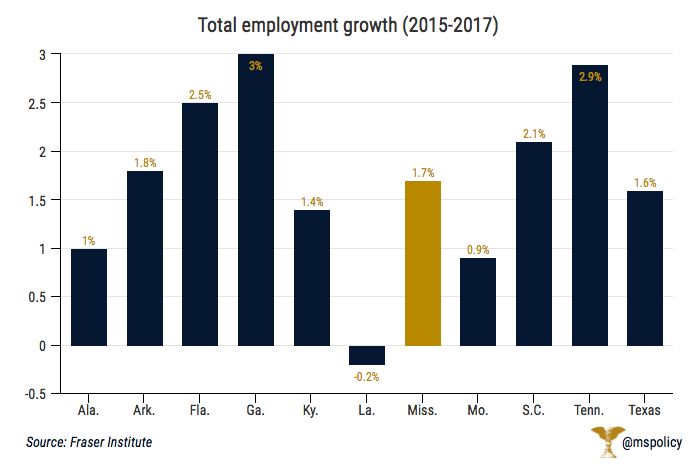
Mississippi’s total employment growth over the three-year period was 1.7 percent, this was 18th overall and 6th among SEC states. But total employment doesn’t differ on whether that growth was driven by the public or private sector. Looking specifically at private-sector job growth we see numbers that are slightly better for Mississippi.
Reviewing private-sector job growth, Mississippi’s employment grew by 2 percent during this period.
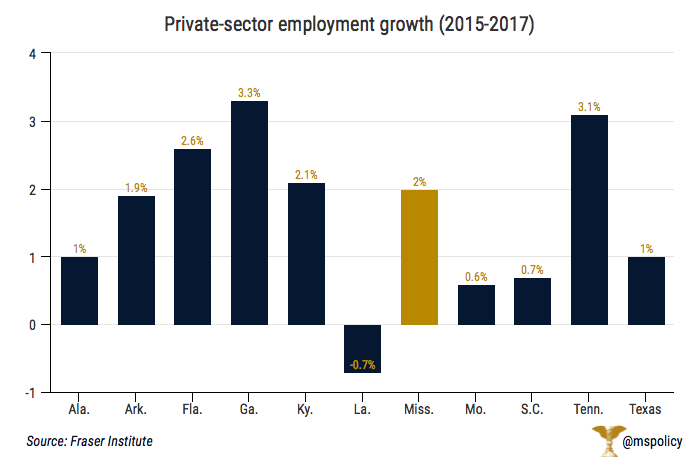
Mississippi was 17th nationally in job growth, trailing only Tennessee’s 3.1 percent employment job growth among our neighbors. Louisiana had the third worst employment growth, at -0.7 percent. Among all SEC states, Mississippi placed 5th.
Recent data from the Bureau of Labor Statistics reveals similar positive numbers in terms of job growth. Employment in Mississippi grew by 1.6 percent over the previous year, behind just Tennessee among neighboring states.
But the positive news stopped there.
Mississippi’s total employment rate and total private-sector employment rate came in last among SEC states and 49th and 48th, respectively.
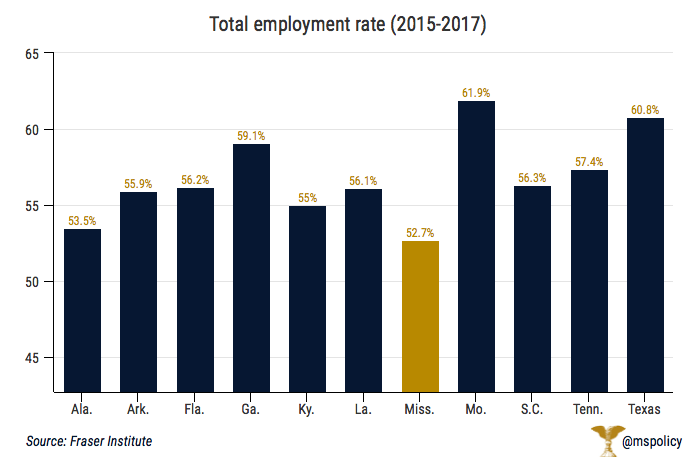
Total employment rates include full-time and part-time work, including private-sector employees, public-sector employees, and the self-employed, as a percentage of the working age population.
Mississippi’s total employment rate is 52.7 percent, last among all SEC states and ahead of only West Virginia. Mississippi moved up to 48th in private-sector employment rates, still last among SEC states.
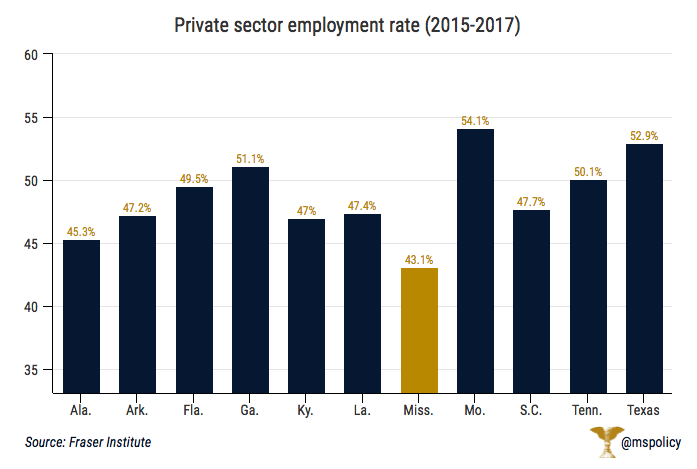
North Dakota led both measures of employment rates at 69.4 percent for total employment rate and 59.2 percent for private-sector employment rate.
While employment rates measure those who are working, the unemployment rate measures those actively seeking work but unable to find it.
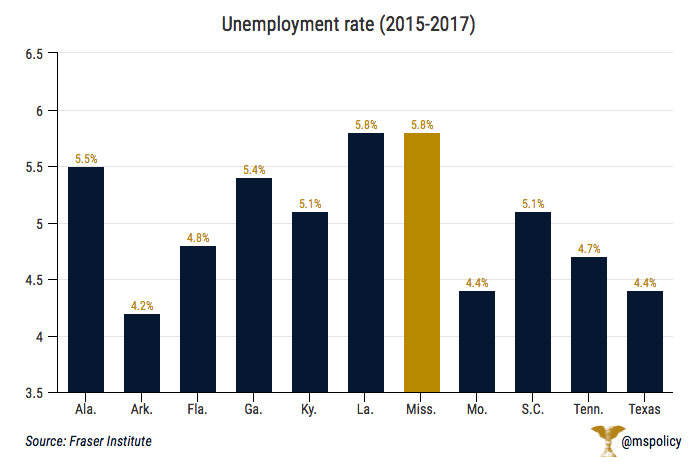
Mississippi’s three-year average rate of 5.8 percent is tied with Louisiana for 45th in the country and tied for last among SEC states. Alabama was slightly better at 5.5 percent, but Mississippi was far behind Arkansas’ 4.2 percent and Tennessee’s 4.7 percent.
Among other Fraser measurements:
- Mississippi placed 43rd for long-term unemployment, those who experience unemployment for 27 weeks or long relative to the total unemployed, at 29.1 percent.
- The state placed 38th among share of involuntary part-time workers, those who desire to work full-time but could not find it as a result of economic conditions.
- The state placed 48th for average output per worker, which is the amount of productivity per worker.