
The latest index on labor markets in America shows Mississippi performing well in some measurements, but behind most other states overall.
The report, published by the Fraser Institute, includes a comprehensive analysis of labor market performance by state. It is based on the average of the following eight key indicators:
- annual total employment growth
- annual private- sector employment growth
- total employment rate
- private-sector employment rate
- unemployment rate
- long-term unemployment
- share of involuntary part-time workers
- output per worker (or average labor productivity)
The data was calculated using a three-year average, from 2015 through 2017.
Mississippi was rated 48th overall among the 50 states with a score of 41.4 (out of 100), ahead of just New Mexico and West Virginia. North Dakota, Utah, and Minnesota led the country with scores of 80.4, 78.3, and 75.8, respectively.
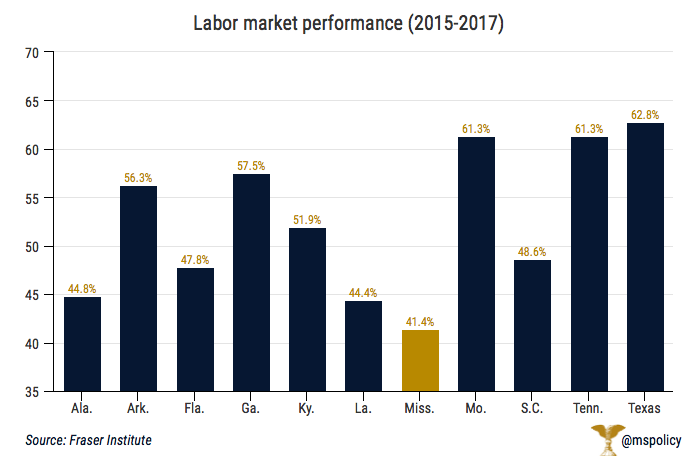
Mississippi’s score placed it last among our neighboring states, and last among SEC states. Tennessee led our neighbors with a score of 61.3 followed by Arkansas at 56.3. Alabama and Louisiana were slightly ahead of Mississippi with scores of 44.8 and 44.4, respectively. Texas led SEC states with a score of 62.8.
Mississippi’s best measurement among the eight categories was job growth, including job growth overall, and more importantly, private-sector job growth.
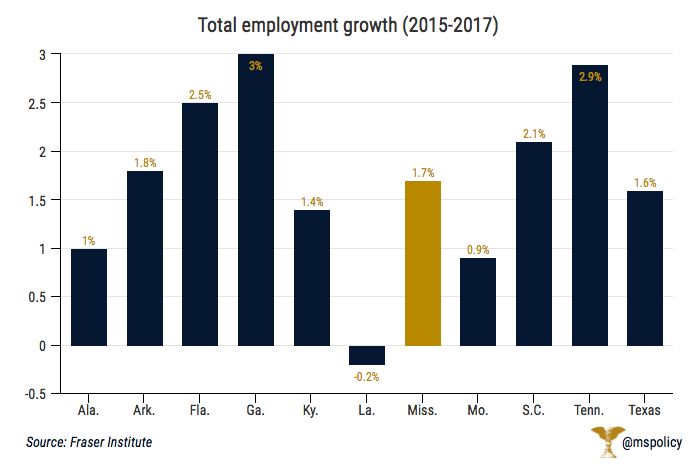
Mississippi’s total employment growth over the three-year period was 1.7 percent, this was 18th overall and 6th among SEC states. But total employment doesn’t differ on whether that growth was driven by the public or private sector. Looking specifically at private-sector job growth we see numbers that are slightly better for Mississippi.
Reviewing private-sector job growth, Mississippi’s employment grew by 2 percent during this period.
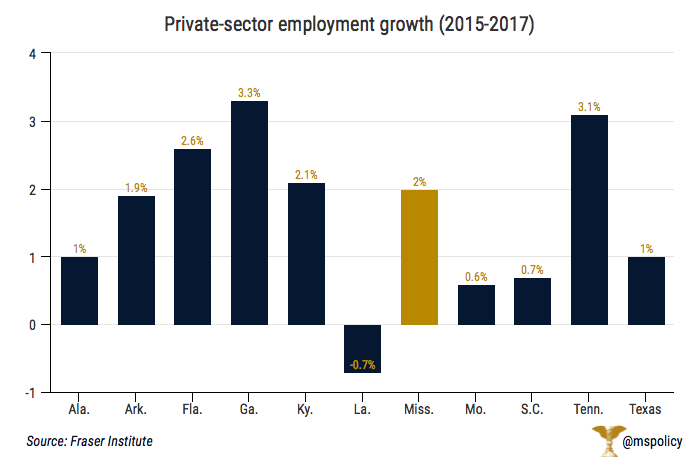
Mississippi was 17th nationally in job growth, trailing only Tennessee’s 3.1 percent employment job growth among our neighbors. Louisiana had the third worst employment growth, at -0.7 percent. Among all SEC states, Mississippi placed 5th.
Recent data from the Bureau of Labor Statistics reveals similar positive numbers in terms of job growth. Employment in Mississippi grew by 1.6 percent over the previous year, behind just Tennessee among neighboring states.
But the positive news stopped there.
Mississippi’s total employment rate and total private-sector employment rate came in last among SEC states and 49th and 48th, respectively.
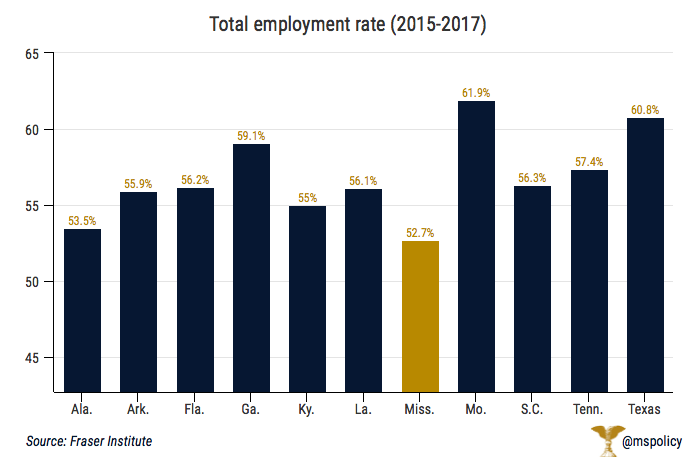
Total employment rates include full-time and part-time work, including private-sector employees, public-sector employees, and the self-employed, as a percentage of the working age population.
Mississippi’s total employment rate is 52.7 percent, last among all SEC states and ahead of only West Virginia. Mississippi moved up to 48th in private-sector employment rates, still last among SEC states.
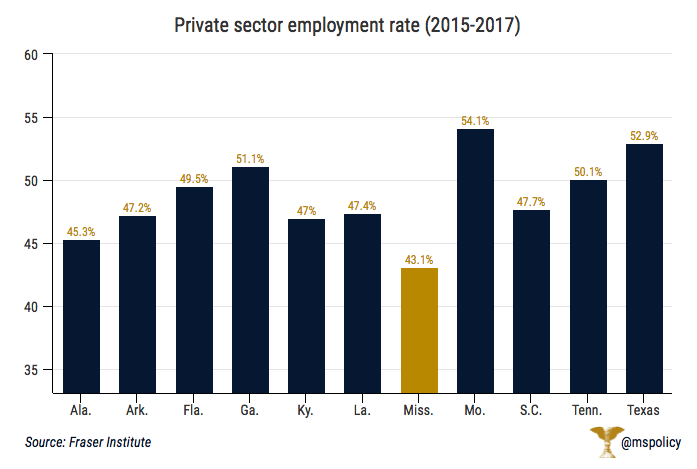
North Dakota led both measures of employment rates at 69.4 percent for total employment rate and 59.2 percent for private-sector employment rate.
While employment rates measure those who are working, the unemployment rate measures those actively seeking work but unable to find it.
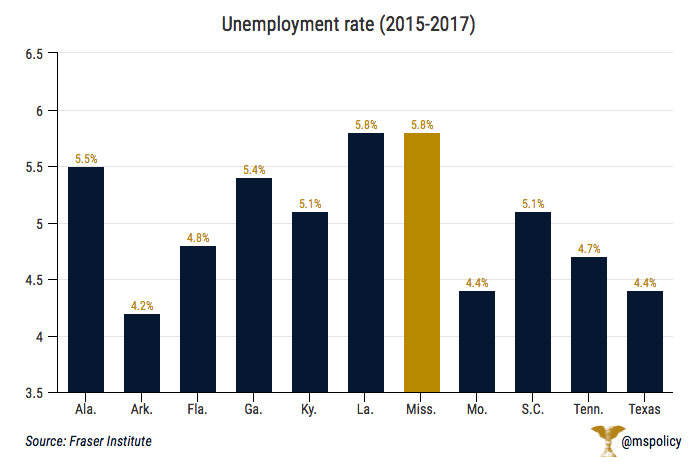
Mississippi’s three-year average rate of 5.8 percent is tied with Louisiana for 45th in the country and tied for last among SEC states. Alabama was slightly better at 5.5 percent, but Mississippi was far behind Arkansas’ 4.2 percent and Tennessee’s 4.7 percent.
Among other Fraser measurements:
- Mississippi placed 43rd for long-term unemployment, those who experience unemployment for 27 weeks or long relative to the total unemployed, at 29.1 percent.
- The state placed 38th among share of involuntary part-time workers, those who desire to work full-time but could not find it as a result of economic conditions.
- The state placed 48th for average output per worker, which is the amount of productivity per worker.
Moody’s Investors Services has revised the outlook for the state of Mississippi from negative to stable.
They also affirmed the Aa2 ratings on outstanding GO bonds and the Aa3 ratings on debt issued from the Mississippi Development Bank.
“The state's stable outlook, which applies to its GO as well as its appropriation debt, is supported by stabilization of revenue and economic trends and a resumption of deposits to the rainy day fund,” Moody’s wrote. “The outlook also incorporates the expected continuance of conservative fiscal management, which will help manage elevated debt levels and potential future revenue weakness.”
To see a future upgrade, Moody’s said Mississippi needs:
- Growth in state wealth levels reflecting a sustained progress trending to national average
- Sustained increase in fund balance
- Substantial decrease in debt and pension liabilities
Pension liabilities are a major issue for the state, as they are for most states. A recent report from Truth In Accounting noted Mississippi’s unfunded retirement obligations. And because of the state’s debt burden of $8.3 billion, each taxpayer has a burden of $11,300.
In September, S&P Global Ratings similarly revised the state’s general obligation debt outlook from negative to stable.
“Now, all three of Mississippi’s credit ratings are strong and positive,” said Treasurer Lynn Fitch. “Taxpayers will benefit from recent efforts to meet economic challenges head-on, such as putting money back into the Rainy Day Fund and strengthening PERS’ funding policy. Better ratings mean the bond issuances currently in the works for capital and transportation improvements across the State will yield better deals for taxpayers.”
A depletion of financial reserves, economic underperformances, and persistent growth in retiree benefit liabilities could lead to a future downgrade.
Mississippi’s business tax climate rating dropped slightly over the past year.
The Tax Foundation’s “State Business Tax Climate Index” grades each state on the burden of their corporate taxes, individual income taxes, sales taxes, property taxes, and unemployment insurance taxes. Fewer policy areas are as important as tax policy when it comes to economic growth.
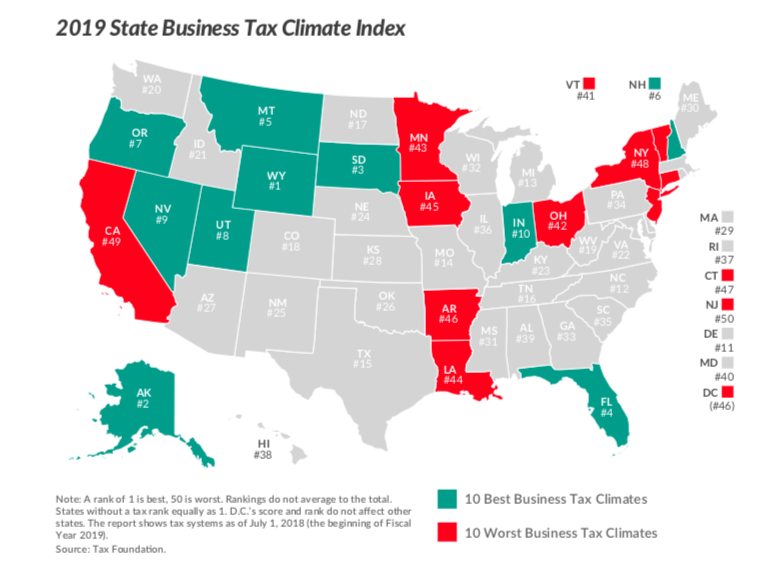
The five highest rated states were Wyoming, Alaska, South Dakota, Florida, and Montana, while the five worst states in terms of business tax climate were New Jersey, California, New York, Connecticut, and Arkansas.
Mississippi’s ranking isn’t that much different from where it has been the past four years, ranging from a high of 29 (in 2016 and last year) to a low of 31 (this year). In 2017, the state ranked 30th. Still, Mississippi did drop slightly from the previous year.
This change, however, isn’t due to negative action taken by the state but simply because other states had passed Mississippi. One of those was Kentucky, the biggest gainer nationwide. They moved up 16 spots from 39th to 23rd after a series of tax reforms in the Bluegrass State.
Compared to our neighbors, Tennessee is doing the best by far. The income-tax-free state was rated 16th. Mississippi, however, bested our three other border states: Alabama (39), Louisiana (44), and Arkansas (46). That is good, but not anything to necessarily celebrate as it says more about their poor-performance.
Looking within the different tax categories, Mississippi did best with respect to unemployment insurance taxes (5) and corporate taxes (15). In fact, the corporate taxes topped all neighboring states, including Tennessee. However, Mississippi’s rankings for individual taxes (27), sales taxes (35), and property taxes (36) held the state back.
Generally speaking, the states with the best business tax climate are also the states that having a growing economy and a growing population.
Mississippi added more than 14,000 jobs over the past year while the state’s unemployment rate sits at 4.8 percent, a near historic low.
Overall, the national unemployment rate sits at 3.9 percent for the month of August.
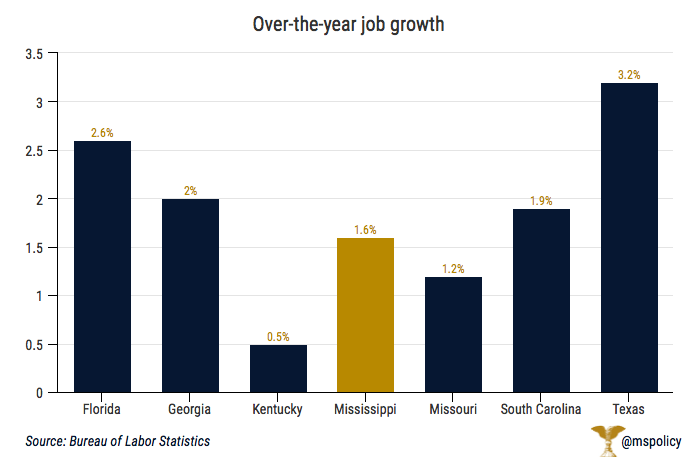
Statistically, Mississippi’s 1.6 percent over-the-year job growth compared favorably among the state’s neighbors.
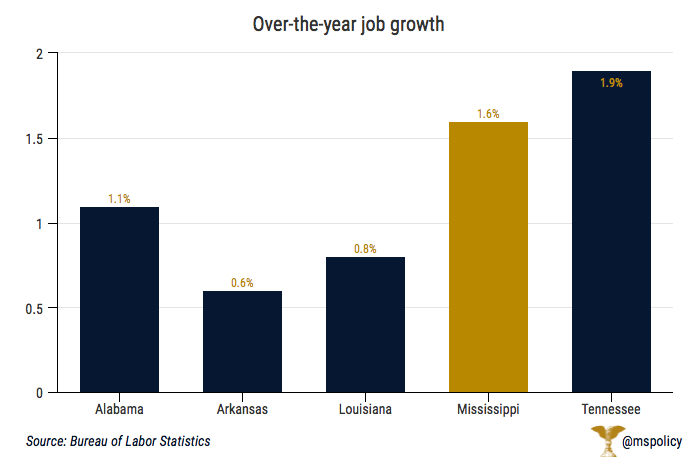
Only Tennessee, whose payrolls grew by 1.9 percent saw greater improvement in terms of job numbers, percentage wise, than Mississippi. Alabama grew by 1.1 percent while Arkansas and Louisiana grew by .6 percent and .8 percent, respectively.
Outside of Mississippi’s immediate neighbors, we saw strong gains in most SEC states, with Kentucky being an outlier among this group.
Mississippi's unemployment rate
At 4.8 percent, Mississippi’s unemployment rate remains near the state’s historic low of 4.6 percent. That occurred just this past December. But among Mississippi’s neighbors, every state but Louisiana had a lower unemployment rate.
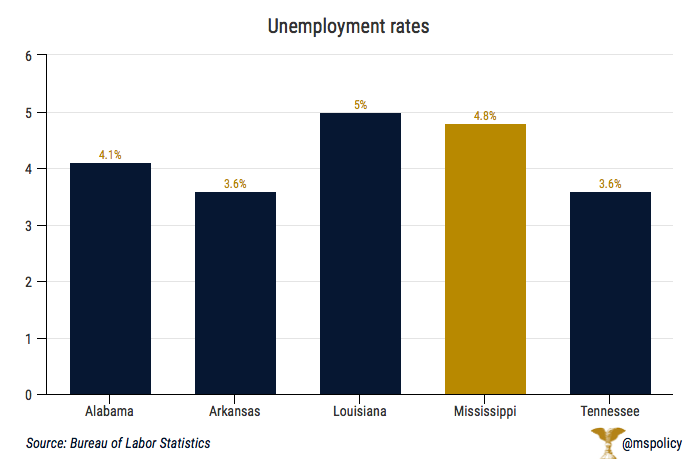
Though low, and down from just a few years ago, Mississippi’s unemployment rate is still 47th nationally.
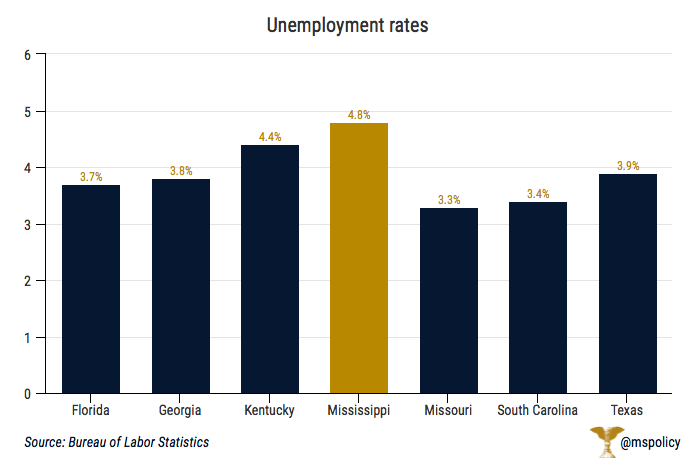
Among the other SEC states, we see unemployment rates ranging from 3.3 percent in Missouri to 4.4 percent in Kentucky.
Within Mississippi, the following counties had unemployment rates under 4.2 percent (for July 2018): Rankin (3.6%), Union (3.7%), Desoto (4%), Lamar (4.1%), Madison (4.1%), and Pontotoc (4.2%). The following had unemployment rates above 9.1 percent: Humphreys (9.4%), Wilkinson (10.1%), Holmes (10.3%), Claiborne (10.8%), and Jefferson (15.2%).