
Mississippi lawmakers say they’ll spend part of the summer studying the state’s Medicaid program to see if there’s a way to save taxpayer money. But if recent history is any indication, the effort will not yield significant fruit.
Lawmakers in other states have, for years, picked through the federal-state medical welfare partnership, and so far, the best they’ve been able to do is slightly lower the annual increases.
Knowing the outcome of the inquiry is obvious, perhaps lawmakers would be better served in examining the questions that, so far, no state has dared to address:
- Has Medicaid quietly replaced our human capacity for compassion with something cold and rigid?
- Has Medicaid calcified the propensity to show our neighbors love and kindness – the qualities that defined Mississippi and Mississippians for generations?
- Is the six-decades-long experiment in government-administered aid an appropriate substitute for the neighborly concern our grandparents and their parents and grandparents prioritized in their communities?
This is not to say that state officials should not bother spending their time looking at the financial ledger of the state’s Medicaid program, overturning all the accounting rocks in search of waste, fraud, abuse, and potential for savings. But this leaves untouched the matter of what happens to society when compassion becomes a line item, when caring for the vulnerable is outsourced to a bureaucracy, and when neighbors are quietly absolved of any felt obligation to one another.
The Legislature already knows that real reforms — and therefore, real savings — require doing the things no one seems willing to do, such as wholesale elimination of the program’s federally unrequired elements, including prescription drugs and prosthetics.
Indeed, most states including Mississippi have found eliminating program components politically undesirable, and so they avoid raising the question. The reason is not simple electoral cowardice. It is that decades of Medicaid have conditioned Americans to regard government-provided care as so natural that imagining its absence feels monstrous — even though government is filling the role once held by the private charitable networks, church benevolence funds, and community mutual-aid societies.
When the government guarantees a service, the moral urgency to provide it privately fades. The obligation migrates, and with it, something irreplaceable about how a community understands its own members.
Of course, the most optional part of Medicaid is the decision of a state to offer the program at all. No state is required to participate in the Great Society program that Congress passed and President Lyndon B. Johnson signed into law in 1965. States have, one by one, agreed to participate. Mississippi joined in following a contentious special session of the Legislature in 1969. And to date, not a single state has seriously weighed the prospect of dropping from the program, even as costs skyrocket.
Across the country, Medicaid is now the largest program that states administer, far surpassing education as the government’s chief responsibility by cost. Mississippi is expected to spend roughly $8.5 billion on government-run healthcare in the budget year that starts July 1. The state’s portion of the tab will cross $1 billion for the first time, an increase of roughly 16%.
Meanwhile, the loudest debate in Mississippi Medicaid circles is whether the state should expand coverage under the Affordable Care Act to able-bodied, childless adults. Expansion proponents argue that the federal government would cover 90 percent of the cost, that hundreds of thousands of working-age Mississippians fall into a coverage gap, and that rural hospitals struggle with uncompensated care.
Opponents argue the long-run costs are uncertain, federal promises are unreliable, and expansion would add 200,000 or more people to a program already straining the budget.
Both sides are, again, counting money. Neither is exploring the tougher, more challenging matter.
Mississippi has a tradition — rooted in its churches and towns, its extended families and its history of community survival under genuine hardship — of people caring for one another without being instructed to by statute. That tradition has not been destroyed by Medicaid, but it has been crowded out.
When the government guarantees a service, the neighbor who once organized the collection plate for a sick family now assumes there’s a government program somewhere to handle it. He doesn’t need to know about the struggles occurring on his block, across town, or on the other side of the state.
People who are sick need care, and the mere existence of a program is not care. “Care” requires active awareness of the plight of others. Such knowledge can seemingly challenge the capacity of voluntarism alone. But “challenging” doesn’t mean impossible. And it’s important to remember that Medicaid, as large as it is, still has a tough time meeting the needs of the people, in part because it is so large — and because bureaucratic rules often displace personal judgment and local knowledge.
The question is not whether the sick receive help but through what means, and at what cost to our common life and our moral character as a people.
Mississippi has spent decades and tens of billions of dollars discovering that you can administer a program for hundreds of thousands of people; you can budget it and audit it and let contracts for it, but you cannot manufacture compassion or replace what is lost when the community stops being its own first answer.
If Mississippi lawmakers really want to understand Medicaid and its consequences, these are the questions they should spend their time considering this summer.
— Wayne Hoffman is President of the public policy education and advocacy organization, Level Up Humanity, and is a research fellow of the Mississippi Center for Public Policy.
Governor Tate Reeves announced that he is open to calling a special legislative session on education. He should.
Two and a half months into the session, Mississippi’s state legislature has so far accomplished remarkably little.
Senator Jeremy England’s well thought out efforts to restore the ballot initiative (SCR 518) failed. Speaker Jason White and Representative Jansen Owen’s flagship school choice bill (HB 2), a product of months of work and careful deliberation, died. So too did the House proposal on teacher pay (HB 1126). Ditto for plans to reform PERS, the Public Employee Retirement System, into which a lot of first responders and others had put enormous thought.
Having convened for more than 40 days, it is hard to think of a single significant legislative achievement this session.
That the legislature has so little to show for all those hours (and per diem payments) is not due to a lack of effort on the part of many lawmakers. There was no shortage of good proposals. The problem is that they all died in the Senate.
Governor Tate Reeves now has the power to break the logjam with a special session.
He should make it clear that he will call a special session for April, with a single education bill on the agenda, one that both raises teacher pay (modeled on HB 1126) and gives parents more power (modeled on HB 2). Any lawmaker who votes against what is put before the special session will be voting against teacher pay increases.
At the same time, our Governor should make it clear that if there is no agreement, he will call a second special session in May, then in June, July, and into the summer if that is what it takes.
In Texas, where families now control their child’s education tax dollars, that is what Governor Greg Abbott ended up having to do. Governor Reeves would be in good company.
Lawmakers are up for reelection next year. This time next year, some might face primary elections. It would be a bold move to go into a long summer, months before a potential primary election, repeatedly voting to kill teacher pay increases and parent power.
In his comments earlier this week, Governor Reeves remarked, “I do not have much time left”. With the end of his eight year term in sight, and term limited, he appears to be reflecting on his legacy. What an impressive legacy it already is.
Mississippi is on a roll economically. In 2024, we ranked second nationally in real GDP growth. Household incomes have surged. Outside investment is pouring in. After decades of decline, more people moved to Mississippi last year than left.
But for a Southern state now surrounded by neighbors that have embraced school choice, one key policy remains conspicuously absent: effective, meaningful school choice here at home.
Governor Reeves has a historic opportunity to change that by calling a special session. In doing so, he could deliver this long sought reform, cement a lasting achievement for Mississippi families, and virtually guarantee that his successor is pro parent power too.
A small win for freedom in Mississippi! Governor Tate Reeves recently signed HB3, a law that reforms the state’s Certificate of Need (CON) rules.
CON is basically a government approval process healthcare providers (like hospitals) must go through before they can add certain services, build new facilities, buy expensive equipment, or make big expansions.
HB3 makes some modest changes, allowing more flexibility for some specific providers. It also raises the dollar threshold for capital spending requiring approval.
Perhaps the most significant part of the bill is that it mandates the Mississippi Department of Health to do a study over the course of this year into the feasibility of letting smaller hospitals skip CON when providing kidney dialysis treatment and adult psychiatric services.
While HB3 does not give us the reforms Mississippi needs, it is a step in the right direction. In a legislative session that has seen most significant reforms killed in the Senate, this is one rare example of a free market reform in the 2026 session.
The future for our state looks bright. In just the past five years, Mississippi has seen more economic growth than in the entire fifteen years before that combined.
We’re on track to phase out the state income tax entirely, allowing families to keep more of what they earn. Mississippi has attracted a surge of new investment, and for the first time in years, our workforce participation rate is finally heading in the right direction.
Zoom out, and the picture gets even better. Contrary to the endless gloom from the pundits, the American economy has consistently outperformed expectations for decades. Since the late 1990s, the U.S. has delivered strong, steady growth that few forecasters saw coming.
But there is one dark cloud on all our horizons that we cannot forever ignore; US national debt.
As of today, US national debt stands at $38 trillion (with a capital T).
To grasp how enormous a single trillion really is, try this:
- One million seconds ago was just last week, right before Halloween.
- One billion seconds ago was early 1994, when Clinton was president and the internet was dial-up.
- One trillion seconds ago was roughly 30,000 BC, deep in the Stone Age, when humans were still chasing mammoths.
Now here’s the gut-punch: that $38 trillion mountain of debt has roughly doubled in just the past ten years.
Costly foreign wars, mega bailouts, COVID giveaways and all those federal entitlement programs LBJ said would “end poverty”, eventually add up. (Incidentally, living standards for America’s poorest citizens are light-years higher than when those programs launched in the 1960s (indoor plumbing, air conditioning, smartphones, modern medicine), but the number of people dependent on government assistance is larger than ever).
Rather than pay for all that using tax receipts, the US government has borrowed, issuing IOUs. Today we spend more money servicing all those IOUs than we do on defense.
As my fellow Brit, the historian Niall Ferguson, likes to point out, any great power that spends more on debt servicing than on defense risks ceasing to be a great power. That was true of the Romans and the British, the Habsburgs and the Dutch.
What must America do to avoid a similar fate?
When President Trump was first elected, Elon Musk and Vivek Ramaswamy launched the Department of Government Efficiency (DOGE) with an ambitious target: to reduce annual federal spending by $2 trillion.
Because mandatory entitlement programs - Social Security, Medicare, and Medicaid - remained largely untouched, DOGE hasn’t come close to achieving that yet. The federal deficit has barely budged.
Where, one might ask, are all those Tea Party types that railed against federal overspending ten years ago as the debt to GDP ratio went from 90 percent in 2010 to 125 percent today?
If the US cannot rein in the growth of the debt, the only other way to avoid going the way of the Romans is to try to make the GDP part of the equation rise faster. In other words, to try to grow our way out of the debt.
In order to stabilize debt-to-GDP at the current 125 percent of GDP, America will need to achieve real GDP growth of about 4 - 5 percent for the next 10 to 20 years. With the advent of AI and robotics, as Elon Musk suggests, it could be done.
Put it another way; without an AI / Robotics induced growth surge, US debt will hit 150 – 170 percent of GDP by 2050. Mamdani-economics would then become the least of our worries, as inflation and tax rises became inevitable whoever held office.
The older I get, the more I think that there are two fundamental things that the federal government needs to get under control: mass immigration and the deficit. Do that, and states like Mississippi have a bright future. Don’t, and all the good that we might do will only matter at the margins.
FOR IMMEDIATE RELEASE
October 30, 2025
MISSISSIPPI CENTER FOR PUBLIC POLICY HONORS LEGISLATIVE HEROES AT ANNUAL GALA CELEBRATING STATE SUCCESS
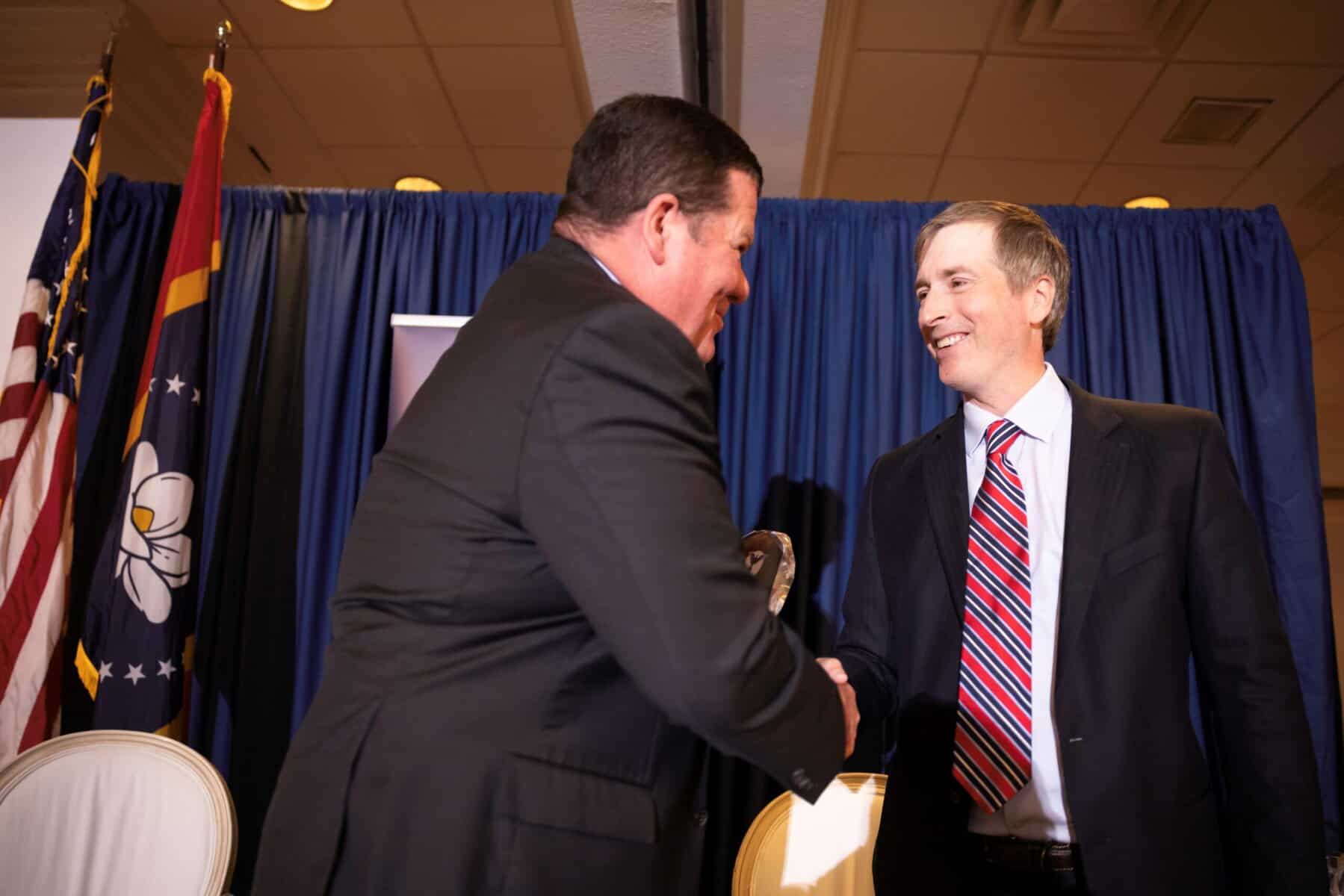
JACKSON, MS – October 30, 2025 –Six of Mississippi’s leading lawmakers were presented with award to honor them for championing principled conservative policy. Rich Lowry, editor of the National Review, presented each of the winners.
Healthcare
Rep. Sam Creekmore and Rep. Hank Zuber were jointly honored for their leadership in challenging Mississippi’s Certificate of Need (CON) laws, which restrict the expansion of healthcare providers and limit patient access.
Countering DEI
Sen. Angela Hill received the award for her early and unwavering stand against the encroachment of divisive DEI (Diversity, Equity, and Inclusion) policies in Mississippi’s public universities. Long before the issue gained national attention, Sen. Hill worked to safeguard academic freedom and institutional integrity at the state’s flagship campuses.

Education Reform
Rep. Jansen Owen was recognized for leading the 2025 legislative effort to expand open enrollment through HB 1435. Though the bill passed the House with broad bipartisan support - uniting parents, educators, and lawmakers - it was ultimately blocked in the Senate.

Income Tax Elimination
Mississippi became the first state since Alaska in 1980 to phase out its personal income tax through HB1. Rep. Trey Lamar and Speaker Jason White were honored as the driving forces behind this transformative reform. Through public town halls, transparent negotiations, and superior policy arguments, the duo outmaneuvered opposition and delivered a pro-family, pro-growth tax cut that is already attracting investment and enhancing Mississippi’s competitiveness.“


These lawmakers represent the best of conservative leadership - courageous, principled, and effective,” said Douglas Carswell of the Mississippi Center for Public Policy. “Their work is making Mississippi a national model for freedom, opportunity, and common-sense governance.”
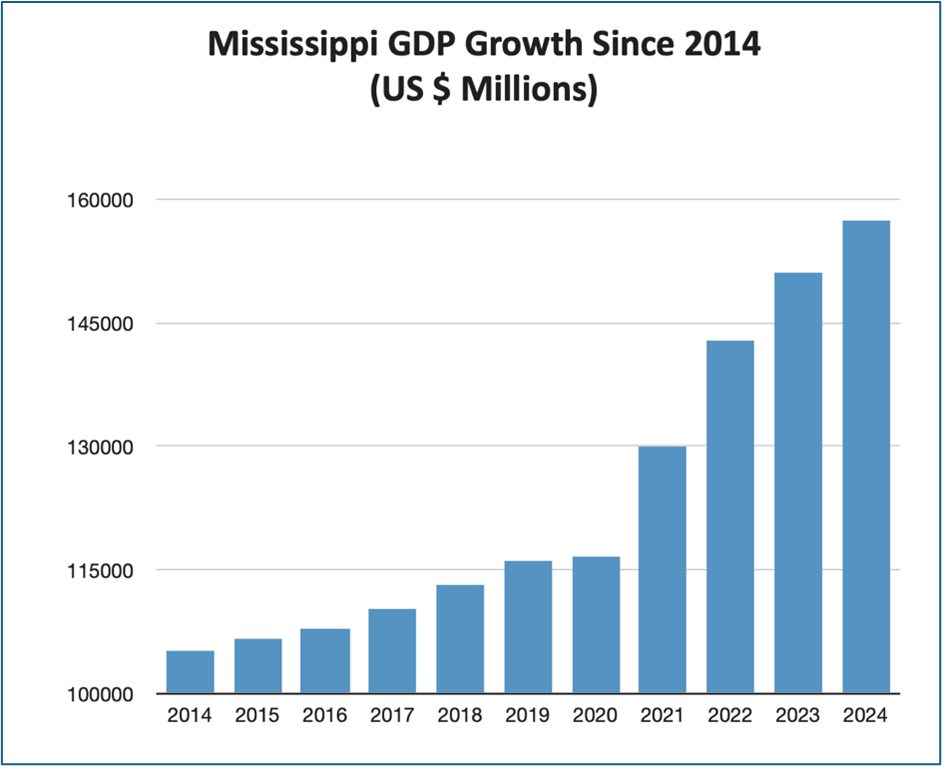
Mississippi is shedding its image as an economic laggard. Over the past five years, the state’s economic output has grown more than it did over the previous fifteen years combined.
According to the U.S. Bureau of Economic Analysis, Mississippi posted the second-fastest per capita GDP growth and fifth-fastest personal income growth among all states in Q4 2024. Billions in capital investment have flowed in.
This growth is happening across the state—from the Gulf Coast and Pine Belt to DeSoto County, the Jackson metro area, and the university hubs of Oxford and Starkville.
Mississippi whoooooosh!
Mississippi’s recent growth is no accident. It is down to good public policy. Since 2022, Mississippi has implemented transformative tax cuts, reduced the state income tax and lowered the grocery sales tax and easing business inventory taxes. A 2021 law streamlining occupational licensing reduced barriers for workers and entrepreneurs, with the Mississippi Secretary of State reporting a 12% increase in new business registrations in 2023 alone.
Energy in our state is affordable, Mississippi electricity rates averaging 13.43 cents per kilowatt-Hour, helping draw in energy-intensive industries, including two major data centers in Madison and Rankin counties. To top it all, Mississippi’s public universities are fueling growth, and around Oxford and Starkville, entrepreneurial ecosystems are thriving.
But to maintain this momentum, our state needs to abandon policymaking as usual and embrace bold reform. That’s why the Mississippi Center for Public Policy (MCPP) has just launched The Mississippi Miracle? Bold Reforms for Growth.
Our paper details practical steps to sustain and accelerate this momentum:
- Empower Parents Through School Choice: Let families use state funds for public, private, or homeschooling options to drive competition and elevate education standards.
- Refocus Higher Education: Cut administrative bloat, prioritize workforce-relevant programs, and redirect resources from low-value courses to practical, job-focused education.
- Rein in Public Spending: Cap budget growth to population growth plus inflation to ensure fiscal discipline and curb waste.
- Cut Red Tape: Eliminate outdated regulations, repeal Certificate of Need laws, and create a business-friendly environment to spur innovation.
- Reform Public Procurement: Mandate transparent, competitive bidding with regular audits to prevent cronyism and maximize taxpayer value.
- Promote Welfare-to-Work: Emphasize work requirements, job training, and time-limited benefits to foster self-sufficiency and reduce program costs.
These reforms are practical policies that lawmakers can implement to improve lives across Mississippi.
To explore them in detail, visit mspolicy.org under “Publications” or email me at [email protected] for a direct link.
MCPP has a small, but highly productive team. We punch above our weight, producing policy proposals that become law, and helping set the agenda at the Capitol. We are able to do all this because we have the input of so many people across our state. Please read our proposals and share your thoughts—I want to hear what you think.
For decades, Mississippi exported people. Young people in particular tended to leave our state for places like Atlanta, Nashville, Huntsville and Austin.
I believe the tide is starting to turn. I often hear anecdotes of young people moving back to Mississippi. The data suggests that growth in our state is creating opportunities and drawing more people to move here .
Have a read of our report and help us build on this momentum.
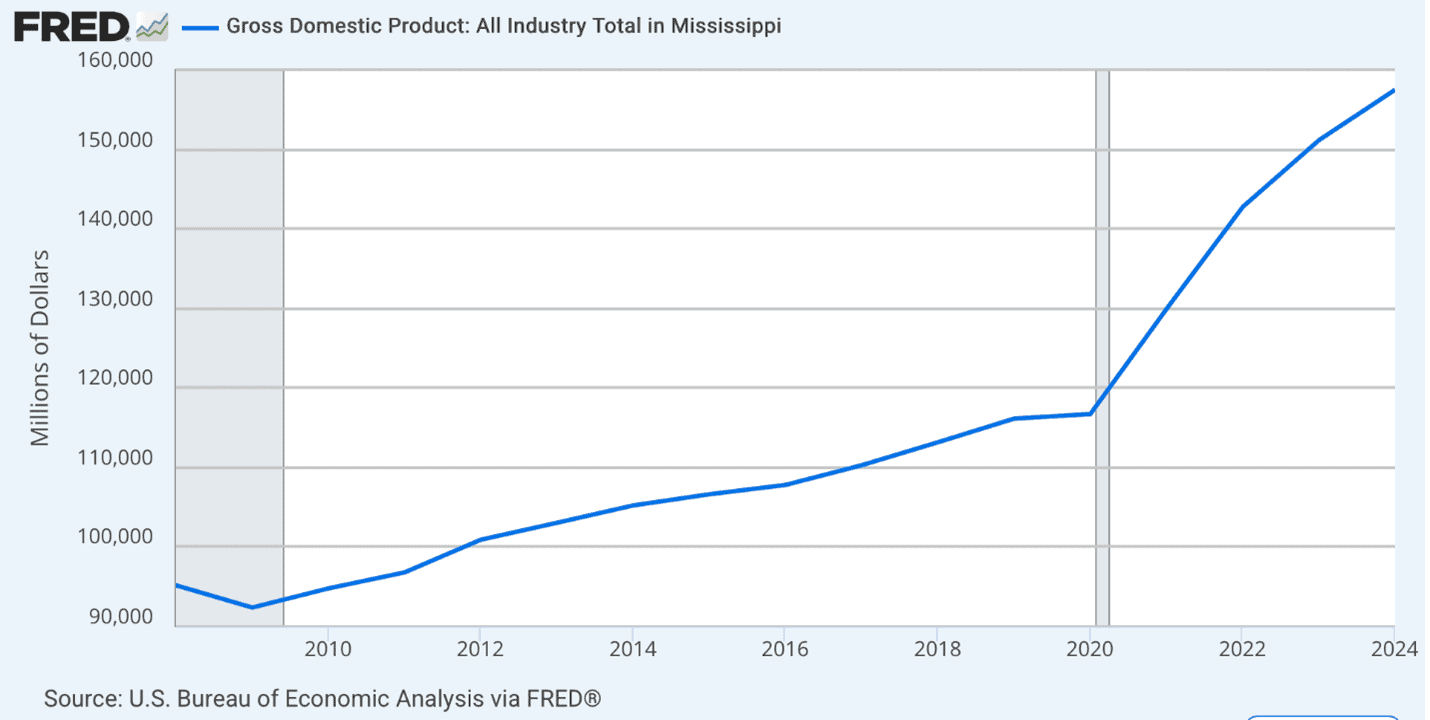
Mississippi is on the move. Over the past five years, economic output rose more than it did over the previous fifteen.
According to data from the Federal Reserve Bank of St. Louis, Mississippi’s economic output has soared by $41.4 billion, climbing from $116.1 billion in 2019 to $157.5 billion in 2024. That’s more growth in half a decade than we saw in the previous fifteen years combined.
This growth did not happen by chance. It came about thanks to deliberate, pro-growth policies that are transforming our state.
In 2021, we saw labor market deregulation with a bill to reform occupational licensing. Then in 2022 came a substantive tax reform bill, which paved the way toward the income tax elimination bill passing in 2025. At the same time, Mississippi has kept energy costs low and rolled out the red carpet for inward investors.
Every one of these victories came about thanks to principled conservative leaders who fought for change against fierce opposition from leftist lawmakers wedded to the status quo. At the time that these reforms were proposed, there was no kumbaya consensus in favor of any of it. Change only happened because a handful of conservative leaders – and dare I say it conservative organizations - were willing to go out on a limb for it.
The Mississippi Center for Public Policy (MCPP) recently honored some of those in our legislature that truly are committed to this pro-growth agenda, and we should all celebrate their determination.
But the question remains: Is your local lawmaker part of Mississippi’s new pro-growth agenda, or are they standing in the way?
Did your own Representative and Senator help lead Mississippi’s growth, or are they one of the one’s that opposed everything but showed up for the cameras?
Despite Mississippi’s strong conservative majority, we often fall short on basic conservative priorities like school choice. Too many solid bills mysteriously “die in committee” with no explanation, no recorded votes, and no accountability. Lawmakers who oppose pro-growth policies have gotten away with vague soundbites on Supertalk, dodging any real consequences. That ends now.
The new Mississippi Freedom Index, which you can access by logging on to our website at mspolicy.org, empowers everyday Mississippians to hold their representatives accountable. This tool shows how your lawmaker voted on key pro-growth policies, details their campaign finance contributions, and even lets you message them directly.
We’ve identified four flagship growth policies that define Mississippi’s economic surge—any lawmaker who opposed them doesn’t meet our definition of a conservative, plain and simple.
So, where does your representative stand? Log on to mspolicy.org and click on the Freedom Index to find out. If any lawmaker disagrees with their rating, they’re welcome to reach out. They can post their remarks, or if they’re willing to publicly commit to supporting the policies they didn’t vote for, we’ll reconsider their score.
Mississippi is on the rise. Check the Freedom Index today—because our state’s future depends on leaders who deliver, not ones who hide.
Mississippi has made history as the first state in the U.S.—aside from oil-rich Alaska—to pass legislation aimed at phasing out its income tax.
This monumental achievement, spearheaded by Governor Tate Reeves and House Speaker Jason White, marks a significant victory for the state. The newly passed bill outlines a plan to eliminate the income tax over the next decade, starting with incremental cuts and followed by a series of budget-driven "triggers."
Beginning next year, Mississippi’s income tax rate will drop in 0.25 percent increments, sliding from 4 percent to 3 percent by 2030. After that, further reductions will hinge on the state’s budget surplus. Given Mississippi’s recent track record of substantial surpluses, the income tax could vanish entirely by the mid-2030s.
So, how did Mississippi become such a trailblazer? It very nearly did not happen.
The push to eliminate the income tax has been a cornerstone of Governor Reeves’ agenda, with serious legislative efforts kicking off in 2022 under then-House Speaker Philip Gunn.
Gunn’s genius was to simplifying the state’s variable tax rates into a flat 4 percent on income above $10,000. While this didn’t eliminate the tax outright, it leveled the playing field for Mississippi households, setting the stage for broader support of full elimination.
Fast forward to this year, when Speaker Jason White and Representative Trey Lamar introduced a plan to phase out the income tax by 2037. Their initial proposal included a partial tax swap, offset by modest increases in gas and sales taxes.
What happened next was both fascinating – and, if you support income tax elimination, rather fortuitous.
The Mississippi Senate has been a constant drag on conservative reform. They have either opposed, or come to grudgingly accept, almost every conservative policy proposal over the past few years, from school choice to red tape reduction. So, too, with income tax elimination.
The Senate, reluctant to fully embrace income tax elimination, opted for a cautious approach. They amended the bill with a "trigger" mechanism, tying future tax cuts to significant revenue growth outpacing spending increases. Some in the Senate perhaps saw this as a clever stall tactic—until a fortunate blunder turned the tables.
The Senate miscalculated the formula, placing a decimal point in the wrong place. Math matters. Something the Senate design as a brake on tax cuts turned out to be an accelerator.
Unless the state government runs a deficit, future surpluses will likely drive steady cuts, and Mississippi – despite the Senate leaderships best efforts – will be as competitive in tax terms as Tennessee and Texas.
Set aside the soap opera, this is great news for our state. Already there is evidence that in 2024, by some measures, Mississippi performed well economically, and may have been one of the fastest growing states in America that year. This tax reform will only add to this Mississippi momentum.
Perhaps what the Senators math missteps shows is that Mississippi now needs to turn its attention to education reforms? If the Senators stopped blocking school choice the way they tried to block income tax elimination, maybe math standards might be better both inside and outside the legislature.
In politics, nothing moves unless it’s pushed. Change doesn’t happen because of empty platitudes—it happens because principled conservatives like you step up to demand principled policies.
At the Mississippi Center for Public Policy (MCPP), we’ve been pushing hard this legislative session for four flagship conservative priorities. With just three weeks left, here’s where we stand—and how your support is making a difference.
1. School Choice
For years, no bill allowing even basic public-to-public school choice had been granted a floor vote. This session, we saw progress: a bill passed the House with a strong majority, only to be stalled in the Senate Education Committee under Chairman Dennis DeBar.
Sadly, this proposal appears dead for now—a frustrating outcome when every neighboring state offers universal school choice, and President Trump himself champions this policy. But the opposition’s grip may be weakening. Killing bills in committee no longer comes cost free for left leaning Senators, as it did for years. If principled conservatives keep shining a light on who’s blocking progress, we will win this fight.
2. Income Tax Elimination
Governor Tate Reeves has made income tax elimination a priority, and the House agreed, passing Speaker Jason White and Rep. Trey Lamar’s HB1 bill early in the session.
Now, the Senate’s liberal leadership is stalling, with a critical deadline looming this Tuesday. If HB1 fails, it will be a deliberate choice by Lt. Governor Delbert Hosemann, whose stance aligns more with liberals than with conservative taxpayers. We can’t waver. We must rally behind leaders like the Governor and Speaker who take bold conservative stands—and call out those who don’t. To achieve change, conservative organizations must not equivocate.
3. Outlawing DEI
When State Auditor Shad White exposed how Diversity, Equity, and Inclusion (DEI) programs in higher education were costing taxpayers millions, some at the Capitol scoffed. For years, they buried anti-DEI bills.
But the truth is out: DEI has been rampant, and Shad White was right. Now, an anti-DEI bill banning these wasteful, divisive practices is finally nearing the Governor’s desk. This is what happens when principled conservatives push forward. You’ve helped make this possible—thank you.
4. Removing Red Tape
In healthcare, excessive regulations stifle progress and hurt our economy. Two steadfast conservatives, Rep. Zuber and Rep. Creekmore, have worked tirelessly to cut this red tape. Their bill is on the cusp of becoming law—a testament to what principled leadership can achieve.
What’s Next?
The final weeks of the session could bring surprises. The Senate might dig in, forcing a special session, or conservative Senators could step up, demanding action on income tax elimination, anti-DEI measures, and red tape reduction—policies voters like you support. As Barry Goldwater famously said, “Extremism in defense of liberty is no vice. Moderation in pursuit of justice is no virtue.” Your commitment to these principles is driving change in Mississippi.