
For decades, America has been told that the key to better schools is more money. Underperformance, the argument runs, is really a question of resources. Just give the teacher unions what they ask for, and good outcomes will follow.
Mississippi is starting to show that this simply is not true.
Over the past decade, Mississippi has made such progress in fourth grade reading that people have taken to calling it the “Mississippi miracle.” Mississippi ranked 9th in the country for fourth grade reading in 2024, up from 49th in 2013 — a forty-place climb in a decade, from near the bottom of the table into the top ten.
Mississippi’s fourth graders now read better than their peers in New York, Minnesota and California — every one of them a state that spends a great deal more per child than we do. And here is the part the spend-more crowd would rather you did not dwell on. We get those better results on far less money.
Mississippi spends around $12,300 per pupil, one of the five lowest figures in America. New York spends $31,918 — more than two and a half times as much — and its children read less well for it. New York, in other words, buys more than two dollars of schooling for every one of ours, and ends up further behind.
Perhaps the starkest comparison of all is with California. A Black fourth grader in Mississippi is now somewhere between two and a half and three times more likely to read at grade level than a Black fourth grader in California — 19 percent reach proficiency here, against just 7 percent there — and California spends well over half as much again per pupil as we do. If money were the answer, those numbers would be the other way round.
There is no reliable relationship between what a school spends and what its children actually learn. Mississippi proves this point not only when you compare our results to other states, but when you examine what is happening inside Mississippi in granular detail.
Here at the Mississippi Center for Public Policy, we built a free online tool — CompareMySchool.com — that lets any parent in the state see exactly how their school is doing. Type in a school’s name and up comes its grade, the share of children reading and doing math at grade level, and how it ranks against every other school in Mississippi — and against the rest of America, too.
We intended it to be a tool for families to use this summer, as they contemplate the start of the next school year and perhaps begin to wonder if their kids are in the right school. CompareMySchool.com pulls all of the data into one place, in user friendly format.
But once we built the site, something unexpected leapt out. The tool lets you line up every school district in Mississippi and set what it spends per pupil against how its
children actually perform. If the conventional wisdom were right, you would expect a clear pattern: the more a district spends, the better it does.
There is indeed a correlation between spending and outcomes, but it is the opposite kind of correlation. The higher the per pupil spending the worse the grades.
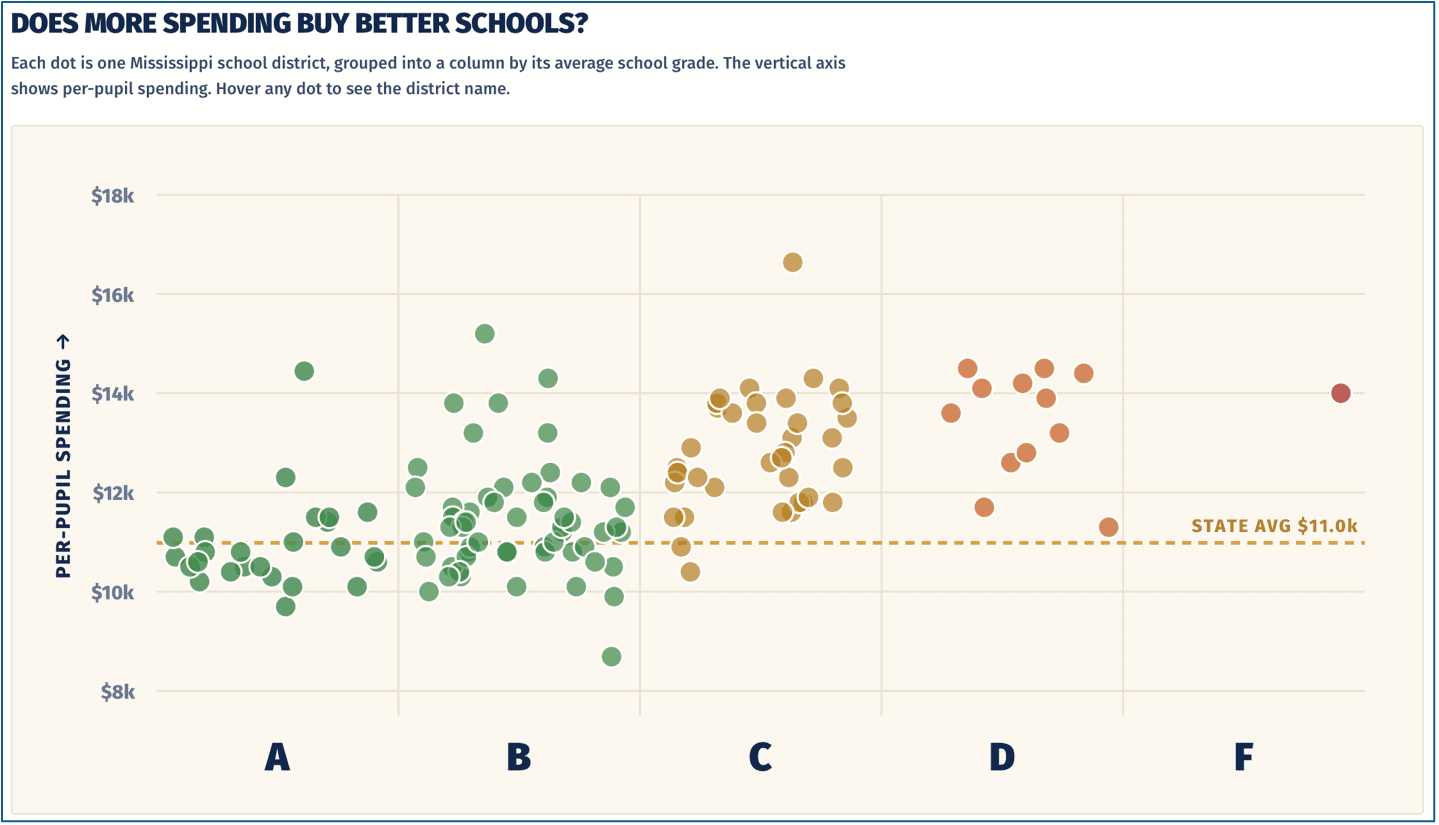
Higher spending, worse results
Across Mississippi’s districts, higher per-pupil spending goes hand in hand with worse outcomes, not better ones. The lowest-spending quarter of districts gets, on average, 63 percent of children to proficiency in reading and math. The highest-spending quarter manages just 36 percent. Read that again. The districts spending the most are getting barely half the results of the districts spending the least.
Ocean Springs, down on the Gulf Coast, is the top-performing district in the state - more than three-quarters of its students at proficiency - on about $10,300 per pupil. Jackson Public Schools spends $16,640 per pupil, more than 60 percent more than Ocean Springs, and gets fewer than a third of its children to proficiency. Petal spends roughly 42 percent less per pupil than Jackson — and more than doubles Jackson’s results. DeSoto County, the largest district in the state, educates nearly 34,000 children on the lowest per-pupil budget in Mississippi — and still beats Jackson almost two to one.
Our webtool also allows families to compare what their public school district spends against what the local private school down the road charges to do the very same thing — and the gap is startling.
Jackson Public Schools spends $16,640 of public money on each child. A few minutes away, there are private schools that charge about a third that amount. It’s the same story across the state where typical private school charges about $7,000 a year, while often getting far better results. The public sector, it turns out, is not the cheap option.
What matters is not how much a district spends, but how it spends it. This data in Mississippi strongly suggests that what we need to see are reforms that allow families dissatisfied with what their school board has to offer with the option of taking their child’s share of funding to a school outside government control.
Mississippi’s own data — now in the hands of every parent at CompareMySchool.com — makes the argument that money is not the answer. Better-run schools are, and the surest way to get more of them is to trust parents to choose.
Imagine your family spent more this year than you earned. It wouldn't be comfortable, but you'd manage. Now imagine your family had spent more than it earned every single year since 2001. By now you'd be destitute.
Well, that is exactly what the federal government has been doing.
For the past 25 years — ever since Bill Clinton left the White House — Washington has spent more than it has taken in. Every single year. The result is a national debt that now stands at $39 trillion.
In 2001, the United States owed less than $6 trillion. Today we owe nearly $39 trillion. That means the federal debt has grown by $33 trillion in just 25 years.
The pace is accelerating
Here is the worrying part. In the entire 212 years from George Washington's first inauguration through Bill Clinton's last day in office — through the Civil War, the Great Depression, two World Wars, and the Cold War — the United States ran up $5.8 trillion in debt.
In the 25 years since, we have added $33 trillion more. More than four-fifths of the total debt has been acquired in the past quarter-century.
And it is getting faster. Of that $39 trillion, $2.7 trillion was added in just the past year. A staggering $10 trillion — more than 27 percent of every dollar America has ever borrowed — has been piled on in the past five years alone. The federal government now adds roughly $8 billion of new debt every single day.
What a trillion actually looks like
Millions, billions, trillions. Our brains are not wired to grasp numbers this large, so let me put it another way.
A million seconds ago was about 11 days ago — late April. A billion seconds ago was 32 years ago, in 1994, when something called the World Wide Web was just getting started.
A trillion seconds ago? That was around 32,000 years ago. Woolly mammoths still roamed Europe, farming had not yet been invented, and no one (we think) had yet made it to North America.
That is what a trillion looks like. And we owe almost forty of them.
The Ferguson limit
Great nations are rarely destroyed by external enemies. They are more often destroyed by debt.
The historian Niall Ferguson has warned that when the crushing cost of servicing old debts begins to crowd out the essential investments that sustain national strength — especially defense — decline becomes almost inevitable.
History is littered with cautionary tales. Habsburg Spain. Bourbon France. The Ottoman Empire. Each was once the greatest power on earth. Each was overstretched by debt.
Ferguson identifies a critical threshold — sometimes called the Ferguson limit — beyond which a great power cannot long survive: the moment a nation spends more on debt interest than on defense. At that point, fiscal arithmetic begins to dismantle geopolitical power.
The United States is now flirting with that threshold.
What's at stake
A few months ago, I was at the Ole Miss game in Oxford when a B-2 stealth bomber flew over the stadium. The crowd went wild. It was one of the most thrilling sights I have ever seen — a symbol of American strength, the kind of demonstration of raw power that not only keeps the United States secure but keeps the bad guys across the globe in line.
Each B-2 cost over $2 billion to build, which is why only 21 were ever produced. Keeping one in the air costs about $150,000 per hour.
The risk is that one day the United States — like Habsburg Spain — will simply not be able to afford the things that make us strong. And it isn't just the defense budget at stake. Will America be able to pay its Medicaid bills? Its pensions? Its Social Security obligations?
Spending restraint and growth
We pour enormous attention into elections and congressional redistricting. But unless we get the debt under control, none of that will matter.
At the start of President Trump's second term, I had high hopes. Elon Musk and DOGE talked seriously about reducing public spending. I hoped Congress might finally wake up and do its job.
But cutting spending alone will not be enough. We also need economic growth — and I am confident we are on the cusp of a massive AI-driven productivity boom that could deliver it. Spending restraint and growth, working together, could narrow the deficit over a decade or so. Eventually we could even begin to pay the debt itself down.
This — not the midterms, not the game of musical chairs over congressional districts — is what really matters.
Controlling the deficit will decide whether our children's children live better lives than we do, or whether we follow Europe down the path of higher taxes, rising costs, and demographic decay.
Mississippi lawmakers say they’ll spend part of the summer studying the state’s Medicaid program to see if there’s a way to save taxpayer money. But if recent history is any indication, the effort will not yield significant fruit.
Lawmakers in other states have, for years, picked through the federal-state medical welfare partnership, and so far, the best they’ve been able to do is slightly lower the annual increases.
Knowing the outcome of the inquiry is obvious, perhaps lawmakers would be better served in examining the questions that, so far, no state has dared to address:
- Has Medicaid quietly replaced our human capacity for compassion with something cold and rigid?
- Has Medicaid calcified the propensity to show our neighbors love and kindness – the qualities that defined Mississippi and Mississippians for generations?
- Is the six-decades-long experiment in government-administered aid an appropriate substitute for the neighborly concern our grandparents and their parents and grandparents prioritized in their communities?
This is not to say that state officials should not bother spending their time looking at the financial ledger of the state’s Medicaid program, overturning all the accounting rocks in search of waste, fraud, abuse, and potential for savings. But this leaves untouched the matter of what happens to society when compassion becomes a line item, when caring for the vulnerable is outsourced to a bureaucracy, and when neighbors are quietly absolved of any felt obligation to one another.
The Legislature already knows that real reforms — and therefore, real savings — require doing the things no one seems willing to do, such as wholesale elimination of the program’s federally unrequired elements, including prescription drugs and prosthetics.
Indeed, most states including Mississippi have found eliminating program components politically undesirable, and so they avoid raising the question. The reason is not simple electoral cowardice. It is that decades of Medicaid have conditioned Americans to regard government-provided care as so natural that imagining its absence feels monstrous — even though government is filling the role once held by the private charitable networks, church benevolence funds, and community mutual-aid societies.
When the government guarantees a service, the moral urgency to provide it privately fades. The obligation migrates, and with it, something irreplaceable about how a community understands its own members.
Of course, the most optional part of Medicaid is the decision of a state to offer the program at all. No state is required to participate in the Great Society program that Congress passed and President Lyndon B. Johnson signed into law in 1965. States have, one by one, agreed to participate. Mississippi joined in following a contentious special session of the Legislature in 1969. And to date, not a single state has seriously weighed the prospect of dropping from the program, even as costs skyrocket.
Across the country, Medicaid is now the largest program that states administer, far surpassing education as the government’s chief responsibility by cost. Mississippi is expected to spend roughly $8.5 billion on government-run healthcare in the budget year that starts July 1. The state’s portion of the tab will cross $1 billion for the first time, an increase of roughly 16%.
Meanwhile, the loudest debate in Mississippi Medicaid circles is whether the state should expand coverage under the Affordable Care Act to able-bodied, childless adults. Expansion proponents argue that the federal government would cover 90 percent of the cost, that hundreds of thousands of working-age Mississippians fall into a coverage gap, and that rural hospitals struggle with uncompensated care.
Opponents argue the long-run costs are uncertain, federal promises are unreliable, and expansion would add 200,000 or more people to a program already straining the budget.
Both sides are, again, counting money. Neither is exploring the tougher, more challenging matter.
Mississippi has a tradition — rooted in its churches and towns, its extended families and its history of community survival under genuine hardship — of people caring for one another without being instructed to by statute. That tradition has not been destroyed by Medicaid, but it has been crowded out.
When the government guarantees a service, the neighbor who once organized the collection plate for a sick family now assumes there’s a government program somewhere to handle it. He doesn’t need to know about the struggles occurring on his block, across town, or on the other side of the state.
People who are sick need care, and the mere existence of a program is not care. “Care” requires active awareness of the plight of others. Such knowledge can seemingly challenge the capacity of voluntarism alone. But “challenging” doesn’t mean impossible. And it’s important to remember that Medicaid, as large as it is, still has a tough time meeting the needs of the people, in part because it is so large — and because bureaucratic rules often displace personal judgment and local knowledge.
The question is not whether the sick receive help but through what means, and at what cost to our common life and our moral character as a people.
Mississippi has spent decades and tens of billions of dollars discovering that you can administer a program for hundreds of thousands of people; you can budget it and audit it and let contracts for it, but you cannot manufacture compassion or replace what is lost when the community stops being its own first answer.
If Mississippi lawmakers really want to understand Medicaid and its consequences, these are the questions they should spend their time considering this summer.
— Wayne Hoffman is President of the public policy education and advocacy organization, Level Up Humanity, and is a research fellow of the Mississippi Center for Public Policy.
Governor Tate Reeves announced that he is open to calling a special legislative session on education. He should.
Two and a half months into the session, Mississippi’s state legislature has so far accomplished remarkably little.
Senator Jeremy England’s well thought out efforts to restore the ballot initiative (SCR 518) failed. Speaker Jason White and Representative Jansen Owen’s flagship school choice bill (HB 2), a product of months of work and careful deliberation, died. So too did the House proposal on teacher pay (HB 1126). Ditto for plans to reform PERS, the Public Employee Retirement System, into which a lot of first responders and others had put enormous thought.
Having convened for more than 40 days, it is hard to think of a single significant legislative achievement this session.
That the legislature has so little to show for all those hours (and per diem payments) is not due to a lack of effort on the part of many lawmakers. There was no shortage of good proposals. The problem is that they all died in the Senate.
Governor Tate Reeves now has the power to break the logjam with a special session.
He should make it clear that he will call a special session for April, with a single education bill on the agenda, one that both raises teacher pay (modeled on HB 1126) and gives parents more power (modeled on HB 2). Any lawmaker who votes against what is put before the special session will be voting against teacher pay increases.
At the same time, our Governor should make it clear that if there is no agreement, he will call a second special session in May, then in June, July, and into the summer if that is what it takes.
In Texas, where families now control their child’s education tax dollars, that is what Governor Greg Abbott ended up having to do. Governor Reeves would be in good company.
Lawmakers are up for reelection next year. This time next year, some might face primary elections. It would be a bold move to go into a long summer, months before a potential primary election, repeatedly voting to kill teacher pay increases and parent power.
In his comments earlier this week, Governor Reeves remarked, “I do not have much time left”. With the end of his eight year term in sight, and term limited, he appears to be reflecting on his legacy. What an impressive legacy it already is.
Mississippi is on a roll economically. In 2024, we ranked second nationally in real GDP growth. Household incomes have surged. Outside investment is pouring in. After decades of decline, more people moved to Mississippi last year than left.
But for a Southern state now surrounded by neighbors that have embraced school choice, one key policy remains conspicuously absent: effective, meaningful school choice here at home.
Governor Reeves has a historic opportunity to change that by calling a special session. In doing so, he could deliver this long sought reform, cement a lasting achievement for Mississippi families, and virtually guarantee that his successor is pro parent power too.
The future for our state looks bright. In just the past five years, Mississippi has seen more economic growth than in the entire fifteen years before that combined.
We’re on track to phase out the state income tax entirely, allowing families to keep more of what they earn. Mississippi has attracted a surge of new investment, and for the first time in years, our workforce participation rate is finally heading in the right direction.
Zoom out, and the picture gets even better. Contrary to the endless gloom from the pundits, the American economy has consistently outperformed expectations for decades. Since the late 1990s, the U.S. has delivered strong, steady growth that few forecasters saw coming.
But there is one dark cloud on all our horizons that we cannot forever ignore; US national debt.
As of today, US national debt stands at $38 trillion (with a capital T).
To grasp how enormous a single trillion really is, try this:
- One million seconds ago was just last week, right before Halloween.
- One billion seconds ago was early 1994, when Clinton was president and the internet was dial-up.
- One trillion seconds ago was roughly 30,000 BC, deep in the Stone Age, when humans were still chasing mammoths.
Now here’s the gut-punch: that $38 trillion mountain of debt has roughly doubled in just the past ten years.
Costly foreign wars, mega bailouts, COVID giveaways and all those federal entitlement programs LBJ said would “end poverty”, eventually add up. (Incidentally, living standards for America’s poorest citizens are light-years higher than when those programs launched in the 1960s (indoor plumbing, air conditioning, smartphones, modern medicine), but the number of people dependent on government assistance is larger than ever).
Rather than pay for all that using tax receipts, the US government has borrowed, issuing IOUs. Today we spend more money servicing all those IOUs than we do on defense.
As my fellow Brit, the historian Niall Ferguson, likes to point out, any great power that spends more on debt servicing than on defense risks ceasing to be a great power. That was true of the Romans and the British, the Habsburgs and the Dutch.
What must America do to avoid a similar fate?
When President Trump was first elected, Elon Musk and Vivek Ramaswamy launched the Department of Government Efficiency (DOGE) with an ambitious target: to reduce annual federal spending by $2 trillion.
Because mandatory entitlement programs - Social Security, Medicare, and Medicaid - remained largely untouched, DOGE hasn’t come close to achieving that yet. The federal deficit has barely budged.
Where, one might ask, are all those Tea Party types that railed against federal overspending ten years ago as the debt to GDP ratio went from 90 percent in 2010 to 125 percent today?
If the US cannot rein in the growth of the debt, the only other way to avoid going the way of the Romans is to try to make the GDP part of the equation rise faster. In other words, to try to grow our way out of the debt.
In order to stabilize debt-to-GDP at the current 125 percent of GDP, America will need to achieve real GDP growth of about 4 - 5 percent for the next 10 to 20 years. With the advent of AI and robotics, as Elon Musk suggests, it could be done.
Put it another way; without an AI / Robotics induced growth surge, US debt will hit 150 – 170 percent of GDP by 2050. Mamdani-economics would then become the least of our worries, as inflation and tax rises became inevitable whoever held office.
The older I get, the more I think that there are two fundamental things that the federal government needs to get under control: mass immigration and the deficit. Do that, and states like Mississippi have a bright future. Don’t, and all the good that we might do will only matter at the margins.
FOR IMMEDIATE RELEASE
October 30, 2025
MISSISSIPPI CENTER FOR PUBLIC POLICY HONORS LEGISLATIVE HEROES AT ANNUAL GALA CELEBRATING STATE SUCCESS
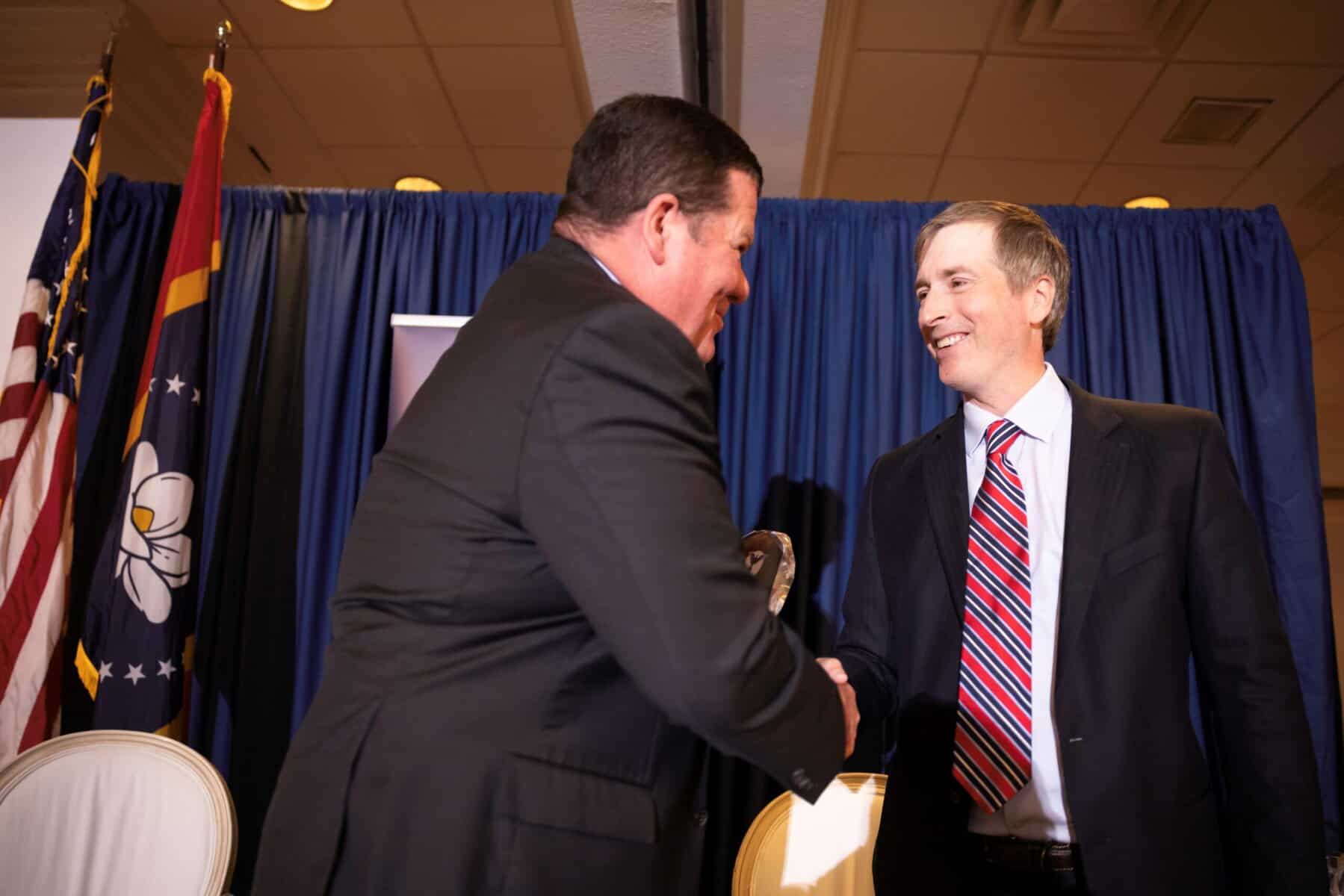
JACKSON, MS – October 30, 2025 –Six of Mississippi’s leading lawmakers were presented with award to honor them for championing principled conservative policy. Rich Lowry, editor of the National Review, presented each of the winners.
Healthcare
Rep. Sam Creekmore and Rep. Hank Zuber were jointly honored for their leadership in challenging Mississippi’s Certificate of Need (CON) laws, which restrict the expansion of healthcare providers and limit patient access.
Countering DEI
Sen. Angela Hill received the award for her early and unwavering stand against the encroachment of divisive DEI (Diversity, Equity, and Inclusion) policies in Mississippi’s public universities. Long before the issue gained national attention, Sen. Hill worked to safeguard academic freedom and institutional integrity at the state’s flagship campuses.

Education Reform
Rep. Jansen Owen was recognized for leading the 2025 legislative effort to expand open enrollment through HB 1435. Though the bill passed the House with broad bipartisan support - uniting parents, educators, and lawmakers - it was ultimately blocked in the Senate.

Income Tax Elimination
Mississippi became the first state since Alaska in 1980 to phase out its personal income tax through HB1. Rep. Trey Lamar and Speaker Jason White were honored as the driving forces behind this transformative reform. Through public town halls, transparent negotiations, and superior policy arguments, the duo outmaneuvered opposition and delivered a pro-family, pro-growth tax cut that is already attracting investment and enhancing Mississippi’s competitiveness.“


These lawmakers represent the best of conservative leadership - courageous, principled, and effective,” said Douglas Carswell of the Mississippi Center for Public Policy. “Their work is making Mississippi a national model for freedom, opportunity, and common-sense governance.”
Mississippi is shedding its image as an economic laggard. Over the past five years, the state’s economic output has grown more than it did over the previous fifteen years combined.
According to the U.S. Bureau of Economic Analysis, Mississippi posted the second-fastest per capita GDP growth and fifth-fastest personal income growth among all states in Q4 2024. Billions in capital investment have flowed in.
This growth is happening across the state—from the Gulf Coast and Pine Belt to DeSoto County, the Jackson metro area, and the university hubs of Oxford and Starkville.
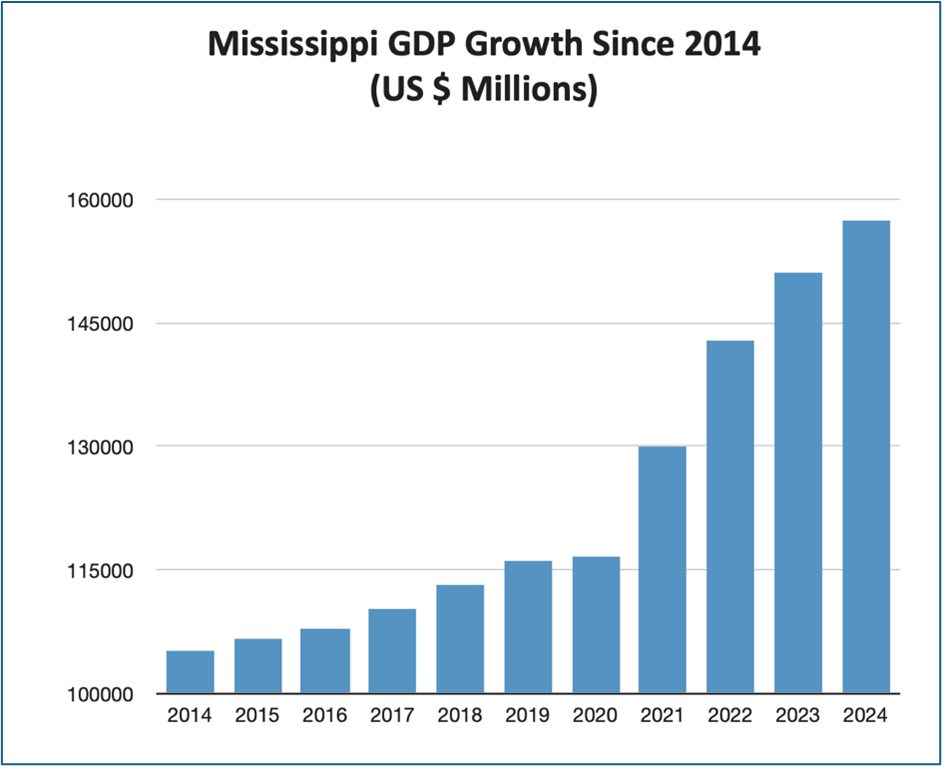
Mississippi whoooooosh!
Mississippi’s recent growth is no accident. It is down to good public policy. Since 2022, Mississippi has implemented transformative tax cuts, reduced the state income tax and lowered the grocery sales tax and easing business inventory taxes. A 2021 law streamlining occupational licensing reduced barriers for workers and entrepreneurs, with the Mississippi Secretary of State reporting a 12% increase in new business registrations in 2023 alone.
Energy in our state is affordable, Mississippi electricity rates averaging 13.43 cents per kilowatt-Hour, helping draw in energy-intensive industries, including two major data centers in Madison and Rankin counties. To top it all, Mississippi’s public universities are fueling growth, and around Oxford and Starkville, entrepreneurial ecosystems are thriving.
But to maintain this momentum, our state needs to abandon policymaking as usual and embrace bold reform. That’s why the Mississippi Center for Public Policy (MCPP) has just launched The Mississippi Miracle? Bold Reforms for Growth.
Our paper details practical steps to sustain and accelerate this momentum:
- Empower Parents Through School Choice: Let families use state funds for public, private, or homeschooling options to drive competition and elevate education standards.
- Refocus Higher Education: Cut administrative bloat, prioritize workforce-relevant programs, and redirect resources from low-value courses to practical, job-focused education.
- Rein in Public Spending: Cap budget growth to population growth plus inflation to ensure fiscal discipline and curb waste.
- Cut Red Tape: Eliminate outdated regulations, repeal Certificate of Need laws, and create a business-friendly environment to spur innovation.
- Reform Public Procurement: Mandate transparent, competitive bidding with regular audits to prevent cronyism and maximize taxpayer value.
- Promote Welfare-to-Work: Emphasize work requirements, job training, and time-limited benefits to foster self-sufficiency and reduce program costs.
These reforms are practical policies that lawmakers can implement to improve lives across Mississippi.
To explore them in detail, visit mspolicy.org under “Publications” or email me at [email protected] for a direct link.
MCPP has a small, but highly productive team. We punch above our weight, producing policy proposals that become law, and helping set the agenda at the Capitol. We are able to do all this because we have the input of so many people across our state. Please read our proposals and share your thoughts—I want to hear what you think.
For decades, Mississippi exported people. Young people in particular tended to leave our state for places like Atlanta, Nashville, Huntsville and Austin.
I believe the tide is starting to turn. I often hear anecdotes of young people moving back to Mississippi. The data suggests that growth in our state is creating opportunities and drawing more people to move here .
Have a read of our report and help us build on this momentum.
At the end of May, Mississippi lawmakers returned for a Special Session to finalize the state’s budget after failing to reach an agreement during the regular session. The result? A more conservative budget.
For years, Mississippi’s budgets were decided behind closed doors over a single weekend during the session. Speaker Jason White and the House changed that by demanding an open, public process.
Speaker White’s commitment to transparency paid off. When Governor Tate Reeves called the Special Session, he urged fiscal restraint. This matters because Mississippi’s general fund has grown far faster than inflation since 2020.
Lawmakers listened, passing a $7.1 billion budget — a modest increase from last year and one of the most fiscally responsible in recent years. The big spend items are $3.3 billion, for education, $1.4 billion for Transportation and $431 million (up from $407 million) to try to improve our dysfunctional prison system.
Speaker Jason White was right all along. When lawmakers decide the budget in public through a proper process, they are more careful with our money. Sunlight truly is the best disinfectant.
One subplot to the budget saga merits attention. Some Senate members made a misguided attempt to cut basic funding for the State Auditor’s department, hindering its ability to function. This echoed attempts by leftist politicians in Washington, D.C., to block DOGE from auditing federal funds.
Every conservative in Mississippi should applaud the House for standing firm and restoring the State Auditor’s funding. The Auditor can continue investigating misuse of public funds. (Why would any politician scheme to block the Auditor from scrutinizing tax dollar spending? Did they really think they could do so and not look ridiculous? If Homer Simpson did political strategy, I doubt he’d make that mistake. It is political positioning 1.0.) Restraining public spending matters in Mississippi for several reasons.
First, all those efforts to pass a law to eliminate the state income tax over the coming year will amount to little unless we continue to maintain a budget surplus. The budget passed will maintain a modest surplus and sets a precedent that puts us on the road to actual income tax elimination.
Second, if Mississippi’s economy keeps growing at a rate of 3-4 percent a year, and the budget only grows by 1-2 percent a year, the size of the private sector will grow relative to the overall economy. This is the only way to lift Mississippi over the next generation from being one of the poorest states in the Union to being one of the richest.
Perhaps the most significant thing about this year’s budget is not just that it is fiscally restrained. It was decided openly and transparently. The days when billion-dollar decisions could be made by a handful of good ole boys at the Capitol in private are coming to an end.
A new generation of leaders is emerging in our state who not only support pro-growth policies. They aren’t willing to keep doing politics like its 1960-something.
What a win! This week, Mississippi made history as the first state in the U.S.—aside from oil-rich Alaska—to pass legislation eliminating the income tax. While nine other states have never had an income tax, Mississippi is blazing a trail by actively dismantling it.
“So what?”, you might say. “Why does this matter if full elimination is still a decade away?” The answer is simple: it’s already transforming our state for the better. Eliminating the income tax makes Mississippi a magnet for growth. Look at Texas, Florida, and Tennessee—three southern states without income taxes that are booming. Even Arkansas recently lowered its rate to stay competitive with us!
Since we began reducing our rate to a flat 4% in 2022, the Mississippi Development Agency reports an extraordinary $25 billion in inward investment. Businesses are flocking here, confident that the payroll tax burden is fading away. This victory isn’t just about economics—it’s a triumph for conservative reform.
Around the Governor’s desk on Thursday evening, we saw bold leadership from Speaker Jason White, Rep. Trey Lamar, and a few dedicated others who fought for this change. We should not forget the role of former Speaker, Philip Gunn, either. Mississippi is, as you know, full of southern charm. One consequence of this is that each time a significant reform passes in the state legislature, there is a tendency to pretend that the change came about because of some kind of kumbaya consensus.
This win came from grit, not just goodwill. Days ago, some were still resisting real elimination. Minds moved because of determined advocacy. This success proves that the roadblocks to reform can be overcome with bold, principled leadership.
There might be a consensus about income tax elimination now, but it is a new consensus, won by bold conservative leaders fighting for it. We salute those that put principle on the line and fought for change!