
Mississippi has made history as the first state in the U.S.—aside from oil-rich Alaska—to pass legislation aimed at phasing out its income tax.
This monumental achievement, spearheaded by Governor Tate Reeves and House Speaker Jason White, marks a significant victory for the state. The newly passed bill outlines a plan to eliminate the income tax over the next decade, starting with incremental cuts and followed by a series of budget-driven "triggers."
Beginning next year, Mississippi’s income tax rate will drop in 0.25 percent increments, sliding from 4 percent to 3 percent by 2030. After that, further reductions will hinge on the state’s budget surplus. Given Mississippi’s recent track record of substantial surpluses, the income tax could vanish entirely by the mid-2030s.
So, how did Mississippi become such a trailblazer? It very nearly did not happen.
The push to eliminate the income tax has been a cornerstone of Governor Reeves’ agenda, with serious legislative efforts kicking off in 2022 under then-House Speaker Philip Gunn.
Gunn’s genius was to simplifying the state’s variable tax rates into a flat 4 percent on income above $10,000. While this didn’t eliminate the tax outright, it leveled the playing field for Mississippi households, setting the stage for broader support of full elimination.
Fast forward to this year, when Speaker Jason White and Representative Trey Lamar introduced a plan to phase out the income tax by 2037. Their initial proposal included a partial tax swap, offset by modest increases in gas and sales taxes.
What happened next was both fascinating – and, if you support income tax elimination, rather fortuitous.
The Mississippi Senate has been a constant drag on conservative reform. They have either opposed, or come to grudgingly accept, almost every conservative policy proposal over the past few years, from school choice to red tape reduction. So, too, with income tax elimination.
The Senate, reluctant to fully embrace income tax elimination, opted for a cautious approach. They amended the bill with a "trigger" mechanism, tying future tax cuts to significant revenue growth outpacing spending increases. Some in the Senate perhaps saw this as a clever stall tactic—until a fortunate blunder turned the tables.
The Senate miscalculated the formula, placing a decimal point in the wrong place. Math matters. Something the Senate design as a brake on tax cuts turned out to be an accelerator.
Unless the state government runs a deficit, future surpluses will likely drive steady cuts, and Mississippi – despite the Senate leaderships best efforts – will be as competitive in tax terms as Tennessee and Texas.
Set aside the soap opera, this is great news for our state. Already there is evidence that in 2024, by some measures, Mississippi performed well economically, and may have been one of the fastest growing states in America that year. This tax reform will only add to this Mississippi momentum.
Perhaps what the Senators math missteps shows is that Mississippi now needs to turn its attention to education reforms? If the Senators stopped blocking school choice the way they tried to block income tax elimination, maybe math standards might be better both inside and outside the legislature.
How much do you imagine it costs to send a child to public school in Hinds County every year? $5,000 per year? Maybe $10,000? $15,000?
Actually, according to data from the Mississippi Department of Education, when you divide the number of students attending school by the total expenditure, in 2023-24 Hinds County spent $16,589 per student.
That is more than twice the average private school fees in our state. Indeed, $16,589 is not far off what it would cost to send your child to a top private school.
Now ask yourself if each child in Hinds County is getting a top education for that $16,589? Of course not. A large chunk of the kids can’t read or do basic math. One in three of them regularly skip school.
So, why not give families in Hinds County the right to take a portion of that $16,589 and allocate it to a school of their choice?
It’s not just Hinds County. The same question could be asked in Madison ($17,037 spent for every public school pupil per year) or Rankin ($15,198 per pupil per year), or Canton ($18,683) or De Soto ($13,820).
Even if you take the Department of Education’s own more conservative figure for per pupil spending (which includes all the ‘no-show’ students), Mississippi still spends an average of $14,676 per student.
Despite all that money, 4 in 10 fourth graders in Mississippi public schools cannot read properly. Eight in 10 eighth grade kids in Mississippi were not proficient in math in 2022. One in 4 kids routinely skips school.
Nor has $14,676 per student spending translated into better teacher pay. Notwithstanding recent pay increases, our teachers still earn significantly less than they did in 2010, when you adjust for inflation.
If you happen to be one of the fortunate families happy with the public education options available, great. No need to change and no one is proposing any changes that will affect you. But why not allow those families unhappy how things are the freedom to take their tax dollars to a school that best meets their needs?
Suggesting this provokes outrage not from parents, but from various vested interests who like things the way they are. They like a system that puts the $14,676 they get for your child into their administration budget, rather than the classroom. School superintendents making more than the Governor want to keep control of their multimillion dollar budgets for a reason. It’s a boondoggle for bureaucrats.
School Choice will not impoverish public schools. The legislation that Speaker Jason White is proposing would allow families control over the state portion of funding, not locally raised revenues or federal dollars.
In Hinds County, for example, that would mean families being able to allocate no more than $6,700 of the $16,589 overall per pupil funding. (Rather than depleting Hinds County public schools’ budget, actually it would make Hinds County better off in terms of per pupil spend.)
Giving families control over $6,700 of the state funds will not mean a flood of kids coming into your well run school district. Why not? Because the legislation proposed specifically gives school boards the final say on capacity.
What anti School Choice campaigners really fear is not the “wrong” kids coming to your school. What they fear is that you start wondering what the heck they’ve been doing with the $14,676 they get for your child or grandchild every year.
All of the arguments we are now hearing against School Choice in Mississippi have been heard in each of the surrounding states that have since adopted School Choice.
Alabama’s new Educations Savings Account program, which has just opened for applications, has been wildly oversubscribed. The program provides $7,000 funding per student attending a participating private school, while those enrolled in home education programs are eligible for $2,000 per student.
Arkansas allows all K-12 students access to an Education Savings Account from 2025, into which the state government pays the state portion of per pupil funding ($6,600 per year). Families will be able to use this $6,600 money they are given to pay for their child education, including private school tuition. Arkansas also allows public to public school transfers, allowing districts to define capacity.
Louisiana’s GATOR program starts in 2025-26 and establishes an Education Savings Account for those on low incomes, with the details are still being finalized as the law only recently passed. Louisiana already has public to public School Choice.
Texas and Tennessee, too, are at this very moment debating legislation that would create a universal Education Savings Account for families in those states, too.
None of the scare stories we now hear in Mississippi materialised in any of these neighboring states. None of these states has been bankrupted like the critics claimed by letting mom and dad have parent power. Instead, all the evidence suggests School Choice has started to improve education outcomes.
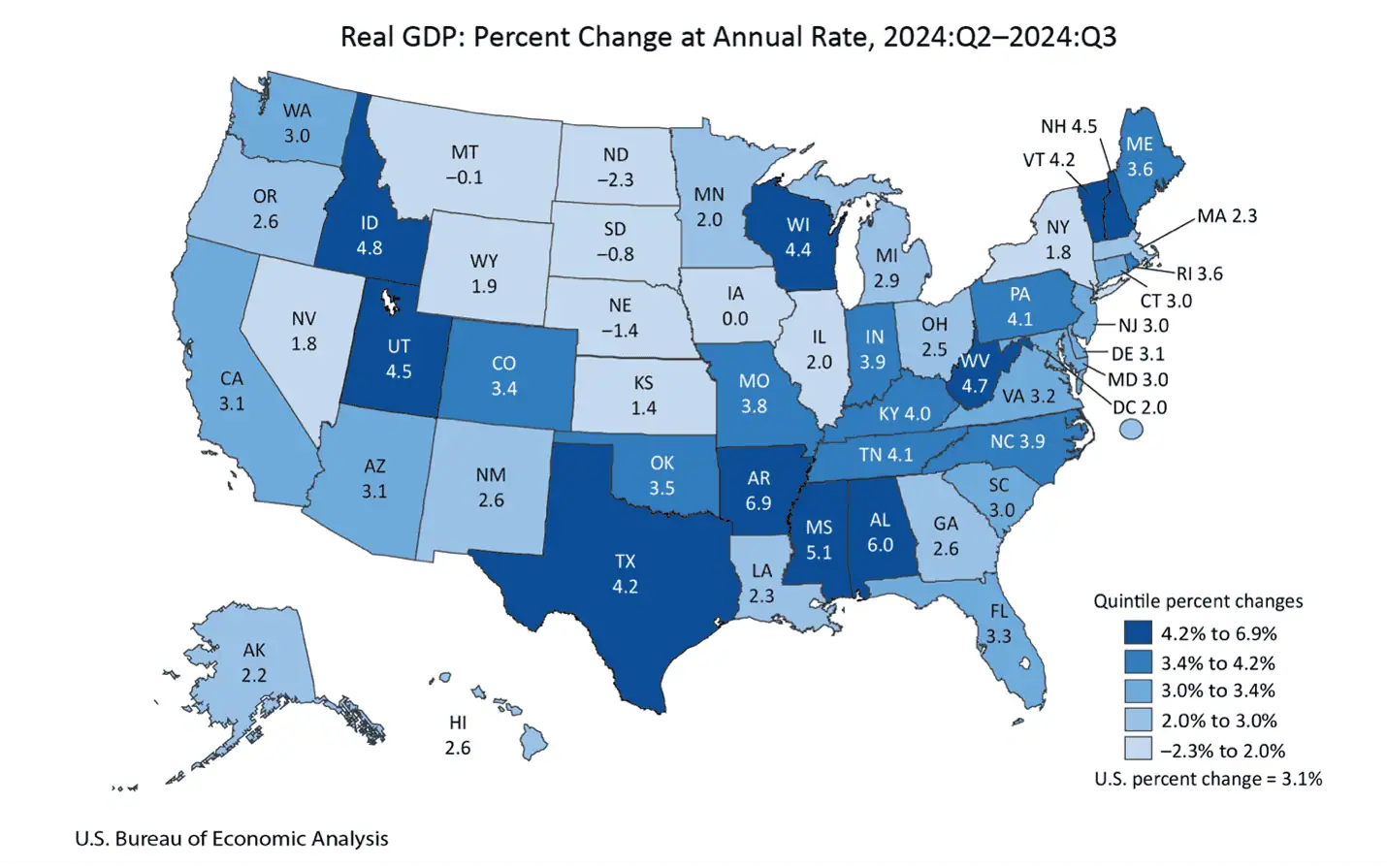
Did you know that Mississippi is now one of the fastest growing states in America? Only two states saw real GDP rise faster than it did here in the third quarter of 2024.
Were you aware that personal income in our state rose more here than almost anywhere in the US this past year?
New data from the Bureau of Economic Analysis shows that Mississippi is on the up.
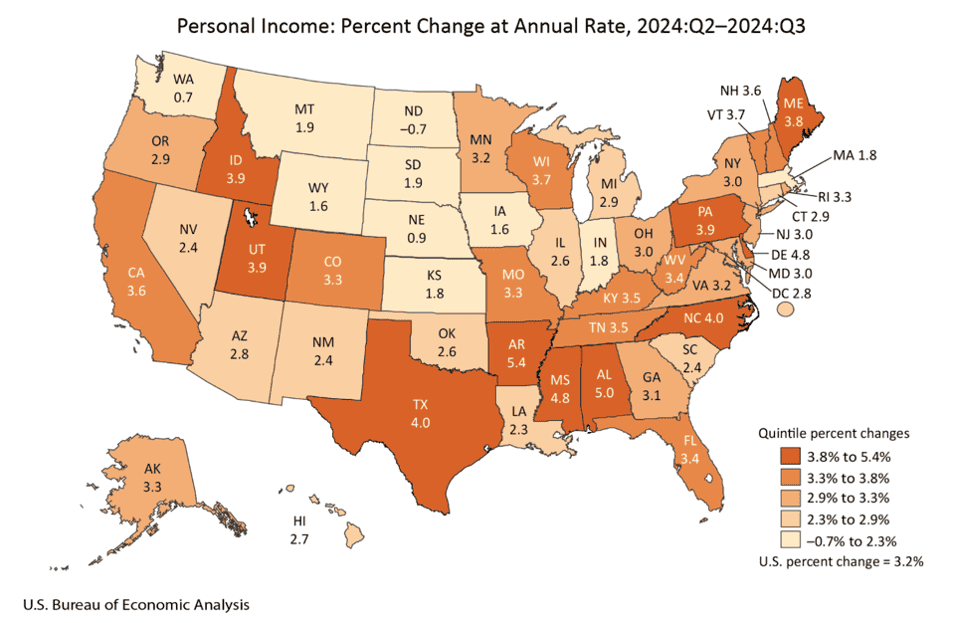
For as long as anyone can remember, Mississippi has ranked 50th out of 50. Not for much longer, perhaps. According to this new data, ours’s was one of the top performing states in 2024. If we keep growing for the next few years the way we did in 2024, we won’t be bottom of the class for much longer.
Mississippi’s success is not an accident. It’s a consequence of a number of key free market reforms:
- Labor market deregulation, with an Occupational Licensing law in 2021.
- Tax cuts with legislation to cut the state income tax to a flat 4 percent in 2022.
- Further tax reform to make it more tax efficient for businesses in 2023.
- Education funding reform as a step towards school choice in 2024.
These reforms have begun to energize our state. They make it easier for people to get ahead, for businesses to invest, and for families to spend their income on their priorities. They draw in inward investment, which is changing our state for the better.
If Mississippi is not to lose this momentum, we need to go even further. That is why MCPP has just published a Blueprint for Mississippi – a list of the ten key reforms that would lift our state to the top of the economic table.
The number one reform we need to prosper is school choice. Why? School choice is the only way to be certain of raising standards. The better job we do of educating young people, the greater their chances of leading a prosperous, fulfilling life.
Our Blueprint sets out how we can accomplish school choice, giving every family in our state the choices that today only the very rich enjoy.
To prosper, our state needs less regulation and less government. Our Blueprint sets out proposals to cut taxes further and dismantle the costly, leftist bureaucracy that seems to be in control no matter who you vote for.
Decades of crony cartel politics has stifled innovation in our state. Years of lobbyists cutting cozy deals in the Capitol that commercially advantage their clients has held Mississippi back. A lot of the intentionally restrictive laws that limit health care provision simply need to go. Our Blueprint sets out how to make this happen.
MCPP has been a driving force behind many of the key free market reforms that have helped energize our state. But at every opportunity, crony cartel politics has tried to prevent change.
The crony cartel will try again. It’s what self-serving cartels do. Already they are mobilizing half-baked arguments against school choice. They are lobbying to maintain intentionally restrictive laws that hold back the healthcare economy. Brace yourself for politicians explaining why we can’t afford tax cuts despite a healthy surplus.
In politics, nothing moves unless it is pushed. MCPP won’t just publish our Blueprint. We will push and push hard. Mississippi’s future is too important to let bad politics get in the way.
Mississippi could be on the cusp of transformative changes. If we keep going, we will not only no longer be 50th, but we could become – like Tennessee or Alabama – a state that young people want to move to, not leave.
Download a copy of our blueprint here!
Local mom, Amanda Kibble, is celebrating an important win for her family, and for school choice.
Earlier this year, Governor Tate Reeves signed HB 1341 into law. This new law gives military families in Mississippi the right to transfer their children to any traditional public school around the state, assuming that the receiving school has capacity. Early indications suggest this is extremely popular, with lots of military families using school choice to switch schools.
Amanda, and her family, found out the hard way that the law might not apply to those who serve their country in the National Guard. There was a real risk that Amanda’s son might lose his place at his preferred school.
That’s when Amanda approached MCPP, and we took up her case. MCPP has a long history of fighting for school choice, and our legal arm, the Mississippi Justice Institute has successfully litigated in defense of school choice.
I am delighted that Attorney General, Lynn Fitch, has now issued an opinion that the new school choice law for military families also applies, at least in part, to those in the National Guard. Three cheers for the AG!
If military families now have public-to-public school choice, why shouldn’t everybody? That is exactly what our “Move Up, Mississippi!” campaign aims to achieve.
This week’s win for school choice makes it all the more disappointing that the new State Superintendent for Education, Lance Evans, took a sideswipe at school choice recently.
Speaking at a lunch in Jackson, Evans criticized school choice, suggesting that if a single dollar of public money went into private schools, those private schools should be subjected to the regulatory oversight that public schools are subject to.
Those that oppose school choice, and indeed I suspect Mr. Evans, know full well that extending state oversight across the private school sector would be untenable – which is why they suggest it. But it is not the clever argument against school choice that they might imagine.
Giving every family in our state the right to choose a public school, as military families are now able to do, would not transfer public dollars into private schools.
Amanda Kibble and those military families that now have school choice are not taking money out of public schools. Does Lance Evans oppose their right to choose a school for their child?
MCPP proposes that under a separate program, families that attend private schools, or who home school, could get a tax credit reflecting the fact that they are already paying for a place at a public school that they are not taking.
Evans attack on parent power was not the worst of it. More disappointing was the plodding presentation that preceded it about how amazing education is in our state.
Evans trumpeted the fact that about a third of districts were rated D or F in 2016. Now only a handful are rated D or F. This, he implied, was evidence of progress, rather than a reflection of a broken accountability system.
When officials invoke the broken grading system as evidence of improvement, it is not just the credibility to the grading we should question.
How bizarre, that in a solidly Republican-run state, we have somehow ended up with an anti-school choice official in charge? Are the nine-member State Board of Education aware of Evans’ anti-school choice position? Are the various state leaders that appointed those members of the Board?
Since 2000, the number of students in America has increased by 5 percent. The number of teachers by around 10 percent. The number of education administrators, however, has shot up by 95 percent.
No wonder the education bureaucrats don’t want mom and dad to have control over where their child’s share of the education budget goes. They might start to demand that it goes into the classroom.
Lance Evans talked about making private schools accountable. Private schools already are accountable to every fee-paying parent. The issue is how to ensure that public schools are made similarly accountable, too.
We need to give every family in our state the public-to-public school choice that military families now have.

Tax reform is on the agenda. This is excellent news for our state!
To prosper, Mississippi must create a tax environment that is friendly to both businesses and families.
We have moved in the right direction in the past three years. According to the Tax Foundation, Mississippi now ranks as the 20th most business-friendly state in terms of tax.
This improvement in our state’s tax competitiveness is a consequence of the Reeves-Gunn tax reforms. Under Governor Tate Reeves and Speaker Philip Gunn, Mississippi passed legislation to cut the state income tax to a flat 4 percent and allowed businesses to fully expense capital spending. But the tax burden in Mississippi is still too high.
Our state is surrounded by states, such as Tennessee, Alabama and Texas, that have a lower tax burden than we do. Even Louisiana manages to tax less than us.
Fortunately, we have some state leaders that recognize this. Speaker Jason White is hosting a Tax Policy Summit in September to look at what might be done. Lieutenant Governor Delbert Hosemann has announced a study group in the Senate to look at fiscal policy, with the ultimate goal, he says, to “lower the tax burden and ensure taxpayer dollars stay in taxpayer pockets”.
Mississippi’s House of Representatives also has a select committee on tax reform, which had its first hearing this week.
To be blunt, the House select committee hearing the other day was a big disappointment, especially seeing as we are a supposedly conservative state. Much of what I heard sounded like special pleading from vested interests to increase taxes, not cut them. I wondered at times if Bernie Sanders was in the room.
The hearing on tax reform began with a witness making the point that Mississippi needed to spend more money to build more road infrastructure. The conversation then became about the best way to do so; raise sales tax, tax gas more or charge motorists per mileage.
Not raising tax revenues was described as a “failure to invest”. Spending more tax dollars would pay for itself, it was asserted. Any serious review of tax policy in our state should not start with special pleading. It should start with the basic facts about the shape of Mississippi’s public finances.
The number one fact about Mississippi public finances is that we have a substantial budget surplus. That is to say politicians in our state have more of our tax dollars than they currently know what to do with.
How could we change the tax system to allow people to keep more of their own money before politicians figure out ways of squandering the surplus? That is where the select committee ought to have started.
What kind of tax reforms are feasible depends on the extent to which our budget surplus is cyclical or structural. In other words, is the budget surplus a temporary phenomenon, caused by growth at this stage in the economic cycle? Or is the surplus a surplus not withstanding fluctuations in economic performance?
This matters because if the surplus is temporary, tax reform will need to be phased in carefully to avoid having to put taxes back up again, as did Kansas. Failure to consider if our budget surplus is a blip or a longer term phenomenon allows those opposed to significant tax cuts to lazily claim Mississippi cannot afford more tax cuts. (Note how when the Senate Leadership was trying to water down the Reeves-Gunn tax cuts in 2022 they were able to get away with the claim that we would be ‘like Kansas’.)
Having established what Mississippi can - and cannot - afford in terms of tax cuts, the select committee should then consider what type of tax cuts.
One possibility would be to cut the grocery tax. This would be a relatively small but symbolic cut, which is why it tends to be favored by the Senate Leadership which is lukewarm about any significant reduction in the size of government in our state.
Another possibility would be to phase out the income tax altogether. This would be a big and bold step, and would need triggers and thresholds to ensure it was not done ‘like Kansas’.
“But who will pay for our roads, Carswell!”, I hear you say. “The witness who said we need to invest in infrastructure had a point, no?” I agree.
There are some things, like roads, that our state government does need to do. As and when we need to raise tax revenue for specific projects, like road building, then our lawmakers should propose ad hoc tax increases to pay for it.
Arkansas asked voters to approve a specific increase in sales tax, for a ten year fixed period, to pay for key state infrastructure. In other words, tax revenue was raised for a purpose. Taxes were not raised on the pretext of special pleading and then kept at the elevated level forever. What is very odd is to allow the special pleading of vested interests to be used as an argument for raising the tax burden, in a conservative voting state, and in front of a supposedly conservative-run House committee.
If Mississippi is going to achieve meaningful tax reform, those considering it need to be less Bernie Sanders, and more Ronald Reagan. The lobbyists might not like it, but the voters will.